
Key Takeaways:
* The ROI of Speed: A single buffering incident can cause up to 40% of viewers to abandon a stream, making latency optimization a critical business revenue driver, not just an engineering metric.
* Protocol Evolution: Standard HTTP streaming has evolved. We are moving from 30-second delays down to sub-second realms using chunked CMAF and WebRTC.
* The Player Bottleneck: Advanced server architecture is useless if the client-side video player is poorly tuned; default player buffers can inadvertently add up to 6 seconds of unwanted delay.
* Future Standards: Emerging technologies like Media over QUIC (MoQ) and Wi-Fi 7 are poised to redefine the absolute floor of glass-to-glass delivery times.
In our experience working with digital broadcasters, the pursuit of low latency live streaming OTT is no longer a luxury reserved for niche applications; it is the fundamental baseline for modern audience retention. When viewers are watching a highly anticipated sports final or participating in a live virtual auction, a delay of even a few seconds can ruin the experience, leading to spoilers on social media before the goal is even seen on screen. We have witnessed firsthand how bridging the gap between business objectives (viewer retention and monetization) and technical architecture (encoding, packaging, and delivery) transforms standard broadcasting into highly engaging, interactive digital ecosystems.
What is Low Latency Live Streaming OTT?
To truly master this domain, we must first dissect the fundamental difference between glass-to-glass latency and player latency. Glass-to-glass latency represents the total elapsed time from the exact millisecond light hits the camera sensor at the live event to the moment those pixels illuminate the viewer’s screen. Player latency, on the other hand, is the specific portion of that delay intentionally injected by the viewer’s device to build a safety buffer against network fluctuations. Understanding this distinction is crucial because platform operators often blame their content delivery networks (CDNs) for delays, when in reality, the viewer’s local device is simply hoarding video chunks before playback begins.
When we break down the spectrum of latency tiers, the numbers reveal a dramatic evolution in streaming capabilities. Classic broadcast streaming (Linear/FAST channels) typically operates with a 15 to 30-second delay. As we move down the tier list, standard low latency sits between 5 to 15 seconds, which is adequate for concerts or sermons. Near-real-time streaming brings this down to 2 to 5 seconds, an absolute necessity for live sports and watch parties. Finally, ultra-low latency operates under 1 second (essential for auctions and betting), while true real-time latency operates under 200 milliseconds for two-way telehealth and video conferencing.
The business justification for investing in these faster tiers is rooted deeply in viewer behavior and platform monetization. Data indicates that a single buffering issue or noticeable delay behind real-world events can drive up to 40% of viewers to click away from a stream entirely. If your platform relies on ad insertions, subscriptions, or live micro-transactions, losing nearly half your audience due to a sluggish feed is a catastrophic revenue leak. By aligning engineering investments with these harsh business realities, OTT providers can confidently justify the higher compute costs associated with specialized live streaming architectures.
However, we must also address the pervasive “zero-latency” myth that often circulates in high-level marketing meetings. True zero latency is scientifically impossible due to the absolute laws of physics. For instance, the speed of light across a coast-to-coast internet hop in the United States takes approximately 40 milliseconds one-way. This means that an 80-millisecond round-trip is the absolute physical floor before we even account for camera capture, video encoding, network routing, and local device decoding. Setting realistic expectations around a sub-200ms target prevents engineering teams from chasing scientifically impossible goals.
Core Protocols: Evaluating low latency HLS vs DASH and Beyond
For massive audience scaling, the industry heavily relies on HTTP-based streaming, and the debate surrounding low latency HLS vs DASH is central to modern platform design. Historically, standard HLS (HTTP Live Streaming) and MPEG-DASH required players to download entire video segments—often 6 to 10 seconds long—before playback could commence, resulting in massive 30-second delays. The revolutionary shift occurred with the introduction of chunked transfer encoding and the Common Media Application Format (CMAF). By breaking these large segments into tiny, self-contained “chunks” that can be transmitted and played while the rest of the segment is still being encoded, we successfully brought HTTP streaming latency down from 30 seconds into the highly competitive 1 to 3-second range.
Moving backward in the streaming pipeline to the ingest phase (how the video gets from the camera to the server), Secure Reliable Transport (SRT) has emerged as the gold standard for remote production. Developed by Haivision, SRT routinely operates with a latency of just 1 to 2 seconds while providing aggressive packet-loss recovery and AES encryption. In our fieldwork dealing with unstable mobile internet connections at remote sports venues, SRT has consistently outperformed older protocols by dynamically adapting to network jitter, ensuring that a pristine master feed reaches the cloud encoder without dropping frames.
Despite these advancements, we cannot ignore the enduring legacy of RTMP (Real-Time Messaging Protocol). Even though Flash is dead and modern browsers natively reject RTMP playback, it remains the dominant protocol for contribution feeds. Millions of content creators utilizing software like OBS Studio or Wirecast still push RTMP to ingest servers because it reliably offers a 1 to 5-second ingest latency and is universally supported by almost every encoder hardware on the market. The modern workflow, therefore, involves ingesting via RTMP or SRT, and immediately transcoding the feed into Low-Latency HLS or DASH for mass global distribution.
Why WebRTC for OTT live broadcasting is the Future of Interactivity
When the business requirement shifts from passive viewing to hyper-interactivity, HTTP-based protocols simply cannot keep up, which is why WebRTC for OTT live broadcasting has become an absolute necessity. WebRTC (Web Real-Time Communication) routinely achieves sub-500ms latency because it fundamentally bypasses traditional TCP web architecture, utilizing UDP (User Datagram Protocol) to stream data directly between peers or through specialized servers without waiting for packet acknowledgments. This lightning-fast delivery is the only way to successfully host live sports betting, real-time virtual auctions, and interactive telehealth sessions where a two-second delay could mean losing a financial bid or missing a critical medical cue.
To scale WebRTC successfully, engineers must deeply understand the underlying server topologies: P2P (Peer-to-Peer), MCU (Multipoint Control Unit), and SFU (Selective Forwarding Unit). While P2P works beautifully for a 1-on-1 video call, it completely collapses under the weight of audience scale because the broadcaster’s upload bandwidth is consumed by every single viewer. In 2026, the SFU is the undisputed default for scaling interactive streams. An SFU acts as an intelligent traffic router; it takes one incoming stream from the broadcaster and efficiently routes it to hundreds of participants without burning massive server CPU for transcoding, allowing interactive rooms to comfortably scale up to 500 concurrent participants.
For massive events that require both interactivity for a select group and massive scale for the general public, top-tier broadcasters are adopting a sophisticated hybrid approach. We often design systems where the “VIP” layer—such as event hosts, live commentators, and select interactive audience members—communicates via a real-time WebRTC room. Simultaneously, that composite WebRTC feed is captured and handed off to a Low-Latency HLS packager to be fanned out to millions of passive viewers. This gives the core participants zero perceptible delay, while the mass audience enjoys a stable 3-second feed at a fraction of the CDN cost.
Designing an ultra-low latency streaming architecture
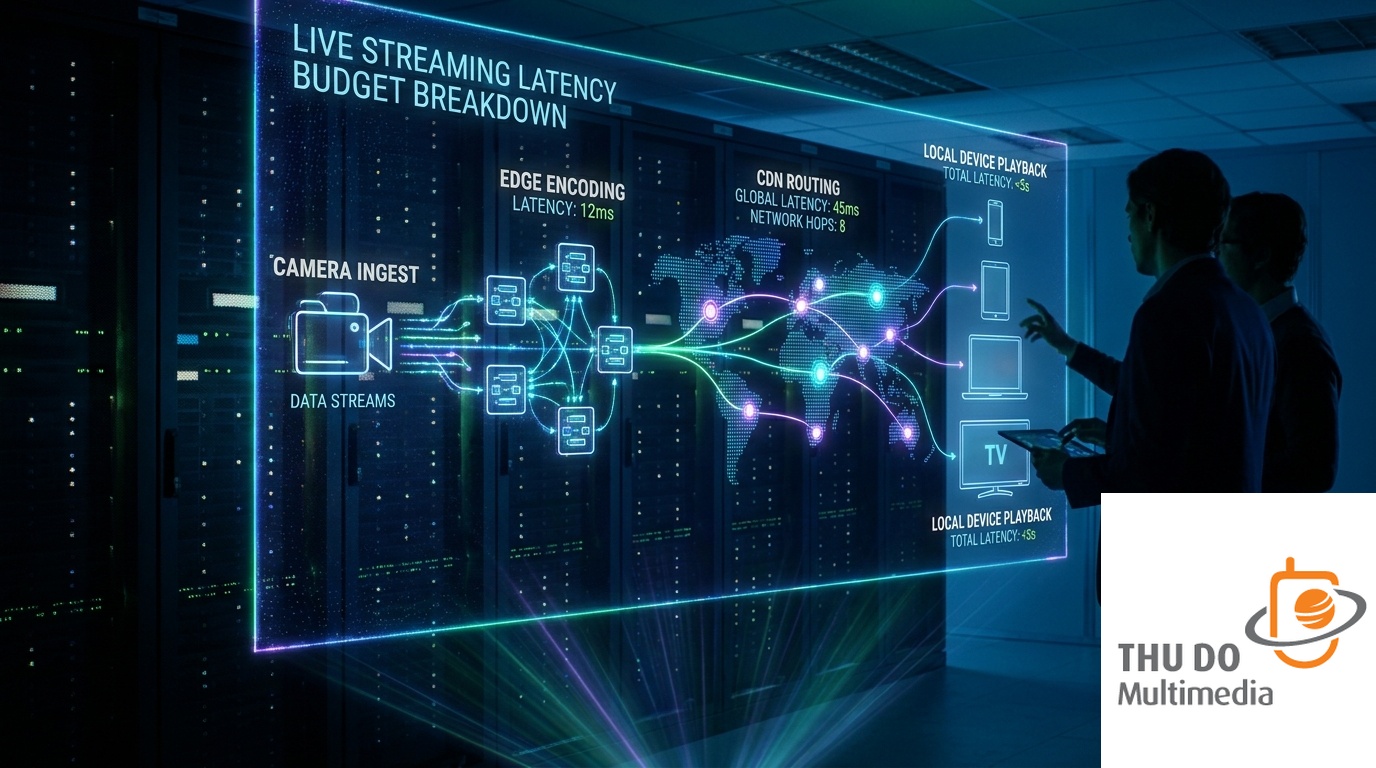
Building an ultra-low latency streaming architecture requires a forensic examination of the “latency budget”—the exact number of milliseconds spent at every single stage of the video pipeline. Let us look at the raw data: a standard workflow might spend 20 to 1,000ms on capture and encoding, 200 to 6,000ms on packaging, 20 to 300ms traversing the network to the CDN, 50 to 500ms during CDN fan-out, a massive 20 to 30,000ms sitting in the player buffer, and finally 10 to 60ms decoding on the screen. To achieve near-real-time streaming, architects must ruthlessly shave milliseconds off each of these six pillars, realizing that a bottleneck in just one area destroys the entire glass-to-glass target.
The choice of video codec plays a deeply complex role in this latency budget, often presenting a fierce trade-off between bandwidth savings and compute time. For example, High-Efficiency Video Coding (HEVC/H.265) cuts video bitrates by 40% to 50% compared to the older H.264 standard, which drastically speeds up network transit times. However, HEVC requires roughly twice the compute power to encode. Taking it a step further, the AV1 codec cuts bitrates by an astonishing 48% to 50% (as measured by Netflix), but it demands up to four times more software encode processing. If your origin server lacks dedicated hardware acceleration for AV1, the time spent encoding the video will completely negate the time saved during network delivery.
To combat processing delays, modern infrastructures rely heavily on Edge packaging. Instead of sending a single, massive master stream to a centralized cloud server in Virginia for packaging and then routing it to viewers in Tokyo, we push the packaging logic to the extreme edges of the network. Utilizing serverless technologies like Cloudflare Workers or AWS Lambda@Edge, the raw feed is ingested, wrapped into CMAF chunks, and packaged geographically closest to the viewer. This highly distributed architecture is the secret to keeping global p95 latency (the latency experienced by 95% of your users) consistently under the 2-second mark.
reducing latency in live video streaming via CDNs
The cornerstone of reducing latency in live video streaming at scale relies heavily on the strategic deployment and configuration of Video Content Delivery Networks (CDNs). A Video CDN acts as a massive global caching layer; instead of a million viewers asking your single origin server for the live video feed, they ask the CDN edge server physically located in their own city. This edge caching completely prevents origin server overload and drastically cuts down network transit time. When chunks are cached locally, the “last mile” delivery to the viewer’s router is executed in mere milliseconds, maintaining the integrity of the live feed.
Relying on a single CDN is highly risky for premium OTT broadcasters. During massive audience spikes—such as the final minutes of a World Cup match—individual network nodes can easily become congested, causing micro-stutters and latency spikes. This is where active Multi-CDN strategies come into play. By employing intelligent, real-time traffic routing, the streaming platform monitors the specific performance and buffer rates of various CDNs (like Akamai, Fastly, and CloudFront) on a viewer-by-viewer basis. If CDN A begins to experience congestion in London, the system autonomously and instantly routes all new London-based viewers to CDN B, preserving the low latency experience without human intervention.
Furthermore, we must implement strict origin shielding. In a low-latency environment using chunked transfer encoding, millions of tiny HTTP requests are generated every second. If a new CDN edge node spins up and does not have the latest chunk cached, it will request it from the origin. Without a shield, a sudden surge in audience numbers could result in a “thundering herd” of requests hitting the master origin server simultaneously, causing a total stream collapse. An origin shield acts as a massive shock absorber—a mid-tier caching layer that aggregates all requests from edge nodes into a single origin request, keeping the master encoder running flawlessly at sub-second speeds.
Actionable end-to-end latency optimization for live video
One of the most glaring gaps we observe in the streaming industry is the disconnect between server engineers and client-side developers, which makes end-to-end latency optimization for live video incredibly difficult. You can build the fastest CMAF pipeline in the world, but a naive video player will destroy it. For instance, the default settings on popular open-source players like HLS.js are aggressively tuned for stability, not speed. A default player reading a perfectly optimized 2-second LL-HLS feed will intentionally wait to download three full segments before rendering a single frame, forcing a 6 to 10-second delay. Tuning the player’s chunk size (down to 200ms) and live sync duration (target buffer of 0.9 to 1.2 seconds) is absolutely mandatory.
Equally important is the alignment of your Adaptive Bitrate (ABR) encoding ladders. Viewers constantly experience bandwidth fluctuations, moving from 5G cellular to localized Wi-Fi. If your encode ladder is not perfectly aligned with identical Keyframe intervals (typically every 1 to 2 seconds), the player cannot seamlessly switch from a 1080p feed to a 480p feed. When keyframes are misaligned, the player is forced to pause, flush its existing buffer, and download a new segment from scratch. This single event causes a jarring buffering wheel and permanently injects an additional 3 to 5 seconds of latency into that specific viewer’s session.
To truly maintain these systems, platforms must conduct rigorous network auditing, which forms the basis of best practices for real-time OTT streaming. Operators must stop looking at “average” latency metrics, as averages heavily mask disastrous viewer experiences. Instead, engineering teams must monitor p95 and p99 latency metrics (the worst 5% and 1% of viewer experiences). Tail-end variances—where a small pocket of users experiences 15-second delays on a 2-second feed—are exactly what cause mass viewer churn and negative app store reviews. Continuous end-to-end monitoring ensures that latency drift is caught and rectified at the player side before the viewer hits the exit button.
Top scalable low latency streaming solutions on the Market
For brands looking to launch rapidly, choosing fully managed enterprise OTT platforms is often the most financially sound route. We highly recommend leveraging scalable low latency streaming solutions like OTTEngine, Muvi Live, or Dacast. OTTEngine, for instance, is purpose-built to handle the heavy lifting of multi-CDN routing, edge packaging, and player tuning right out of the box. By utilizing a platform like OTTEngine, media brands can launch interactive sports broadcasts or live commerce events in weeks rather than months, completely bypassing the grueling process of hiring bespoke engineering teams to manually configure WebRTC topologies and CMAF chunks.
For organizations with deep internal development resources building custom applications, specialized developer and engineering tools provide granular control over the latency budget. Platforms such as Wowza, Red5 Pro, and Dolby Millicast offer powerful SDKs and server infrastructures specifically designed for sub-second streaming. Red5 Pro is particularly renowned for its ability to autoscale WebRTC clusters across various cloud providers (AWS, Google Cloud, Azure), allowing developers to build interactive fan-wall experiences that dynamically scale up to millions of concurrent connections without breaking the 500ms barrier.
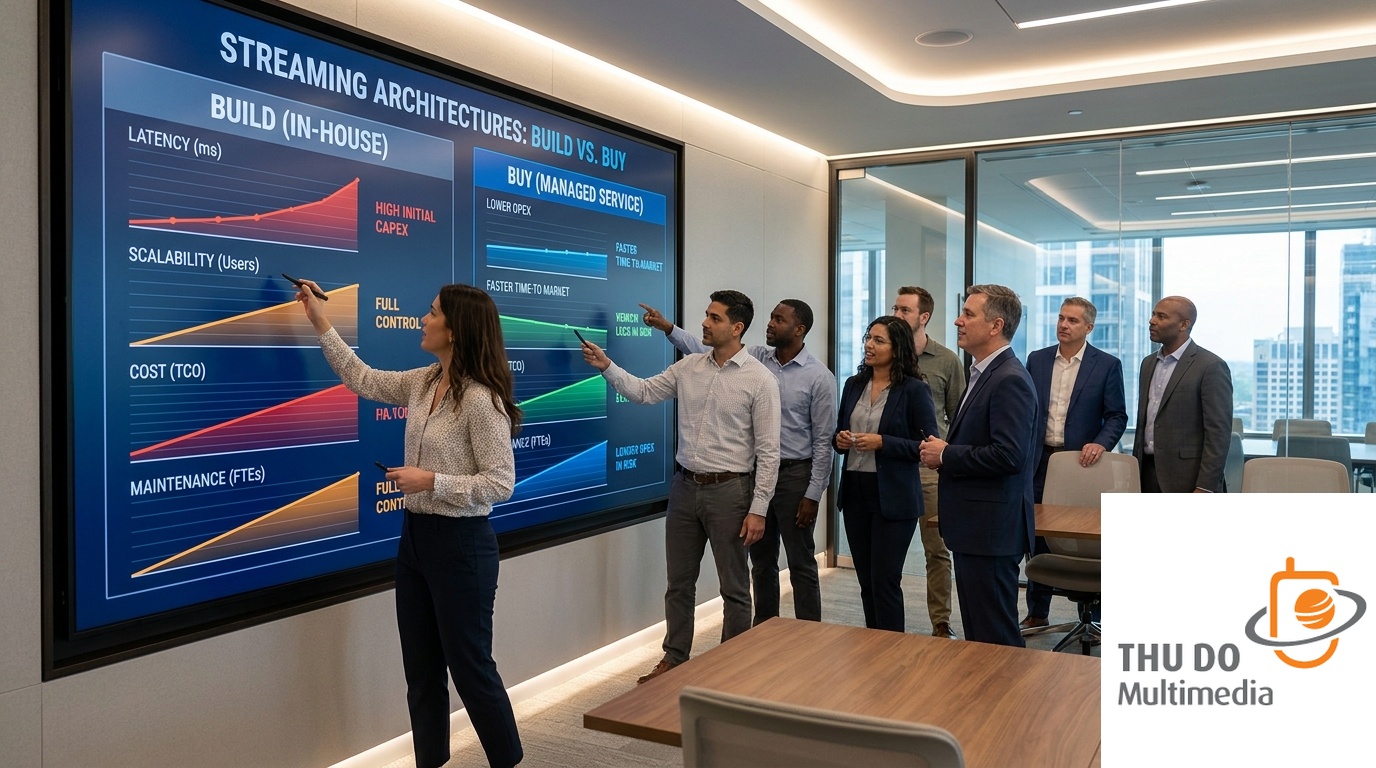
Ultimately, brands must navigate the complex “Build vs. Buy” decision. A key factor in this checklist should be raw infrastructure and delivery costs. While building a custom WebRTC solution gives you absolute architectural freedom, the software compute costs for transcoding AV1 and the per-gigabyte egress costs from public clouds can quickly bankrupt a project. Conversely, utilizing a white-label SaaS like OTTEngine often provides predictable, bundled hourly CDN costs per viewer, offering a clear and tangible ROI framework for Chief Financial Officers who need to map latency improvements directly to subscription revenues.
The Future of OTT: 5G, Wi-Fi 7, and Media over QUIC (MoQ)
Looking strictly at the horizon, network innovations are radically altering the “last mile” delivery bottlenecks. The widespread rollout of Private 5G networks in stadiums and Wi-Fi 7 in smart homes is drastically reducing localized packet loss and network jitter. Wi-Fi 7, with its Multi-Link Operation (MLO) capabilities, allows a smart TV to simultaneously receive video data over multiple frequency bands (2.4 GHz, 5 GHz, and 6 GHz). This means that even if someone starts downloading a massive file on the same home network, the live streaming feed will dynamically route around the congestion, preserving the ultra-low latency buffer without a single dropped frame.
Perhaps the most exciting paradigm shift on the horizon is the emergence of Media over QUIC (MoQ) and WebTransport. While WebRTC rules the sub-second space today, it is notoriously difficult to cache at the edge. MoQ is positioned as the next massive global standard, allowing publish/subscribe media delivery over HTTP/3. By utilizing the underlying QUIC protocol, MoQ provides multiplexed, secure, and rapid transport that can theoretically combine the sub-second speed of WebRTC with the massive CDN scalability and caching capabilities of HLS. We are aggressively watching MoQ, as it has the potential to completely replace older transport methods by 2028.
Finally, the integration of inline Artificial Intelligence is beginning to fit neatly inside these microscopic latency budgets. Historically, adding real-time translation, closed captioning, or video super-resolution required delaying the feed by several seconds to give cloud servers time to process the AI models. Today, hardware-accelerated Edge AI and Neural Processing Units (NPUs) built directly into modern viewing devices allow broadcasters to send lightweight, low-resolution streams at lightning speeds, while the viewer’s local device utilizes AI to intelligently upscale the video to 4K and generate real-time captions locally, effectively bypassing the cloud latency penalty entirely.
Frequently Asked Questions
What is the difference between standard and low latency in OTT streaming?
Standard latency prioritizes absolute video stability and maximum resolution by intentionally delaying a live broadcast by 15 to 30 seconds. This large buffer ensures smooth playback even on terrible internet connections. Low latency significantly reduces this gap to 2 to 5 seconds by utilizing chunked media formats. This near-real-time viewing tier is heavily suited for live sports, gaming, and interactive chats where viewers need to react to moments as they happen.
How do you achieve zero-latency live streaming?
From a strictly scientific standpoint, true “zero latency” is impossible due to the physical distance data must travel and the time required for glass-to-glass processing. However, broadcasters can achieve ultra-low latency of under 500 milliseconds by utilizing UDP-based protocols like WebRTC. To the human eye and brain, a 500ms delay is largely imperceptible, creating a flawless illusion of true real-time communication.
Which is better for live streaming: WebRTC or LL-HLS?
The choice depends entirely on your business use case and audience scale. WebRTC is vastly superior for highly interactive, sub-second streams such as live auctions, telehealth, or two-way video conferencing. However, WebRTC is difficult and expensive to scale to millions. LL-HLS (Low-Latency HLS) is better for broadcasting to massive, passive audiences (like the Super Bowl or a global concert) where a 2 to 5-second delay is perfectly acceptable in exchange for immense CDN scalability and lower compute costs.
Why does latency spike during a live OTT broadcast?
Latency spikes are rarely caused by a single point of failure. They are typically triggered by untuned client-side player buffers reacting poorly to network dips, “last mile” Wi-Fi congestion on the viewer’s end, or origin server overload when millions of requests hit the system simultaneously. Employing a multi-CDN strategy paired with aggressive origin shielding is the most effective architectural defense against these mid-stream latency spikes.
How does video codec choice (HEVC, AV1) affect live streaming latency?
Advanced codecs drastically alter the latency budget equation. Codecs like HEVC and AV1 reduce the final file size (bitrate) by roughly 40% to 50% compared to the older H.264 standard, which greatly accelerates network delivery speed. However, they are incredibly complex and require significantly more hardware processing power to encode in real-time. If a broadcaster’s ingest servers lack proper hardware acceleration, the time spent encoding these advanced codecs will inadvertently add massive latency right at the beginning of the workflow.
Mastering the intricacies of low latency live streaming OTT requires a holistic, deeply integrated approach from the camera lens all the way to the viewer’s screen. By aligning the right protocols, utilizing scalable platforms like OTTEngine, and meticulously tuning the final playback experience, modern broadcasters can deliver flawless, interactive realities that captivate audiences worldwide.
Recent Comments