### Key Takeaways
* **Duration and Public Domain:** US copyright protection typically lasts for the author’s lifetime plus 70 years, while works published before January 1, 1931, are currently in the public domain.
* **Expression Over Ideas:** The law protects only the tangible expression of an idea, not the raw concept or factual data itself, ensuring facts remain free for public use.
* **Statutory Advantages:** While protection is automatic upon creation, formal registration allows creators to sue for statutory damages ranging from $750 to $150,000 per willful violation.
* **Strategic Enforcement:** Utilizing digital locks, DMCA takedowns, and professional services is vital for modern creators to defend against rampant digital piracy and AI-scraping.
As creators pouring our souls into our work, there is nothing more devastating than seeing our art, words, or videos stolen and monetized by strangers. I have witnessed firsthand the emotional and financial toll content theft takes on brilliant minds in the creator economy. That is why understanding **copyright protection** is not just a legal formality; it is the fundamental armor required to survive in today’s digital landscape. Without a firm grasp of your rights, you risk losing ownership of your most valuable assets. We firmly believe that educating yourself on these protective measures empowers you to create boldly, knowing your financial future and artistic integrity remain securely guarded.
## Understanding the Basics of Intellectual Property Laws
To truly defend your creative portfolio, we must first trace the roots and structure of **intellectual property laws**. Copyright is a highly specific legal mechanism that grants the creator of an original work the exclusive legal right to copy, distribute, adapt, display, and perform that work. In our experience, many creators are surprised to learn how deep these protections go historically. The earliest blueprint for creator rights was the *Statute of Anne* enacted in 1710 in England and Scotland, establishing the foundational principle that authors deserve control over their printed works. On a global scale, the Berne Convention of 1886 provided the first international framework for cross-border protection. Interestingly, the United States resisted joining the Berne Convention until 1989. Instead, American legal protections stem directly from Article I, Section 8, Clause 8 of the US Constitution, a mandate explicitly designed “To promote the Progress of Science and useful Arts.”
We constantly see creators fundamentally misunderstand the “Idea-Expression Dichotomy,” a principle that dictates copyright only protects the physical or digital *expression* of an idea, rather than the abstract idea itself. You cannot monopolize the concept of a boy wizard attending a magical school, but you can absolutely defend the specific narrative expression found within *Harry Potter*. Courts rely heavily on the precedent set by the landmark *Feist Publications* case, which struck down the “sweat of the brow” doctrine. The Supreme Court ruled that mere facts, such as alphabetical lists found in phonebooks, cannot be copyrighted regardless of the immense effort required to compile them because they lack a minimum spark of creative expression. Conversely, works created by the US federal government—including statutes, court decisions, and federal laws—are entirely ineligible for any ownership claims and belong strictly in the public domain for citizens to access freely.
Navigating the timeline of ownership is equally crucial, particularly regarding the intersection of modern creation and the public domain. Internationally and within the US, copyright terms generally span between 50 to 100 years following the creator’s death. Specifically, American law dictates that protection lasts for the life of the author plus 70 years, or, for anonymous works and works made for hire, 95 years after publication or 120 years after creation. Navigating this timeline requires knowing the public domain cutoff: any work published in the United States before January 1, 1931, is currently completely free for anyone to use, remix, or monetize. We saw this reality dominate headlines when the 1928 version of Mickey Mouse from the film *Steamboat Willie* famously entered the public domain on January 1, 2024. As of January 1, 2025, a wave of 1929 cartoons and literature followed suit, offering a treasure trove of historical assets for modern artists to reimagine.
## Steps for Complete Copyright Protection: How to Secure Your Rights
Many emerging artists ask us **how to copyright creative work** without drowning in expensive legal fees. The reassuring truth is that protection is completely automatic the very second a work is fixed in a tangible medium of expression—whether that means hitting save on a word processor, snapping a digital photograph, or recording a voice memo. However, relying solely on this automatic protection is a dangerous game when facing actual infringement in the real world. Without a formal public record, enforcing your rights in a courtroom becomes an uphill battle. Formal registration is the master key that unlocks your ability to file a lawsuit in federal court and, crucially, empowers you to claim exorbitant statutory damages and attorney’s fees. Without it, you are limited to suing for actual damages, which are notoriously difficult to prove and often amount to pennies.
Determining exactly what qualifies for this formal legal shield requires looking closely at the boundaries of eligible works. The law robustly protects literary, musical, dramatic, and architectural works, alongside specific software code and digital art. Furthermore, fully-fleshed fictional characters can secure standalone legal defense under the “character delineation test.” Generic archetypes—like a brooding vampire or a rogue space smuggler—cannot be claimed by anyone. However, highly detailed, visually distinctive characters with extensive backstories, such as Batman or James Bond, possess their own impenetrable layer of legal defense independent of the specific comic books or movies they appear in. If a character is sufficiently delineated and acts as the story’s driving force, stealing their likeness for an unauthorized YouTube animation or indie video game is a direct violation of the original creator’s rights.
For creators looking to establish an impenetrable public record, **registering a copyright online** is a remarkably straightforward process that we strongly encourage every professional to undertake. At RightsGuard Legal, we routinely guide our clients through the official US Copyright Office portal via a simple three-step methodology. First, you create an account on the eCO (Electronic Copyright Office) system and fill out a standard application detailing the author, the claimant, and the nature of the authorship. Second, you pay the non-refundable filing fee, which typically ranges from $45 to $65 depending on whether you are claiming a single work as a sole author. Finally, you deposit a digital or physical copy of your work to serve as the undeniable historical record of your claim. By completing these steps before any infringement occurs, you secure immense legal leverage that forces content thieves to take your cease-and-desist letters seriously.
## Unpacking Copyright vs Trademark Differences
Confusion frequently arises when clients attempt to distinguish between the varying layers of intellectual property, making understanding **copyright vs trademark differences** a vital part of any creator’s legal education. While they often overlap in commercial applications, they serve entirely different masters. Copyright law exists to protect the original artistic and literary expression itself—the actual chapters of a novel, the specific frames of a video, or the brushstrokes of an illustration. Trademarks, on the other hand, are strictly designed to protect source identifiers in the stream of commerce. A trademark defends brand names, logos, slogans, and distinctive packaging to ensure consumers are not confused about who manufactured a product or provided a service. You copyright your documentary film, but you trademark the production studio’s logo that plays before the title sequence.
We can look to iconic historical and pop-culture precedents to see how masterfully brands wield this dual protection. Consider the public domain complexities of historical figures like Wyatt Earp, whose actual life events are facts free for anyone to adapt into books or movies. However, a company could theoretically trademark the name “Wyatt Earp” for a specific brand of whiskey, preventing competitors from using that name in the beverage sector. The most striking modern example is Disney’s strategic handling of Mickey Mouse. While the specific 1928 *Steamboat Willie* animation has lost its copyright and fallen into the public domain, Disney aggressively maintains trademarks on Mickey Mouse as their corporate mascot. You can legally redistribute the 1928 cartoon, but if you slap that vintage mouse on a t-shirt in a way that suggests it is an official Disney product, you will face swift and devastating trademark litigation.
Beyond these two foundational pillars, modern creators must also factor in the “rights of publicity,” a distinct but closely related legal concept. While a photograph of a celebrity is copyrighted by the photographer who took it, the celebrity retains the right to control how their physical likeness, name, or recognizable voice is exploited for commercial gain. You cannot use a paparazzi photo of a famous actor to endorse your new energy drink, even if you paid the photographer for the image rights. The actor’s right of publicity trumps your license to the photograph when used in a commercial advertisement. Navigating the intersection of these three domains—copyright, trademark, and publicity rights—is what separates amateur hobbyists from sophisticated, legally bulletproof business empires.
## Modern Safeguards: Protecting Online Content from Theft
The rapid expansion of the digital creator economy has introduced a terrifying era of frictionless digital piracy, forcing us to rethink traditional security models. In the past, bootlegging required physical manufacturing and distribution networks, limiting the scale of theft. Today, a viral YouTube video, an intricate piece of digital art, or an exhaustive blog post can be perfectly replicated and distributed to millions of people globally with a single keystroke. We see online creators continuously falling victim to sophisticated scrapers, anonymous mirror sites, and AI engines that ingest their proprietary data without credit or compensation. Acknowledging this threat landscape is the first step toward implementing aggressive, proactive defenses tailored for an ecosystem where content is liquid and easily siphoned.
To combat this rampant unauthorized distribution, implementing robust **digital rights management** (DRM) has become a non-negotiable strategy for modern digital publishers. DRM technology acts as an encrypted digital padlock embedded directly into software, e-books, video files, and audio tracks. It physically prevents unauthorized users from copying, sharing, printing, or altering the media file. Whether it is a proprietary streaming platform restricting screen recordings or an indie author using encryption to lock their PDF masterclass to a single device, DRM limits the mechanical ability of thieves to duplicate the asset. While highly sophisticated pirates may eventually crack these codes, DRM drastically raises the barrier to entry, stopping the vast majority of casual thieves and automated scraping bots dead in their tracks.
Beyond technological locks, creators must adopt an aggressive stance on **protecting online content from theft** through vigilant self-enforcement and professional monitoring. We highly recommend utilizing invisible watermarking on images and setting up automated reverse-image searches to track where your visual assets are migrating across the web. When theft is detected, the Digital Millennium Copyright Act (DMCA) is your most powerful weapon; issuing a formal DMCA takedown notice directly to a hosting provider or ISP forces them to remove the stolen material swiftly to avoid secondary liability. For creators generating high volumes of valuable intellectual property, leveraging specialized software like the RightsGuard Takedown Service automates this agonizing process. By continuously scanning the internet and AI training datasets for unauthorized use of your characters, text, and videos, such services execute bulk DMCA takedowns on your behalf, ensuring your revenue streams remain uncompromised.
## Boundaries and Exceptions: Fair Use Policy Explained
No legal right is entirely absolute, and the law deliberately carves out breathing room for society to interact with protected works. Under 17 U.S.C. § 107 of the US Code, the **fair use policy explained** by federal judges allows for the limited, unauthorized use of copyrighted material for vital societal functions. These functions include academic research, teaching, news reporting, parody, and critical commentary. If you are producing a YouTube video essay analyzing the cinematography of a recent blockbuster film, you are generally permitted to use short, necessary clips of that film to illustrate your educational points. Fair use acts as a vital First Amendment safeguard, ensuring that copyright owners cannot use their legal monopoly to silence critics, censor journalists, or stifle educational advancement.
When courts evaluate a fair use defense, they rely on a rigorous four-factor balancing test, but they heavily prioritize determining whether the new work is highly “transformative.” A transformative work does not merely duplicate the original to serve as a market substitute; instead, it injects new aesthetics, insights, or meaning, fundamentally altering the original purpose. A legendary example of this is the *Suntrust Bank v. Houghton Mifflin Co.* case, involving the novel *The Wind Done Gone*, a retelling of *Gone with the Wind* told from the perspective of an enslaved character. The estate of Margaret Mitchell sued to block its publication. However, the court ultimately deemed the new novel a protected fair use because it served as a powerful, transformative parody and critique of the original work’s romanticized depiction of the antebellum South, rather than a mere unauthorized sequel.
Another vital exception that limits an owner’s monopoly involves the doctrine of “useful articles,” which dictates that highly functional, utilitarian items cannot be wholly copyrighted. You cannot claim ownership over the mechanical design of a bicycle or the basic cut of a winter jacket, as doing so would create a backdoor patent monopoly. However, the artistic elements applied to those functional items can be protected if they can be conceptually separated from the object’s utility. The Supreme Court clarified this in the landmark *Star Athletica* case, which involved the graphic designs (stripes, zigzags, and chevrons) on cheerleading uniforms. The court ruled that because the 2D artistic patterns could be imagined as a separate painting or drawing without replicating the functional uniform itself, the visual art was fully protected, even though the physical garment was not.
## Defending Your Work: Copyright Infringement Consequences
When preventative measures fail and a creator’s boundaries are breached, moving into aggressive litigation requires understanding the stringent legal tests courts apply. Proving infringement is not merely about pointing out vague similarities between two pieces of art. A plaintiff must successfully demonstrate a two-part test: first, that the defendant had reasonable “access” to the original work, and second, that the two works share a “substantial similarity” in their protected, expressive elements. If a defendant independently created a similar song without ever hearing your obscure, unreleased demo tape, there is no infringement. However, if your artwork went viral on a platform the defendant frequents, and their subsequent merchandise directly mimics your exact linework, color palette, and unique stylistic choices, the legal threshold for substantial similarity is powerfully met.
The financial realities of pursuing litigation heavily depend on when you formalized your legal standing, completely dictating the **copyright infringement consequences** the defendant will face. If you failed to register your work before the theft occurred, you are restricted to pursuing “actual damages.” This means you must mathematically prove exactly how much money you lost, or the thief gained, which is often an impossible and unprofitable burden of proof. Conversely, if you registered your portfolio proactively, you unlock the ability to demand “statutory damages.” Under US law, a judge or jury can award statutory damages ranging from $750 to $30,000 for each individual work infringed, completely bypassing the need to prove a specific monetary loss. This guarantees that content thieves face steep financial penalties simply for violating your rights, regardless of whether they profited from the theft.
The true terror for intellectual property thieves arises when a court determines the violation was not an innocent mistake, but rather a deliberate and malicious act. Penalties for willful violation allow the courts to dramatically escalate the financial punishment to serve as a brutal deterrent to corporate theft. If a fast-fashion retailer deliberately steals *Star Wars* character designs to print unauthorized merchandise, knowing full well they lack a licensing agreement, the statutory damages can skyrocket up to a staggering $150,000 per infringed work. In addition to these massive financial payouts, federal judges routinely issue permanent injunctions forcing the immediate destruction of all stolen merchandise and order the infringing party to pay the plaintiff’s costly attorney’s fees.
## Frequently Asked Questions
**How long does copyright protection last?**
In the United States, intellectual property protection generally lasts for the life of the author plus an additional 70 years. For works classified as “made for hire,” or those published anonymously or under a pseudonym, the protective term lasts for 95 years from the date of initial publication or 120 years from the date of creation, whichever expires first. Once this time elapses, the asset enters the public domain.
**Are fictional characters protected by copyright?**
Yes, but they must meet a strict legal threshold. Fictional characters are protected only if they are highly developed, visually distinct, and central to the narrative. Generic archetypes—such as a basic wizard or a generic superhero—cannot be protected. However, distinctly delineated characters with specific personality traits, consistent backstories, and recognizable visual designs, such as Superman or James Bond, enjoy full, independent legal protection.
**How much does it cost to register a copyright?**
Registering your creative work online through the official U.S. Copyright Office is highly affordable and an essential business investment. The electronic filing fee typically costs between $45 and $65 for a standard application. The lower $45 tier applies if you are registering a single, independently created work as the sole author and claimant, while the $65 tier applies to more complex registrations involving multiple works or corporate ownership.
**Can an idea be copyrighted?**
No. The law operates strictly on the “idea-expression dichotomy,” meaning it absolutely does not protect raw ideas, basic concepts, historical facts, or overarching themes. It only protects the original, tangible *expression* of that idea. For instance, you cannot legally monopolize the broad idea of a teenage vampire romance, but you can secure exclusive rights to the specific sequence of words and character interactions found in the book *Twilight*.
**What should I do if my online content is stolen?**
If you discover your digital assets are being used without authorization, you should immediately take screenshots to document the theft. Your first aggressive step is to issue a Cease and Desist letter or file a formal DMCA (Digital Millennium Copyright Act) takedown notice with the infringing website’s hosting provider. If the thief ignores these notices, you should consult an intellectual property attorney to explore filing a federal lawsuit for infringement.
***
In an era where digital reproduction requires zero effort, ignorance of the law is a vulnerability you cannot afford to maintain. Whether you are an independent novelist, a software engineer, or a YouTube documentarian, asserting your rights is the only way to ensure your creative legacy remains under your control. By proactively registering your assets and understanding how to wield the law against bad actors, you transform your vulnerable art into an impenetrable business asset. Superior **copyright protection** is the ultimate foundation upon which every successful, enduring creative career is built.
Protect your content in India with DRM & Schedule 10 compliance. Learn how on-premise DRM and SMS integration prevent piracy for IPTV providers.
Safeguarding Indian IPTV: Why DRM & Schedule 10 Compliance Matters
The dynamic landscape of Indian broadcasting and telecommunications demands robust content protection. For IPTV providers, navigating the complexities of digital rights management (DRM) and adhering to the stringent regulations set forth by the Telecom Regulatory Authority of India (TRAI), particularly Schedule 10, is not just a best practice-it’s a legal imperative and a business necessity. This article explores why an on-premise DRM solution, deeply integrated with your Subscriber Management System (SMS), is crucial for safeguarding your content, ensuring compliance, and combating piracy in the Indian market.
The Growing Threat: When Your Content Is Viewed Illegally and There’s Nothing You Can Do
Imagine this: you’ve invested heavily in acquiring exclusive content for your IPTV platform. Minutes after it airs, a crucial piece of that content is secretly filmed and leaked online. You receive an urgent warning from your content partner, followed by the most challenging question: Who leaked it? Without the right systems in place, your answer might be a frustrating silence.
The Indian IPTV market is experiencing exponential growth, yet this expansion brings with it a magnified risk of content loss, copyright infringement, and significant legal repercussions. A critical element often overlooked is the 10th Schedule of the Indian Ministry of Information and Broadcasting, which explicitly mandates that providers possess the capability to track users in the event of violations. If your current DRM system operates in isolation, unable to track viewers or scale with your burgeoning subscriber base, you are highly vulnerable to content leaks and the severe penalties that accompany them.
The Solution: DRM On-Premise & Its Crucial Link to Schedule 10 Compliance
Digital Rights Management (DRM) is the foundational technology for encrypting digital video content and controlling playback rights based on session, device, or user, thereby preventing unauthorized copying, sharing, or screen capturing. However, traditional DRM, in isolation, often falls short when it comes to personalized traceability. If a video is leaked, standalone DRM may not pinpoint the responsible party. This is precisely where an on-premise DRM solution, specifically designed for Schedule 10 compliance, becomes indispensable.
An on-premise DRM solution, like the one offered by Thu Do Multimedia, provides complete control over your content protection infrastructure. This includes your license server, integration with multi-DRM standards (Widevine, PlayReady, FairPlay), and robust anti-copying mechanisms such as forensic watermarking, fingerprinting, and anti-screen recording. Critically, this deployment model ensures that data storage remains within Indian territory, a key requirement of Schedule 10.
Key Aspects of Schedule 10 Compliance Addressed by On-Premise DRM:
Encrypted Content Control: The system is designed to meet mandatory provisions for controlling encrypted content.
Transparent Licensing Mechanisms: It ensures a transparent license issuance mechanism.
Data Storage in India: Crucially, it facilitates data storage within Indian territory.
Integration with Audit Authorities: The system allows for integration with content auditing agencies when required.
Beyond DRM: The Power of SMS Integration for Unicast IPTV
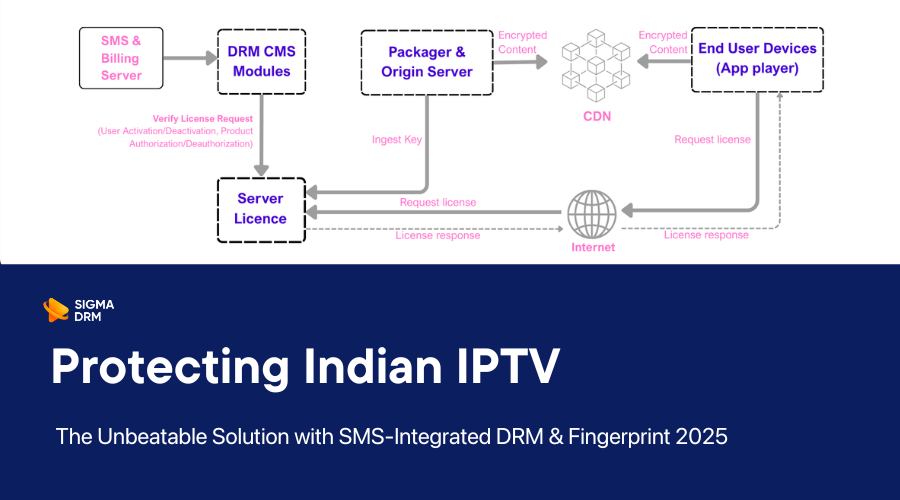
While DRM provides a robust barrier, its effectiveness in tracing content leaks is amplified exponentially when integrated with a Subscriber Management System (SMS). In the IPTV ecosystem, an SMS is your backend platform for registering and authenticating subscribers, managing billing, packages, and service access, and tracking usage by user, device, or IP.
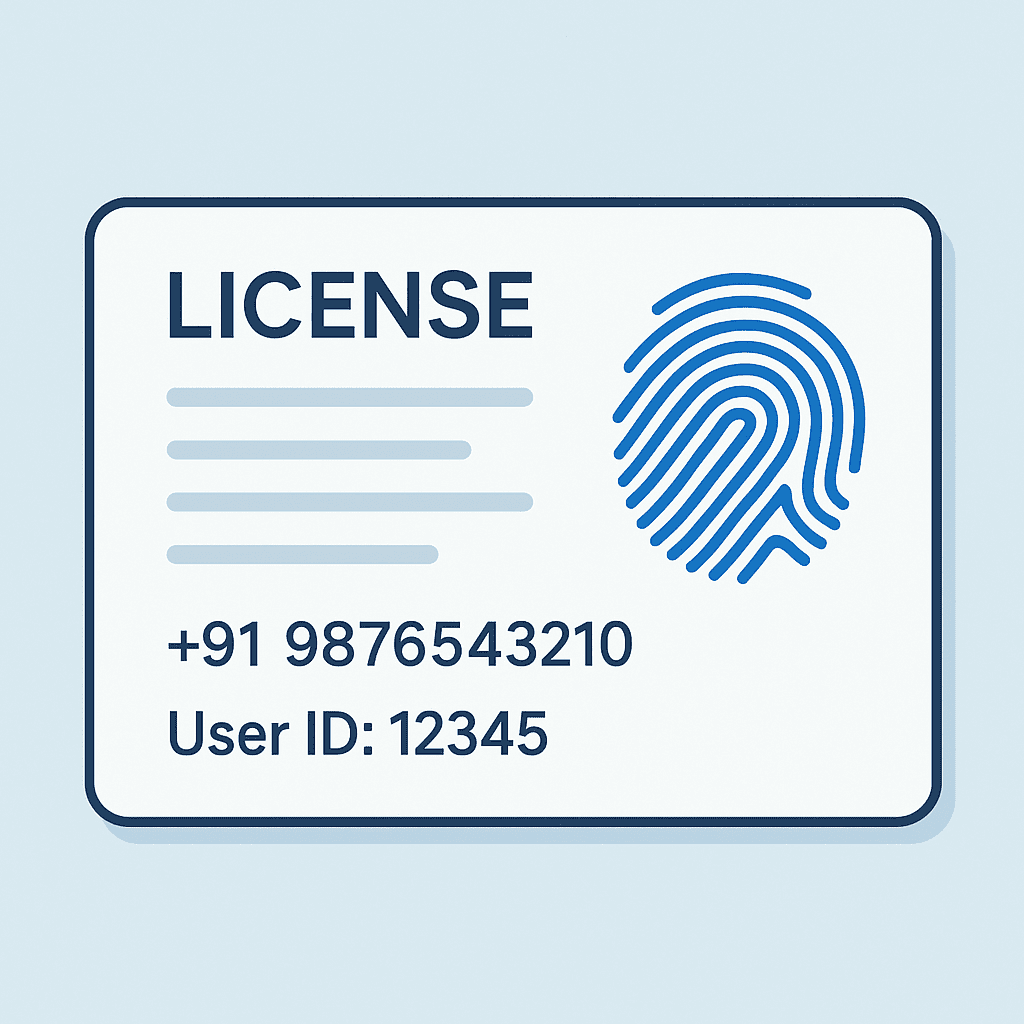
When DRM is integrated with your SMS, every content license issued is tagged with a unique subscriber ID or device fingerprint. This strategic fusion allows content providers to trace any unauthorized use back to a specific user or session, all without altering the content file itself. This makes piracy traceable, enhances trust through legal compliance, and provides Indian IPTV providers with a scalable solution for secure, regulated content delivery, especially critical for unicast IPTV environments.
How SMS-Integrated DRM Works: A Deeper Dive
The user authentication flow via an SMS-integrated DRM license system transforms your content security from a generic barrier into a smart, user-specific enforcement mechanism. When a user requests content, the DRM system communicates with the SMS to verify the subscriber’s rights. Upon successful authentication, a license is issued, uniquely tied to that subscriber.
Fingerprinting: A Non-Intrusive Tracing Tool
A key component of this integrated approach is the fingerprinting mechanism. Unlike traditional watermarking that directly modifies the video content, fingerprinting embeds user or device identifiers into the license issuance process. This allows for:
Identifying the user who accessed the content.
Tracing the playback device and time.
Analyzing copyright violations.
This makes it an ideal tool for environments where infrastructure limitations might make other tracing methods cumbersome, yet leak traceability is paramount.
Benefits for Indian IPTV Providers: Compliance, Protection, and Peace of Mind
Implementing an on-premise, Schedule 10 compliant DRM solution with SMS integration offers a multitude of benefits for Indian IPTV providers:
Enhanced Content Security: Content is accessible only to authorized users, deterring piracy at both technical and subscriber levels.
Reduced Risk of Unauthorized Sharing: Every playback session is traceable. If illegal sharing occurs, the provider can identify the responsible user and take decisive legal or technical action.
No Need for Intrusive Watermarking: The power of DRM with SMS integration often eliminates the need for expensive and potentially visually disruptive watermarking solutions, simplifying content tracking at the system level.
Full Legal Compliance with Indian Copyright Laws: With Schedule 10 of the Indian Broadcasting Ministry mandating strict content control and protection measures, an integrated DRM and SMS solution ensures full compliance while maintaining a seamless user experience. TRAI’s requirements for content protection and auditing are met, helping you avoid administrative penalties or license revocation.
Complete Control and Flexibility: An on-premise deployment provides complete control over your content protection infrastructure, allowing for flexible integration with existing IPTV/OTT infrastructure and third-party systems.
Real-time Monitoring and Reporting: Gain insights into license traffic, access errors, and unusual behavior with real-time dashboards and periodic reports, essential for operational oversight and regulatory compliance.
“Since deploying Thu Do Multimedia’s DRM solution, our ability to track and prevent content leaks has drastically improved. Their local support team in India made the integration seamless, and we’re now fully compliant with TRAI’s Schedule 10 regulations.” – Leading State Broadcaster, India
Ready to Comply and Protect Your Content?
As India’s digital broadcasting landscape continues to mature, deploying a robust DRM solution integrated with your SMS is no longer optional-it’s an essential strategy for long-term success. Thu Do Multimedia offers a DRM solution specifically designed for the Indian market, already deployed and successfully audited.
Don’t let content piracy erode your revenues and reputation.
In an age of rising cyber threats and content piracy, on-premise DRM stands strong behind the firewall, offering broadcasters and media providers unmatched security advantages that cloud-based solutions often struggle to guarantee.
Why Security Still Starts On-Premise
In today’s cloud-first media landscape, Indian broadcasters face a growing dilemma: should they shift entirely to cloud-based DRM, or retain their on-premise setups? While cloud platforms promise speed and scalability, security-conscious organizations continue to trust the time-tested advantages of on-premise DRM.
On-premise DRM provides physical control, direct oversight, and airtight defense mechanisms that cloud DRM still struggles to replicate. In this article, we explore why security teams and CTOs across India’s broadcast sector are sticking with or reverting to on-premise DRM for high-value content protection.
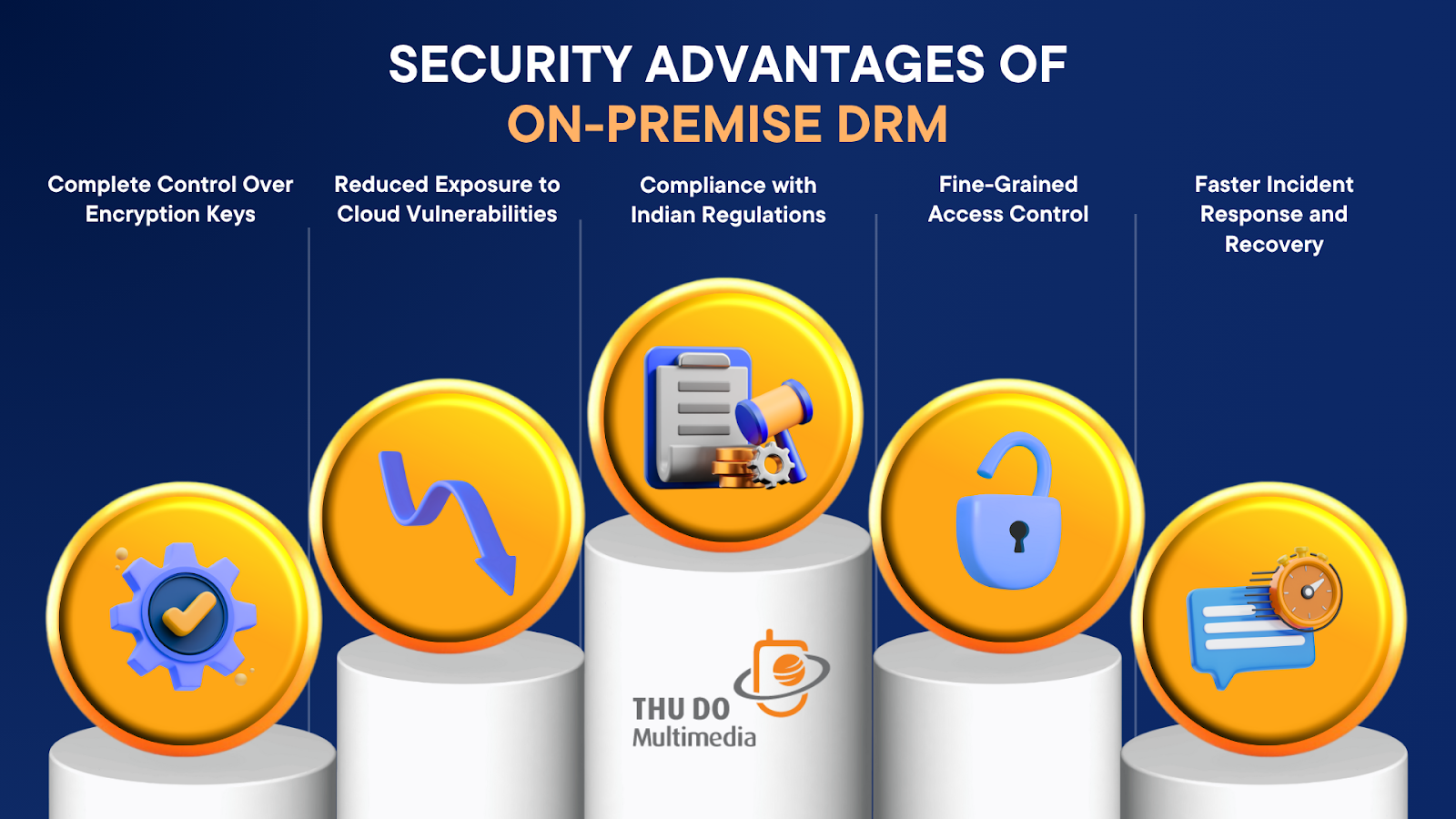
1. Complete Control Over Encryption Keys
One of the most critical security elements in any DRM system is the management of encryption keys. In cloud-based systems, encryption keys often reside with third-party vendors or are transmitted over shared networks. This increases the attack surface.
With on-premise DRM:
Encryption keys never leave your infrastructure.
You can implement hardware-based security modules (HSMs) to safeguard key storage.
Your internal team governs all access, changes, and logging protocols.
This makes it nearly impossible for external actors to intercept or misuse the keys that control your premium content.
2. Reduced Exposure to Cloud Vulnerabilities
Despite advancements, cloud services are still susceptible to breaches and misconfigurations. High-profile incidents like the 2025 Microsoft CLFS exploit (CVE-2025-29824) remind us that even global tech giants can be compromised.
On-premise DRM offers:
Isolation from internet-borne threats.
Ability to deploy air-gapped servers that are completely offline.
No reliance on third-party patch cycles or shared infrastructure.
For broadcasters managing sensitive or politically charged content, on-prem DRM is not just a preference, it’s a necessity.
3. Compliance with Indian Regulations
Indian broadcasters operate under a complex regulatory framework governed by Ministry of Information and Broadcasting (MIB) and the Telecom Regulatory Authority of India (TRAI)
These bodies increasingly advocate for data localization, audit readiness, and traceable content access logs.
On-prem DRM supports this by:
Keeping user data and content rights logs within national boundaries.
Enabling tamper-proof logging for audits and legal inquiries.
Demonstrating direct control over DRM processes during compliance reviews.
4. Fine-Grained Access Control
Broadcast events like cricket tournaments, elections, or blockbuster movie premieres require granular, real-time access control. With on-prem DRM, broadcasters can:
Issue and revoke licenses instantly.
Geo-fence access based on IP and device fingerprinting.
Enforce time-sensitive policies for limited viewing windows.
This is especially useful for preventing piracy during live streams, where every second counts.
5. Faster Incident Response and Recovery
In the event of a suspected breach or system anomaly, on-prem DRM systems allow for:
Immediate isolation of affected nodes.
Local forensic analysis without needing vendor access.
Rollback and restoration from secure offline backups.
This localized approach drastically reduces response time compared to vendor-coordinated cloud incidents.
Hybrid Isn’t a Compromise – It’s a Strategy
While on-prem DRM offers unmatched control, that doesn’t mean cloud should be excluded. The smartest broadcasters are implementing hybrid models:
Cloud handles analytics, CMS, and non-sensitive VOD assets.
On-prem handles encryption, license delivery, and watermarking.
This balances agility with security, ensuring compliance while still moving fast where it counts.
Conclusion: Trust Still Lives Behind the Firewall
For India’s broadcasters, trust equals control. And control begins with secure, local, on-premise infrastructure. From encryption and compliance to response time and audit transparency, on-prem DRM continues to deliver peace of mind in a digital environment fraught with risk.
If your content is valuable, political, or time-sensitive, don’t just follow the cloud hype. Evaluate the full security picture and consider where your DRM truly belongs.
Ready to Upgrade Your Security Stack?
Explore Sigma DRM’s advanced On-prem DRM solutions – designed for Indian networks, compliant with Indian laws, and trusted by national broadcasters. Book a demo now!
DRM with SMS integration is essential for protecting your IPTV/STB system against critical risks, including revenue loss, content piracy, and unauthorized access. Without this integration, you expose your service to untraceable content leaks, uncontrolled subscriber access, and severe security vulnerabilities.
Your IPTV/STB system may be serving millions of subscribers, but are you truly in control of each individual set-top box? What happens if an STB is cloned, allowing unauthorized access to premium content without any traceability? Or when a long-expired subscriber continues to freely enjoy paid channels?
This is no longer hypothetical. These are real-world security gaps and revenue leakages that are challenging providers every day.
However, the absence of an intelligent orchestration layer, a tightly integrated, bidirectional bridge between the DRM and SMS systems, has become the Achilles’ heel of many operations. This missing link introduces serious vulnerabilities that impact security, operations, revenue, and the overall credibility of service providers.
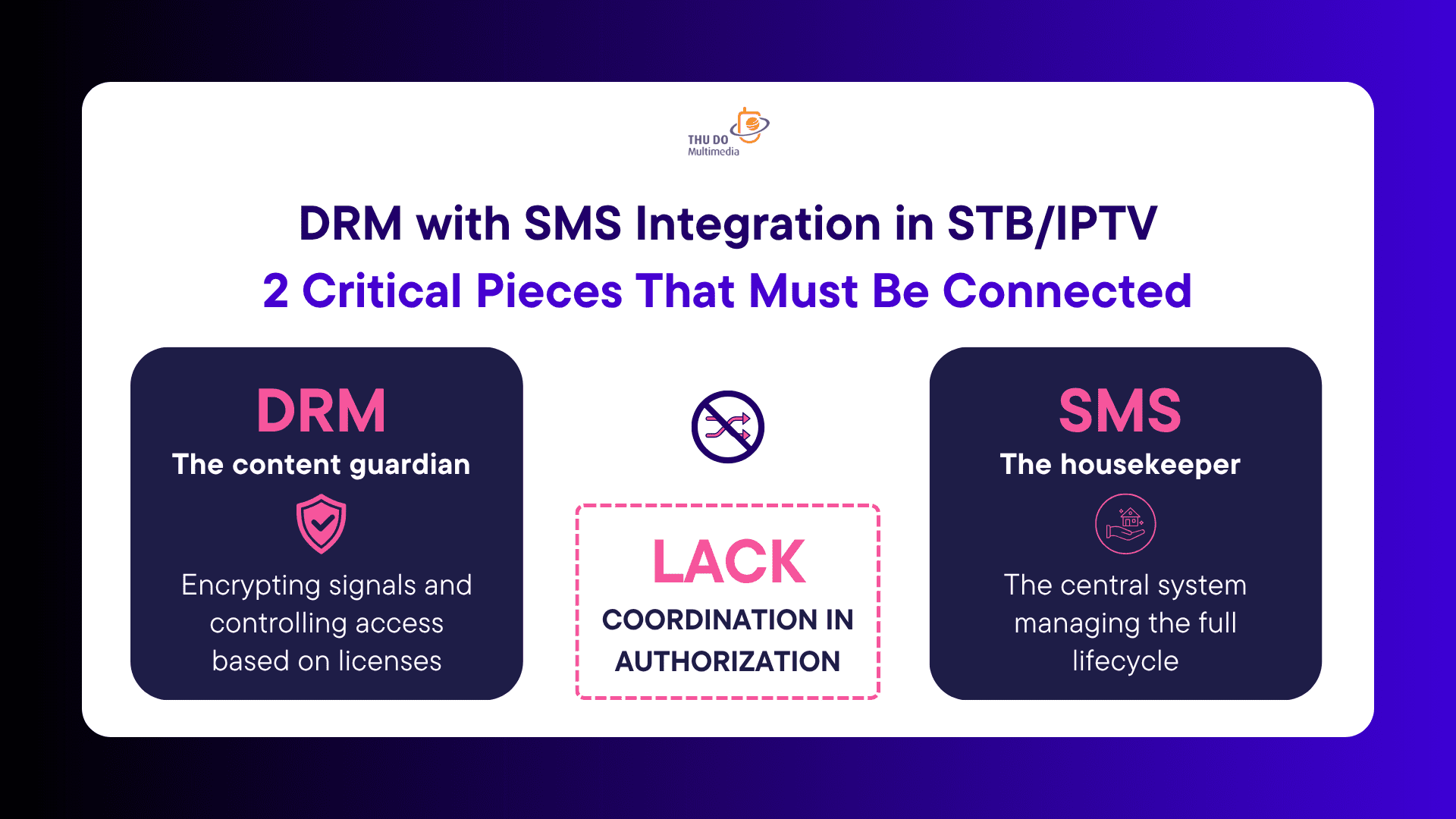
DRM with SMS Integration in STB/IPTV: 2 Critical Pieces That Must Be Connected
DRM with SMS Integration in STB/IPTV: What is lacking?
DRM (Digital Rights Management) – “The content guardian” – is responsible for encrypting signals and controlling access based on licenses granted to each STB. Its mission: prevent unauthorized copying, recording, and redistribution of premium content.
SMS (Subscriber Management System) – “The housekeeper” – serves as the central system managing the full lifecycle of subscribers: from registration, subscription packages, and payment history to account status. It also oversees the lifecycle of every associated STB device.
So, the problem is: DRM knows what content must be protected but cannot verify whether the user is authorized. SMS knows who the legitimate subscribers are but cannot directly enforce access rights to content.
This lack of synchronization between the two systems creates critical security gaps, vulnerabilities that can be exploited by malicious actors.
A fully integrated system ensures that every content access request from a set-top box is verified not only by DRM, but also cross-checked against subscriber information from SMS. This dual-layer validation guarantees consistency and accuracy in enforcing the entitlements and status of every subscriber-STB pair.
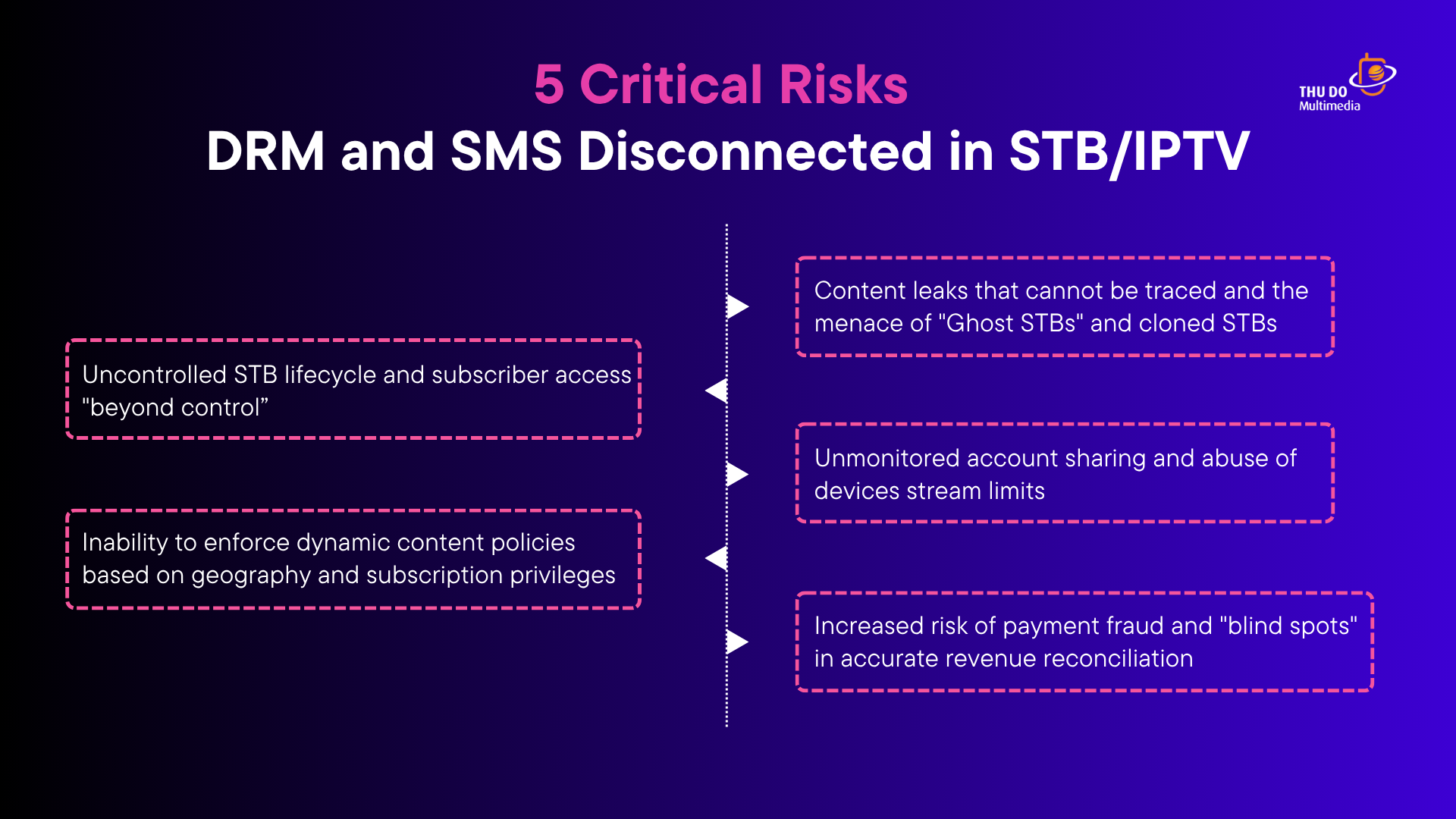
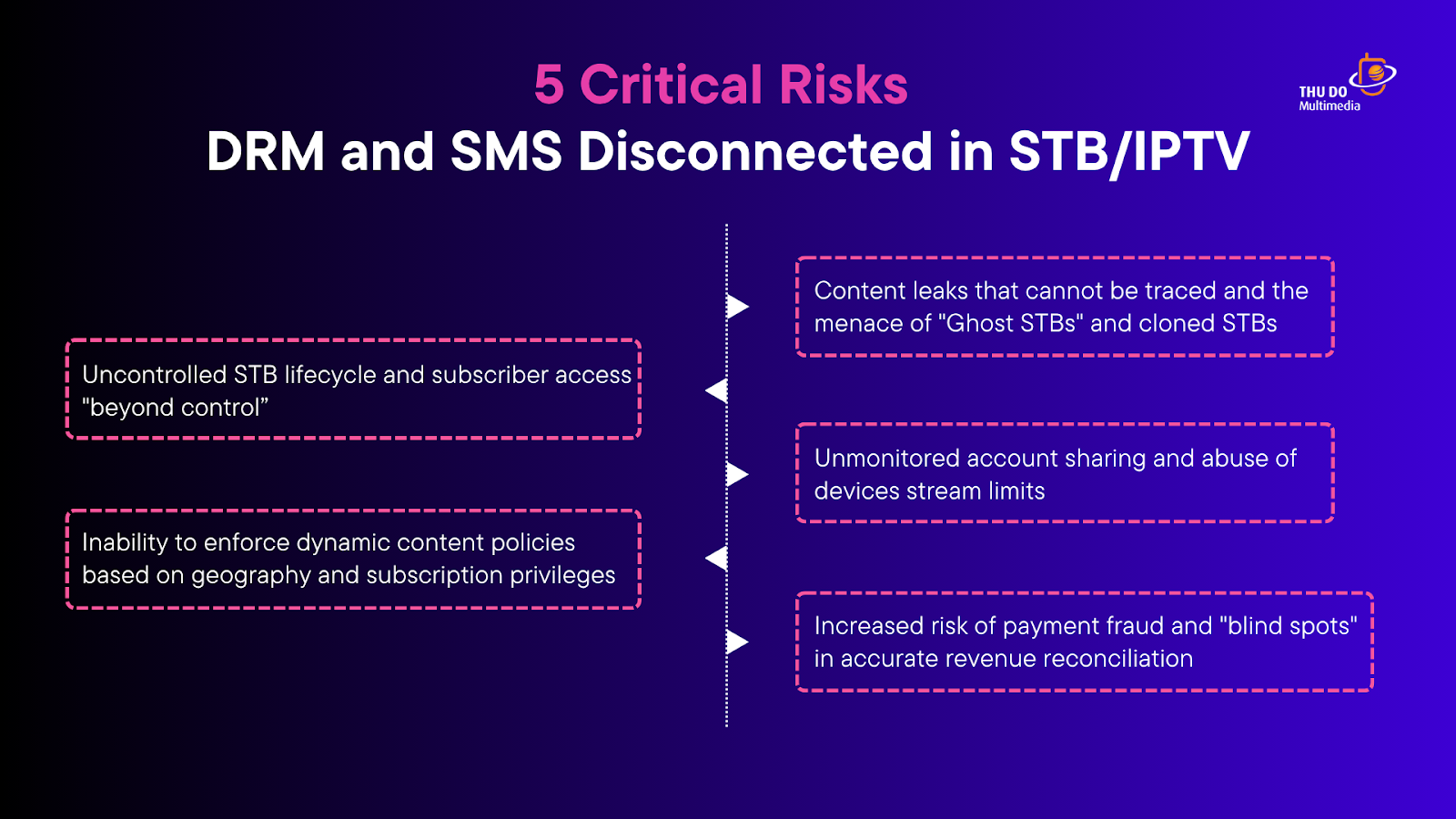
5 Critical Risks When DRM with SMS Integration Are Disconnected in STB/IPTV
5 Critical Risks of Not Implementing DRM with SMS Integration
1. Content leaks that cannot be traced and the menace of “Ghost STBs” and cloned STBs
When the Digital Rights Management (DRM) system is not tightly connected to the Subscriber Management System (SMS), identifying the source of leaked content becomes impossible. Fake or cloned STBs can distribute unauthorized content without leaving any trace.
These cloned devices, often created using stolen credentials or duplicated device IDs, operate outside of the provider’s control. They can stream premium content without authorization, bypassing subscription fees and causing significant financial damage.
Consequently, there will be a significant revenue loss, violation of copyright agreements with content owners, and most critically, the inability to trace the violator for legal action.
2. Uncontrolled STB lifecycle and subscriber access “beyond control”
When the system cannot manage the lifecycle of each STB, expired subscribers can still access content. This occurs when STBs are not properly deactivated, or access licenses are not revoked.
In an ideal setup, SMS should automatically communicate with DRM to revoke access for expired subscriptions. However, without integration, STBs can remain active even after a subscriber cancels their contract
This leads to ongoing revenue losses due to expired subscribers who continue accessing content, along with heightened security risks from unauthorized STBs.
3. Unmonitored account sharing and abuse of devices stream limits
Users can share accounts with multiple others without the provider’s knowledge, making device and stream limits meaningless. This is especially common when subscribers share login credentials with friends or family members.
Without DRM and SMS integration, the provider cannot detect abnormal usage patterns, such as a single account being used simultaneously on multiple devices.
As a result, significant financial losses occur as multiple users share a single account, leading to system congestion and a decline in service quality for legitimate subscribers.
4. Inability to enforce dynamic content policies based on geography and subscription privileges
Due to a lack of synchronization between DRM and SMS, providers cannot enforce content distribution policies based on geographical location, subscription tiers, or user privileges.
For instance, a subscriber with a basic package might gain access to premium channels, or users in restricted regions might bypass geo-blocking.
Copyright violations and loss of broadcasting rights in exclusive regions, resulting in reduced revenue and damage to brand reputation.
5. Increased risk of payment fraud and “blind spots” in accurate revenue reconciliation
A lack of synchronization between DRM and SMS leads to errors in revenue recording, making it impossible to detect and control payment fraud.
This can manifest as incorrect billing, unauthorized Pay-Per-View (PPV) access, or even cases where subscribers continue to be charged after canceling.
Unexplained revenue loss leads to financial reconciliation challenges, triggering customer complaints and ultimately damaging provider credibility.
Common Pitfalls to Avoid When Implementing DRM-SMS Integration
1. Superficial integration: Settling for basic API connections
Many providers make the mistake of considering basic API connections as sufficient for integration. However, without deep integration that enables real-time data exchange, critical information may not sync between DRM and SMS, leaving security gaps.
2. Neglecting data mapping and standardization
Poorly mapped data between DRM and SMS can lead to inconsistencies, such as unauthorized devices gaining access or legitimate subscribers being denied content. Ensure all subscriber information, device data, and access rights are clearly mapped.
3. Lack of a comprehensive testing plan
Failing to conduct thorough testing across all possible scenarios can result in unexpected errors post-launch. Create a detailed testing plan covering functional, performance, and security aspects in a controlled environment (UAT).
In order to create an effective testing plan, it is important to have certain aims and KPIs for the team.
Your DRM-SMS integration should not only meet current needs but also be scalable for future expansion. Neglecting this can result in costly upgrades later.
5. Ignoring security and compliance requirements
Failing to implement strong encryption, access control, and compliance with regional data protection regulations can expose your system to legal and security risks.
Integrating DRM with the Subscriber Management System (SMS) is not just a technological task – it’s a strategic move. For a step by step roadmap to help IPTV providers in India stay on track, avoid pitfalls, and maximize efficiency, you can read more: Roadmap to Tackle IPTV Piracy at Its Root in India 2025
In a rapidly evolving STB/IPTV landscape, disconnected DRM and SMS systems are a ticking time bomb. The risks of untraceable content leaks, uncontrolled subscriber access, and payment fraud are real and growing:
Content leaks that cannot be traced and the menace of “Ghost STBs” and cloned STBs
Uncontrolled STB lifecycle and subscriber access “beyond control”
Unmonitored account sharing and abuse of devices stream limits
Inability to enforce dynamic content policies based on geography and subscription privileges
Increased risk of payment fraud and “blind spots” in accurate revenue reconciliation
A fully integrated DRM-SMS solution transforms your system from vulnerable to secure, from chaotic to controlled. By ensuring that every content access is verified and synchronized between DRM and SMS, you gain complete visibility, protect your revenue, and deliver a premium experience to your subscribers.
Ready to secure your content and maximize your revenue? Schedule a demo today and discover how a fully integrated DRM-SMS solution can protect your service and elevate your business.
DRM with SMS Integration is a powerful solution that maximizes content security and revenue for digital content providers. Every year, the global digital content industry loses tens of billions of dollars due to copyright infringement and unauthorized account sharing.
According to a report by Parks Associates, in 2024 alone, OTT services and pay TV platforms experienced a staggering $12.5 billion in losses due to these practices.
So, how can digital content providers protect their assets and optimize operational efficiency in this high-risk environment? The answer lies in integrating Digital Rights Management (DRM) systems with Subscriber Management Services (SMS).
This synchronization between SMS and DRM not only safeguards content but also streamlines operational processes and unlocks new business opportunities.
This article will provide an in-depth analysis of the remarkable benefits of DRM with SMS integration, including:
Outstanding benefits of DRM with SMS Integration
Outstanding benefits of DRM with SMS Integration
1. Enhanced content security and proactive anti-piracy measures
Accurate tracking and immediate violation handling
Integrating SMS data with DRM enables businesses to trace the origin of copyright violations accurately.
When unauthorized use of content is detected, the SMS-DRM system can swiftly identify the responsible user, device, or account, allowing for timely action.
Comprehensive protection against subscription fraud and unauthorized service usage
With SMS-DRM integration, businesses can closely monitor and control content access activities. This prevents unauthorized account sharing and minimizes revenue loss risks.
Accurate enforcement of complex, multi-layered content policies
SMS-DRM supports the implementation and enforcement of flexible content policies, catering to the complex requirements of major content partners.
Such as Hollywood studios or international sports leagues
Proactive detection and prevention of abnormal activities
By analyzing synchronized data between SMS and DRM, businesses can detect abnormal activities, such as credential stuffing attacks, and apply timely preventive measures.
2. Superior operational efficiency and significant cost reduction
Complete automation of content access granting and revocation processes
Integrating SMS with DRM enables complete automation of processes such as granting content access to subscribers and revoking access upon expiration.
This reduces the workload for technical teams, speeds up request processing, and minimizes errors.
Minimizing human error in operations
Thanks to automation, manual errors are drastically reduced. Content access requests are processed quickly, accurately, and consistently across all platforms, ensuring a smooth and consistent user experience.
Shortening customer request and issue resolution time
Customers no longer have to wait long for access activation or cancellation. The SMS-DRM system processes requests almost instantly through data synchronization and automated handling, improving customer experience and satisfaction.
Simplified and accelerated reconciliation, auditing, and reporting
The SMS-DRM system provides clear and transparent data, making it easier for businesses to meet audit and compliance requirements. Data is automatically recorded and stored, minimizing the risk of errors from manual handling.
3. Increased revenue, new business opportunities, and innovation
Effective revenue leakage prevention
SMS-DRM enables businesses to protect their revenue by preventing unauthorized service usage and invalid account sharing. This helps maintain stable revenue and minimizes the risk of losses.
Establishing a solid foundation for flexible business models
With SMS-DRM, businesses can launch flexible business models, such as daily/weekly subscriptions, freemium with ads, and specialized content packages, catering to diverse customer needs.
Powerful support for cross-selling and up-selling campaigns
SMS-DRM data provides insights into user behavior, allowing businesses to personalize service recommendations. Cross-sell and up-sell campaigns are optimized, increasing conversion rates and revenue.
Enhanced accuracy and transparency in revenue calculation and distribution
SMS-DRM ensures transparency in revenue calculation, building trust with partners. Revenue reports are generated automatically and accurately, supporting audits and collaboration between parties.
Key Factors for Successful SMS-DRM Data Synchronization
Key factors for sucessful DRM with SMS integration/synchronization
1. Choosing the right technology
Businesses should select an SMS-DRM solution that seamlessly integrates with their existing systems. Platforms with high scalability, strong security, and multi-platform support should be prioritized. Evaluating top providers, consulting experts, and testing new technologies are essential first steps.
2. Designing an optimized system architecture
The architecture must ensure fast data processing, robust data security, and scalability for growing demands. This includes selecting secure encryption methods, user authentication, and efficient key management.
3. Standardizing input data
To avoid conflicts and minimize errors, all related data sources must be standardized from the outset, ensuring consistency and accuracy. The standardization process should include data cleansing, consistent format conversion, and applying naming and encoding standards.
4. Building efficient operational processes
Processes from access granting, revocation, to customer request handling must be optimized and automated for speed and accuracy. This includes clearly defining departmental responsibilities, applying automated rules, and creating smart workflows.
5. Regular testing and evaluation
To ensure stable and secure system performance, businesses must conduct regular testing and performance evaluations. Load testing, security testing, and performance assessments are essential. The operations team should be well-informed and closely coordinated to quickly handle any arising issues.
6. Commitment from the team
Successful data synchronization is not just about technology; it also requires commitment from the operations and management teams. Regular training, raising security awareness, and building a culture of data responsibility are key to success.
To streamline your operations and combat IPTV piracy at its root in India by 2025, it is essential to adopt a comprehensive Roadmap for Tackling IPTV Piracy.
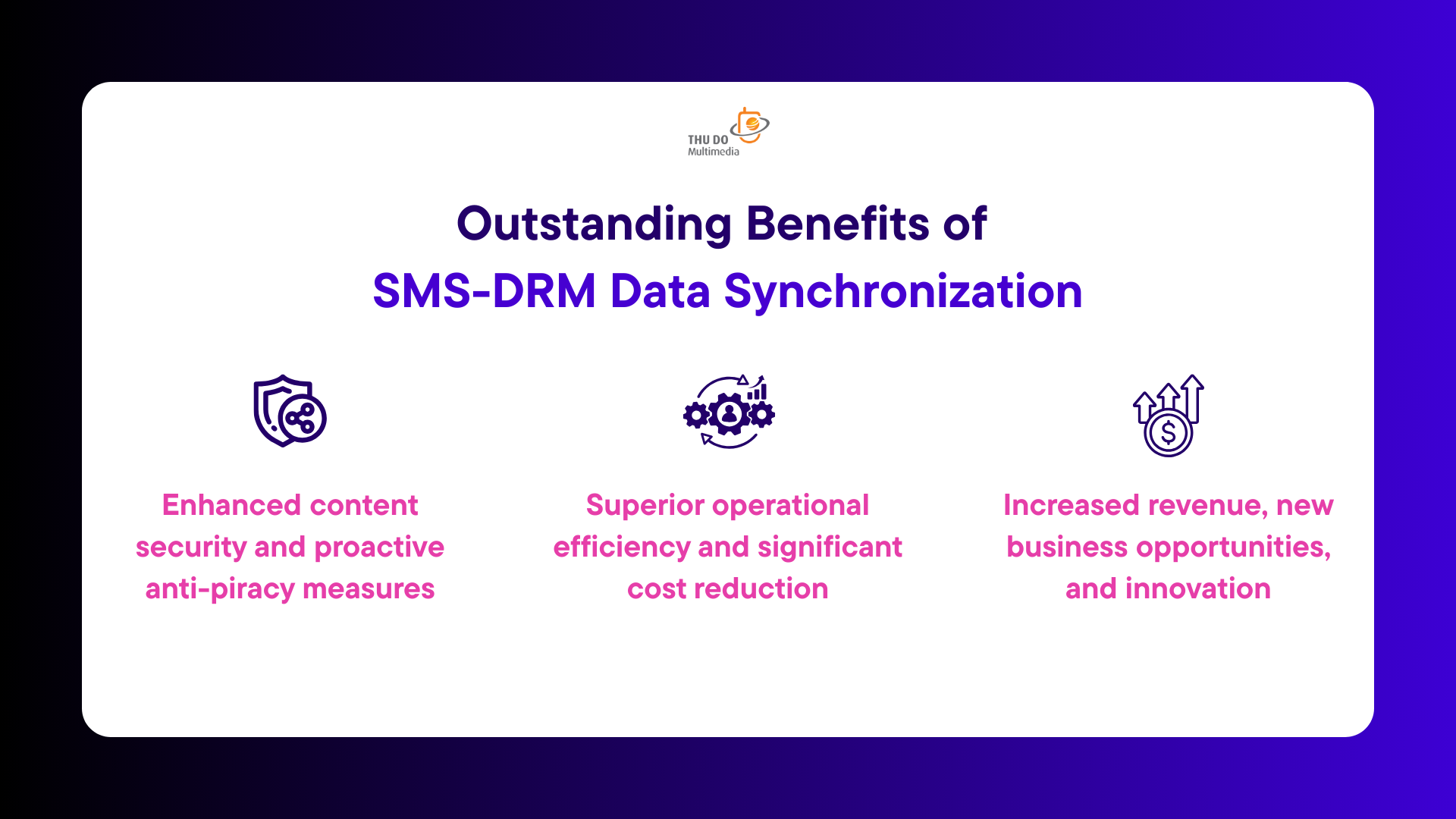
SMS-DRM data synchronization is the key for digital content businesses to not only protect their copyrights but also optimize operations, minimize costs, and unlock new business opportunities. With a smart and flexible SMS-DRM system, you can:
Enhanced content security and proactive anti-piracy measures
Superior operational efficiency and significant cost reduction
Increased revenue, new business opportunities, and innovation
Don’t let your data be just information. Turn it into your competitive advantage with a comprehensive SMS-integrated DRM system. Let Sigma DRM help you elevate your operational strategy, optimize security, and drive business growth.
Schedule a demo today to discover how Sigma DRM can protect your content, optimize efficiency, and boost revenue for your business.
On-premise DRM or Cloud DRM for IPTV in India? A comprehensive analysis comparing costs, security, and key pros and cons of each DRM solution
On-premise vs Cloud DRM: Which Solution is Best for IPTV Providers in India?
India’s expanding IPTV market is facing an urgent challenge: how to protect digital content in an age of increasingly sophisticated and widespread piracy. As a result, Digital Rights Management has become a mission-critical component of any OTT/IPTV provider’s technical infrastructure.
But for many service providers, a key decision remains unclear: Should you choose a Cloud-based or an On-premise DRM solution? Which one offers better cost efficiency, content security, and scalability for future growth?
This article delivers a comprehensive, practical, and expert-level comparison to help you make the most informed choice for your IPTV business in India.
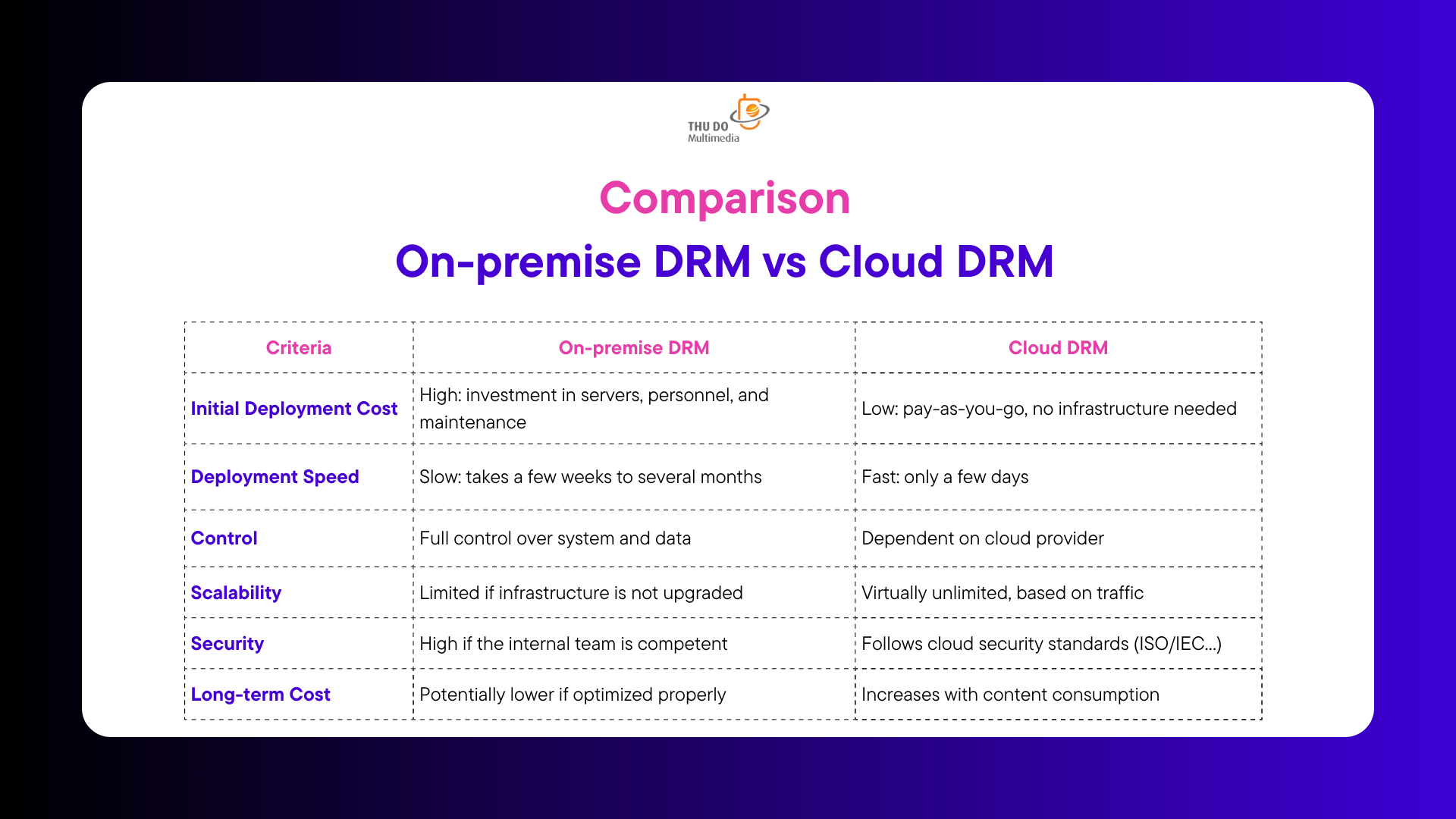
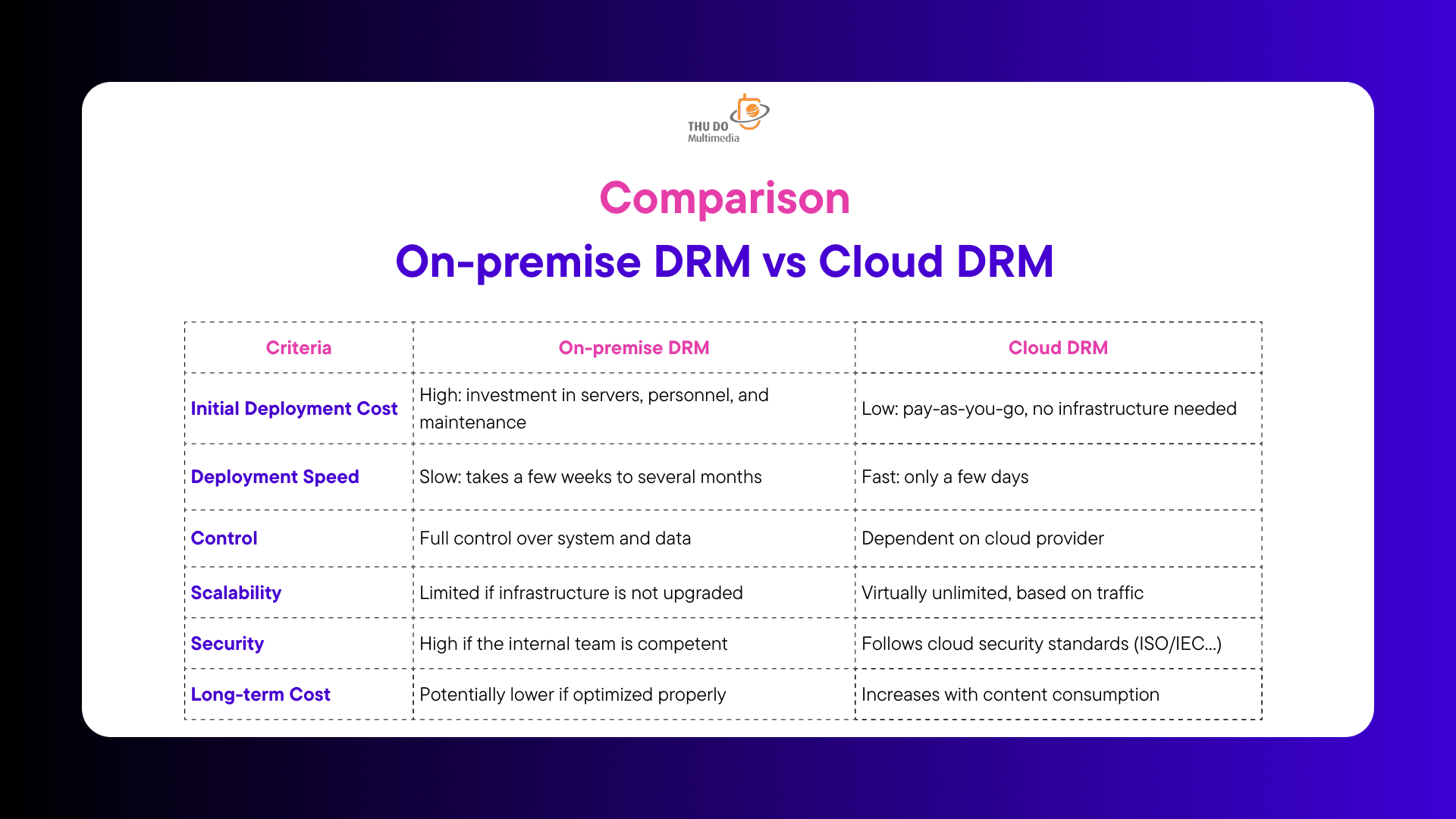
When building a content protection system for IPTV services, especially in a highly regulated market like India, choosing between On-premise and Cloud DRM is more than a technical decision. It’s a strategic move that impacts initial investment, deployment speed, system control, and long-term security.
Each DRM model comes with its own distinct pros and cons. Before deciding, businesses must understand the core differences to align with their internal capabilities, growth goals, and local compliance requirements.
The following comparison table offers a comprehensive overview to support your decision-making:
ComparisonOn-premise DRM vs Cloud DRM
When Should You Choose On-premise DRM?
Best for Large IPTV Providers with Strong In-house Tech Teams
If you’re a large-scale IPTV provider in India with your own server infrastructure and a skilled DevOps team, On-premise DRM could be the ideal choice. Here’s why:
Full control to optimize the Digital Rights Management architecture based on your business-specific requirements.
Subscriber data and content rights stay entirely within your internal systems, reducing exposure risks.
Enables deep integration with your existing SMS, billing, and analytics platforms.
Case Study – Microsoft Security Breach, April 2025
In April 2025, Microsoft released an emergency patch for a critical vulnerability, CVE-2025-29824, found in the Windows Common Log File System (CLFS). Before the patch, ransomware groups like Play and Storm-2460 had already exploited this flaw, launching targeted attacks on major organizations across the U.S., Spain, Venezuela, and Saudi Arabia.
These attacks allowed adversaries to escalate privileges, access Active Directory information, and install malware – posing severe risks to any Windows-based system that hadn’t been updated.
However, Sigma DRM clients using On-premise DRM were completely unaffected by this breach. Thanks to isolated internal security layers and self-managed Digital Rights Management key control, they operated independently of the compromised public cloud systems.
Key takeaway: In an era of increasingly advanced cyber threats, On-premise DRM offers unmatched control and end-to-end security – something that public cloud DRM platforms simply cannot fully guarantee.
Key Evaluation Criteria for Choosing the Right DRM for IPTV Providers in India
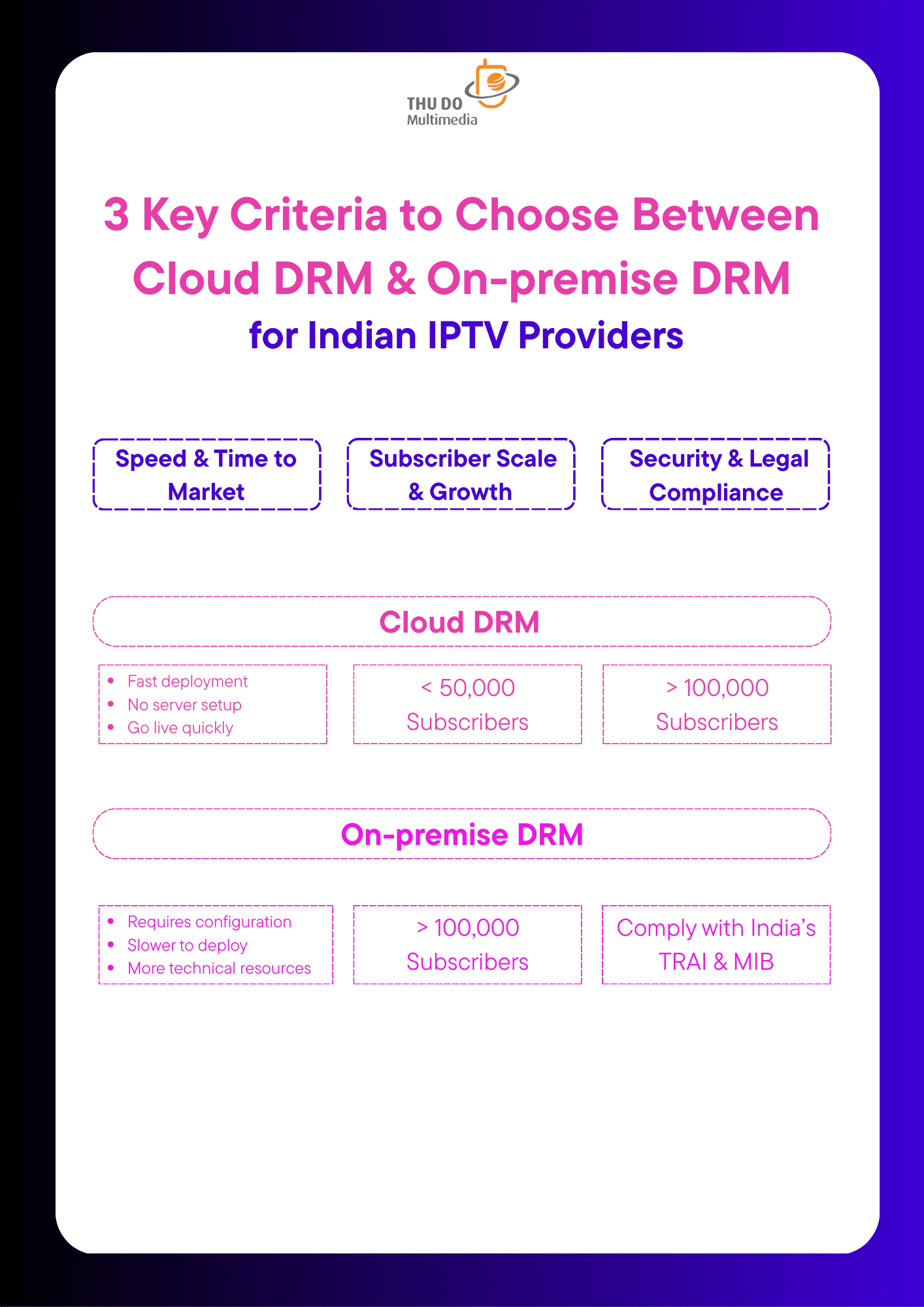
When selecting between On-premise and Cloud DRM, IPTV providers in India must weigh multiple business and technical factors. Below are the three most critical criteria to guide your decision.
1. Deployment Speed & Time-to-Market
If your priority is speed and agility, Cloud DRM offers the fastest path to go live. It’s specifically designed for platforms that need to move quickly, whether you’re entering a competitive market, launching a time-sensitive promotion, or scaling up to meet a sudden spike in demand.
With Cloud Digital Rights Management, you can skip complex server configurations and begin securing your content almost immediately. There’s no need for hardware provisioning or custom backend deployment. Everything is managed via secure APIs, making the process straightforward and fast.
In contrast, on-premise DRM involves a more involved setup. It requires infrastructure provisioning, technical validation, QA testing, and optimization. While this offers greater control in the long term, it can significantly delay your launch timeline, which may not be ideal if you’re working under pressure or trying to beat competitors to market.
The bottom line: Choose Cloud DRM when you need rapid deployment, especially for pilot projects, MVP launches, or urgent content rollouts. It’s your go-to solution for speed without sacrificing security.
2. Subscriber Scale & Growth Projections
The number of subscribers you serve today and how quickly that number is expected to grow, plays a critical role in determining which DRM model is the right fit for your IPTV business.
If you’re managing a base of fewer than 50,000 subscribers, Cloud DRM is typically the more practical option. It’s easier to manage, cost-effective at low scale, and allows you to grow incrementally without committing to heavy infrastructure. Cloud platforms offer the elasticity to expand on demand, making them ideal for small-to-mid scale IPTV operations or new market entrants.
However, if you’re expecting your user base to exceed 100,000 subscribers, the economics start to shift. At larger scales with consistent traffic and high data throughput, On-premise DRM can become more cost-efficient over time. The ability to manage licenses, storage, and encryption locally reduces recurring cloud service fees and gives you tighter control over security, latency, and performance.
In short, Cloud DRM is ideal for early growth stages, while On-premise DRM becomes more financially viable as your platform scales and your need for control increases. Carefully evaluate your current footprint and growth trajectory to choose the most strategic path forward.
3. Data Security & Regulatory Compliance
If your platform handles premium content such as Hollywood movies, live sports, or any form of high-value programming, or if you process sensitive subscriber data, then security and regulatory compliance must be your top priorities.
In such cases, On-premise DRM is often the preferred choice. It provides maximum protection by keeping encryption keys, license servers, and user data entirely within your own controlled infrastructure. This minimizes exposure to external risks and enhances your ability to monitor, audit, and respond to threats in real time.
Alternatively, if you’re considering a cloud-based deployment, make sure to choose a certified Cloud DRM solution that meets industry standards for HD/UHD content protection, such as Widevine L1 or Apple FairPlay with secure key delivery. Not all cloud DRM providers offer the level of security required for premium rights holders, so vetting your vendor is essential.
Equally important is ensuring full compliance with Indian regulations, particularly those issued by TRAI (Telecom Regulatory Authority of India) and the Ministry of Information and Broadcasting (MIB). These regulations may mandate data localization, subscriber consent mechanisms, or specific encryption standards. Whether on-prem or in the cloud, your DRM system must align with these frameworks to avoid legal and operational risks.
Choose On-premise DRM for stricter control and compliance, or verify that your Cloud DRM provider meets industry-grade security certifications.
3 Key Criteria to Choose Between Cloud DRM & On-premise DRM for Indian IPTV Providers
Which DRM Option Is Best for You?
There’s no one-size-fits-all solution when it comes to choosing between On-premise and Cloud DRM for IPTV providers in India. The right choice depends on your business goals, infrastructure, and stage of growth.
If you’re an established IPTV provider with an in-house DevOps team and robust infrastructure, on-premise DRM is often the superior choice. It gives you full control over your architecture and data, allowing for tighter security protocols tailored to your operations. This is especially important when handling premium or exclusive content, where any breach could lead to major revenue losses or legal consequences. On-premise DRM also enables seamless integration with your internal systems, such as Subscriber Management Systems (SMS), billing platforms, and analytics dashboards, ensuring performance, traceability, and compliance are all maintained within your own environment.
On the other hand, if you’re a startup or scaling IPTV platform aiming to go to market quickly and minimize upfront investment, cloud-based DRM can be your fastest and most efficient route. With faster deployment timelines, lower initial infrastructure costs, and hassle-free scalability, cloud DRM lets you focus on growth without getting bogged down in complex implementation. You can launch services faster and pivot more easily as your business model evolves.
Pro Tip: Many Indian IPTV providers begin with cloud DRM to accelerate time-to-market, then gradually transition to on-premise DRM as their subscriber base grows and compliance demands increase. This hybrid approach offers the best of both worlds, speed today and control tomorrow.ders adopt a hybrid approach – starting with Cloud DRM for rapid launch and migrating to On-premise DRM as their subscriber base and data security needs grow.
Choosing the right DRM provider is as important as deciding between On-premise and Cloud deployment. Here are three widely used DRM solutions among Indian IPTV providers:
Widevine (by Google)
One of the most widely adopted DRM solutions globally, Widevine supports multiple platforms and is trusted by major streaming services.
PlayReady (by Microsoft)
Well-integrated with Windows environments and Smart TVs, PlayReady has been a strong player in the market. However, recent industry analyses have raised concerns about its declining trust in terms of security robustness.
Sigma DRM
Built specifically for the Indian IPTV ecosystem, Sigma DRM offers:
Deep integration with Subscriber Management Systems (SMS)
Flexible architecture for both On-premise and Cloud
Optimized for compliance with Indian regulations
Still Unsure Which DRM to Choose?
If you’re still debating between Cloud DRM vs On-premise DRM, we’re here to help.
Let our Sigma DRM experts assist you with:
➡ Evaluating your current infrastructure ➡ Recommending the most efficient architecture ➡ Delivering a live demo of content protection in action



Recent Comments