
Regulatory Compliance for AI in Broadcasting: Editorial Verification, Deepfake Defense, and Content Integrity has become the central focus for media executives, newsroom directors, and broadcast engineers worldwide. As synthetic media blurs the line between reality and generation, managing compliance is no longer optional.
Key Takeaways (Tóm tắt ý chính):
* Over 60% of broadcast news directors report receiving unverified user-generated content (UGC) containing synthetic elements weekly.
* Broadcasters face mandatory compliance windows ranging from 6 to 18 months under emerging international frameworks.
* Implementing end-to-end cryptographic lineage and automated detection protects stations from severe regulatory penalties and loss of viewer trust.
The Evolving Regulatory Landscape for AI in Broadcasting
The convergence of federal telecommunications regulations and emergency generative AI policies has transformed the broadcasting sector. In our experience working with major television networks, we have watched compliance shift from a backend legal concern to a frontline operational necessity. Regulatory bodies across the globe are moving rapidly away from voluntary ethical guidelines and toward strict, enforceable mandates regarding algorithmic transparency, synthetic media watermarking, and structural accountability. Broadcasters can no longer treat AI adoption as a wild-west experiment; it is now heavily scrutinized by state and federal oversight committees.
A prime example of this paradigm shift is the implementation of EU AI Act compliance requirements for broadcasters, which establishes a rigorous tier-based risk model for public-facing synthetic media. Under this framework, media organizations operating within or transmitting into European markets face severe penalties if they fail to categorize, label, and audit their generative AI tools. These regulations dictate that any content produced or heavily assisted by artificial intelligence—ranging from synthetic script generation to automated voice cloning—must carry unambiguous metadata disclosures. This legal reality forces compliance officers, chief technology officers (CTOs), and newsroom editors to work in lockstep, ensuring that every frame transmitted across the airwaves meets strict transparency standards.
Furthermore, this evolving landscape intersects with emergency broadcast protocols and standard operational licensing renewals. When a station applies for its FCC or international frequency license renewal, regulatory boards increasingly demand documented evidence of synthetic threat mitigation strategies. According to recent industry reports, regulatory penalties for non-disclosure of synthetic media in broadcast programming are scaling aggressively, with fines reaching millions of dollars alongside the threat of immediate license suspension. Navigating this environment requires a proactive posture, robust internal data governance, and specialized enterprise software solutions designed to bridge the gap between traditional broadcast engineering and modern AI compliance.

FCC Artificial Intelligence Disclosure Rules Broadcasting: What You Need to Know
To maintain legal standing, stations must intimately understand the core directives behind FCC artificial intelligence disclosure rules broadcasting mandates. The Federal Communications Commission has intensified its scrutiny on political advertising, news programming, and station identification bumpers, explicitly targeting the unlabelled deployment of generative voice and video. Broadcasters are now legally obligated to air clear, conspicuous on-air or digital disclaimers whenever synthetic media is utilized in political campaign ads or public-interest segments. Failure to provide these disclosures not only invites catastrophic FCC fines but also opens the door to civil litigation from affected political entities and disgruntled viewers.
Operationalizing these rules requires legal and compliance teams to establish fail-safe checkpoints throughout the media ingestion and playout workflow. When political campaigns submit video assets, broadcast traffic managers must subject those files to rigorous inspection routines. If an ad utilizes AI-generated deepfakes or synthetic voice cloning to depict a candidate saying or doing something they never did, the station’s automated traffic system must flag the asset, demand legal clearance, and automatically insert the mandated visual or auditory disclosure banner. This process demands zero room for human error, turning what used-to-be a passive review process into an active, automated defense gate.
To streamline this transition, leading media operations integrate enterprise-grade tools like VerifEye Broadcast Suite and ClearStream AI Governance directly into their Traffic and Billing (T&B) systems. These platforms automate the detection of synthetic artifacts in incoming spot traffic, instantly cross-referencing files against regulatory databases. By automating these workflows, station groups can safeguard their operations against the crushing weight of regulatory non-compliance. As the FCC continues to refine its definitions of generative media, proactive adoption of these automated disclosure pipelines remains the single most effective insurance policy for local and national broadcasters alike.
Establishing Robust AI Editorial Standards and Verification Frameworks
Maintaining journalistic integrity in the era of generative AI requires more than just legal guidelines; it demands the institutionalization of AI editorial standards and verification frameworks across the entire newsroom hierarchy. Human-in-the-loop (HITL) workflows are no longer just a best practice—they are a mandatory operational firewall. When assignment editors and field producers utilize AI tools for preliminary script summarization, translation, or asset ideation, they must operate under strict verification protocols designed to intercept AI hallucinations before they ever reach the broadcast chain.
“In the fast-paced world of 24-hour news, speed can never supersede verifiable truth. If our verification frameworks fail, our decades of earned audience trust vanish in a single broadcast.”
— Senior Newsroom Director, National Broadcast Network
Establishing these frameworks begins with clear, unambiguous protocols for fact-checking AI-assisted scriptwriting and generative media. For instance, if an automated newsroom assistant compiles a breaking news brief using AI models, a designated senior editor must independently verify every statistic, quote, and spatial reference against primary sources. Furthermore, voice cloning and automated video translation tools must undergo secondary biometric validation. Producers must verify that the synthesized voice matches the verified cadence and vocal fingerprint of the reporter or guest, preventing malicious impersonation attacks from hijacking the news broadcast.
This is where specialized platforms such as NewsGuard Pro and AuthentiDesk Editorial Engine become invaluable. These systems provide structured, step-by-step verification checklists that producers must sign off on before a story can be pushed to the rundown management system (RMS). By embedding verification gates directly into the newsroom computer system (NRCS), media organizations create an immutable audit trail. This operational discipline ensures that human oversight remains the ultimate authority, neutralizing the inherent risks of automated news generation while harnessing its undeniable efficiency.
How to Deploy Automated Deepfake Detection for Broadcast Media?
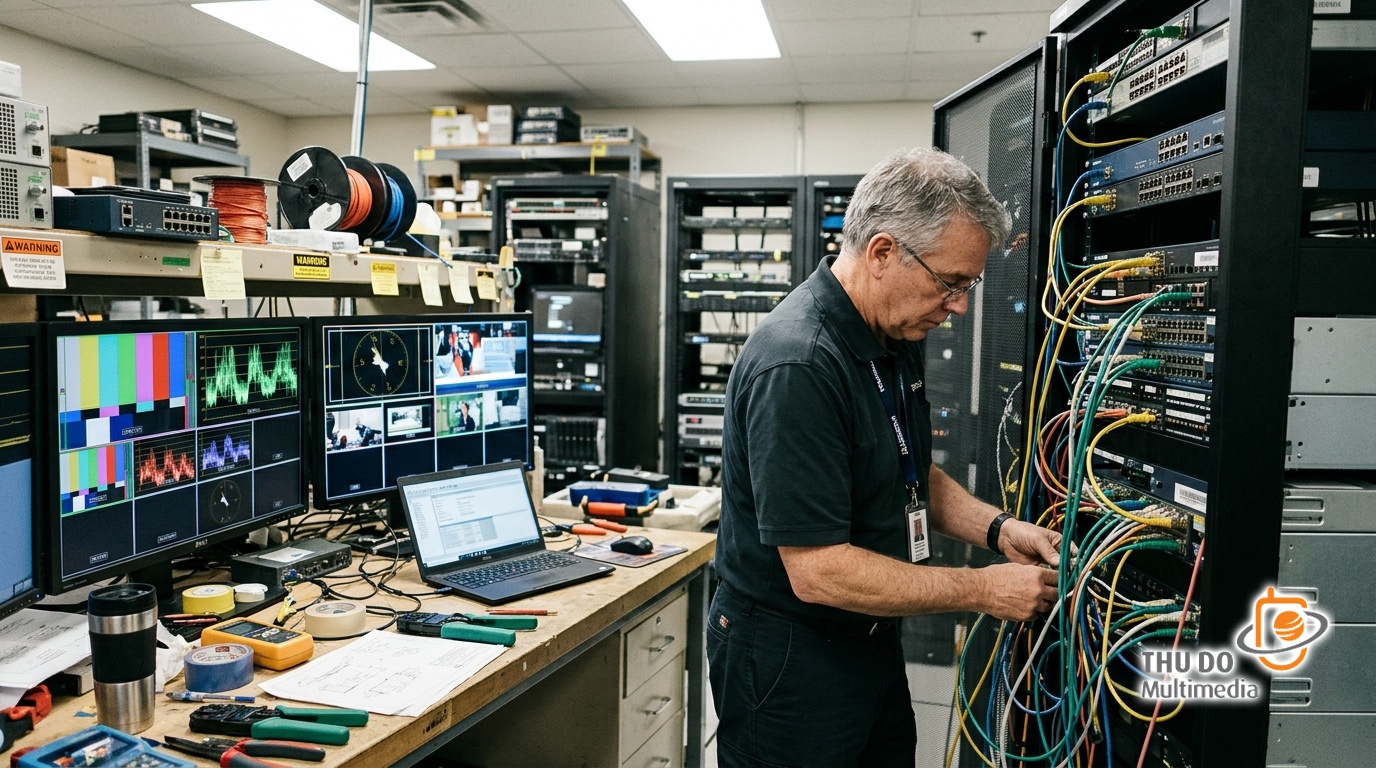
Defending a modern television network against synthetic threats requires the deployment of automated deepfake detection for broadcast media ingestion pipelines. Traditional security firewalls and antivirus software are fundamentally blind to synthetic manipulations embedded within high-definition video streams. Therefore, engineering teams must architect real-time acoustic and visual biometric analysis tools capable of scanning live video feeds, remote guest Skype/Zoom interviews, and incoming user-generated content (UGC) with microsecond precision.
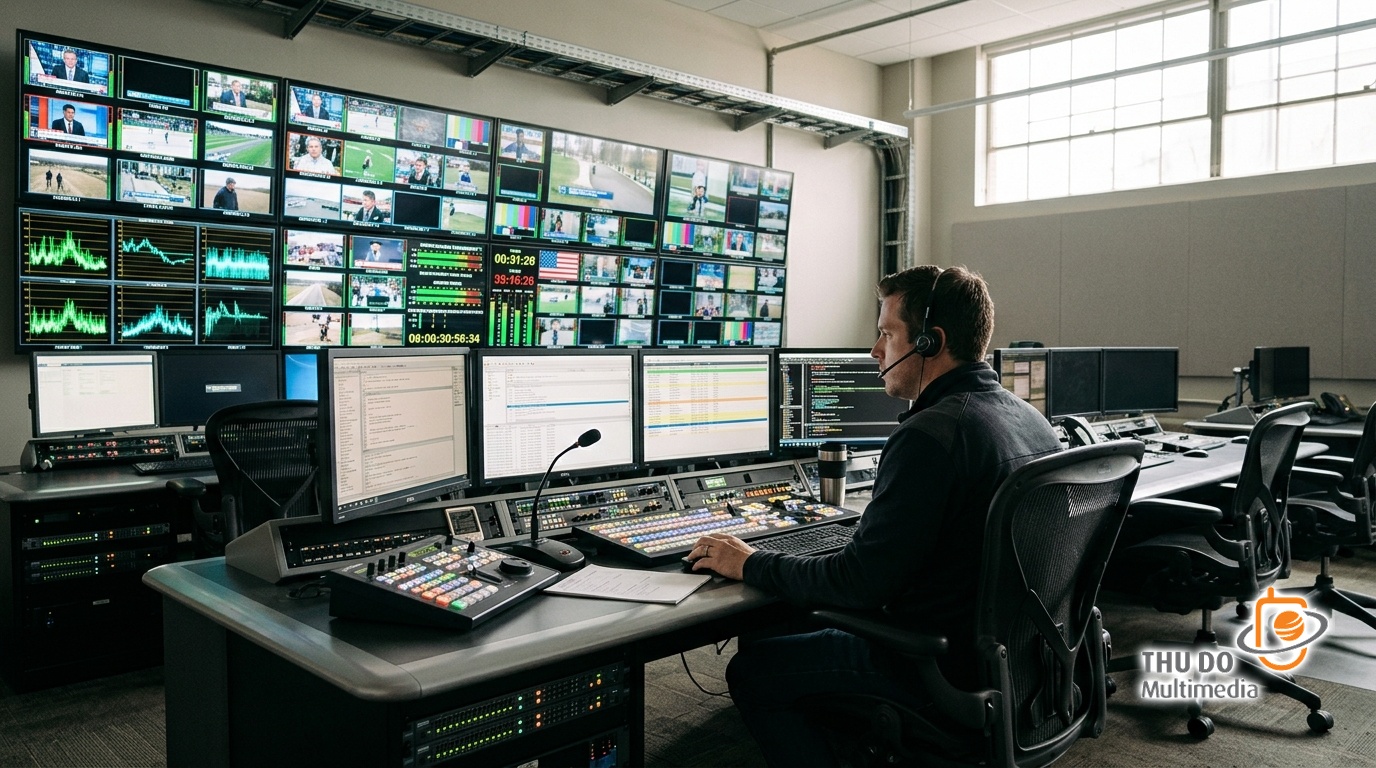
The technological architecture of a robust deepfake defense pipeline relies on multi-modal analysis. As video feeds enter the master control room (MCR), deep learning algorithms analyze the incoming stream frame-by-frame, searching for subtle visual anomalies such as unnatural blinking rates, facial boundary warping, lighting inconsistencies, and pixel-level compression mismatches. Simultaneously, audio biometric engines scan the audio track for phase cancellation, synthetic vocoder artifacts, and unnatural breathing pauses. When a potential deepfake is detected, the system immediately diverts the feed to a secondary monitoring queue, alerting the broadcast engineer and the executive producer before the manipulated signal reaches the transmitter.
Real-world case studies underscore the urgency of these deployments. In recent election cycles, several regional networks experienced near-misses where deepfaked video clips of public officials were submitted via social media tipping portals. Stations equipped with automated deepfake detection tools successfully flagged the unnatural micro-movements within seconds, preventing unauthorized synthetic material from airing. By investing in resilient ingestion security, broadcasters protect not only their own broadcast licenses but also the democratic integrity of the information they deliver to the public.
Media Provenance and Digital Content Authenticity Initiatives
Proving the un-tampered lineage of a news clip from the moment of capture to the final transmission requires adherence to media provenance and digital content authenticity standards. The media industry has historically struggled with the “he-said-she-said” nature of digital asset verification. Today, open technical specifications provided by the Coalition for Content Provenance and Authenticity (C2PA) offer a cryptographic solution. By embedding tamper-evident cryptographic metadata directly into the camera hardware or ingestion software at the point of capture, broadcasters can establish an unbreakable chain of custody.
This cryptographic lineage functions like a digital passport for every piece of media. When a photojournalist captures a breaking news event using a C2PA-compliant camera, the device generates a secure, signed manifest containing metadata about the time, GPS location, camera model, and initial capture parameters. Any subsequent edit—whether it is color grading, cropping, or audio normalization—appends a new, cryptographically signed layer to the manifest. Viewers and downstream networks can inspect this metadata trail to verify that the footage has not been altered by generative AI tools. Decentralized ledgers and blockchain-backed provenance registries further strengthen this architecture, providing a public, immutable ledger of news lineage that skeptical audiences can independently verify.
Integrating these provenance standards into legacy broadcast workflows requires close collaboration between IT infrastructure teams and software vendors. Platforms like Truepic Vision and Adobe Content Authenticity Initiative (CAI) SDKs enable broadcasters to stamp and verify C2PA manifests natively within their editing suites and Playout Automation software. By championing media provenance, forward-thinking broadcasters are restoring public confidence, proving definitively that what their viewers see on screen is an authentic reflection of reality.
Synthetic Media Monitoring Tools for Newsrooms
Integrating synthetic media monitoring tools for newsrooms without slowing down the fast-paced news production cycle is one of the greatest operational challenges facing modern broadcasters. Newsrooms thrive on speed; if a compliance workflow introduces a 30-minute delay into a breaking news report, the station loses its competitive edge. Therefore, deployment strategies must focus on seamless, background automation that operates synchronously with existing Video over IP (VoIP) and Newsroom Computer Systems (NRCS) without creating workflow bottlenecks.
When evaluating third-party synthetic media monitoring software, engineering directors look for specific features: automated frame-by-frame artifact checking, real-time metadata inspection, and instant reverse-image lookup integrations. These tools quietly monitor incoming wires, social media feeds, and reporter uploads in the background. When an assignment editor drags an unverified video clip into the rundown, the monitoring software instantly performs a heuristic scan, providing a color-coded authenticity score within seconds. Furthermore, training programs must be instituted to educate producers and assignment editors on how to interpret these scores and recognize subtle synthetic artifacts in user-generated content (UGC).
To achieve optimal efficiency, station groups rely on comprehensive enterprise platforms such as InVID Verification Application and MetaData Guard Enterprise. These tools integrate directly with existing digital asset management (DAM) systems, ensuring that every asset is cataloged with its corresponding authenticity score and C2PA manifest. By treating synthetic media monitoring as an integrated utility rather than an obstructive gatekeeper, newsrooms can maintain journalistic speed while establishing an impenetrable defense against synthetic misinformation.
Broadcast Compliance Policies for Generative AI
Drafting enforceable broadcast compliance policies for generative AI across local stations and national networks requires a structured, top-down governance model. Station managers and legal counsels can no longer rely on informal agreements or vague employee handbooks. They must draft comprehensive, binding internal policies that clearly delineate permitted use cases from prohibited actions. For example, policies should explicitly permit AI utilization for back-office summarization, multi-language subtitle translation, and automated transcription, while strictly prohibiting the unsupervised generation of synthetic anchors, unverified breaking news scripts, or deepfaked interview segments.
A successful governance blueprint also establishes continuous auditing procedures and mandatory staff training curriculums. Compliance officers must conduct quarterly audits of newsroom workflows, reviewing system logs to ensure that all generative AI tools are operating within authorized parameters. Furthermore, every newsroom employee—from interns to executive producers—must complete mandatory annual certification courses on synthetic threat recognition and regulatory compliance. By fostering a culture of accountability and continuous education, media organizations transform compliance from a bureaucratic hurdle into an ingrained cultural value.
Implementing these policies is simplified by adopting standardized governance frameworks and compliance templates provided by industry consortia and legal advisory firms. By customizing these templates to fit local broadcast regulations and station-specific workflows, executives can establish a bulletproof internal policy. Ultimately, these broadcast compliance policies for generative AI serve as the ultimate shield against regulatory fines, reputational damage, and the erosion of viewer trust in an increasingly automated world.
Câu hỏi thường gặp
Q1: What are the FCC rules regarding AI-generated content in broadcasting?
The FCC requires broadcasters to disclose the use of artificial intelligence-generated audio or video in political ads and public programming. Broadcasters must air clear disclaimers so viewers and listeners are aware that synthetic media was utilized.
Q2: How can newsrooms detect deepfakes during live broadcasts?
Newsrooms deploy automated deepfake detection software that performs real-time biometric, acoustic, and artifact analysis. These tools scan live video feeds and user-generated content for micro-visual inconsistencies or unnatural audio signatures before they hit the broadcast chain.
Q3: What is C2PA and why is it important for media provenance?
C2PA (Coalition for Content Provenance and Authenticity) is an open technical standard that embeds tamper-evident cryptographic metadata into digital files. It allows broadcasters to prove the origin, edit history, and authenticity of a piece of media from capture to transmission.
Q4: How does the EU AI Act impact international broadcasters?
The EU AI Act classifies certain generative AI and synthetic media applications as high-risk or transparency-obligated. Broadcasters operating within or targeting EU audiences must comply with strict algorithmic transparency, risk assessments, and mandatory labeling for deepfakes.
Recent Comments