
Direct Answer: Bandwidth Optimization in Emerging OTT Markets: Comparing AV1, HEVC, and VVC for 4K Live Broadcasts requires balancing high compression gains with constrained mobile infrastructure. While VVC cuts bitrates by 49% over HEVC, its 5-8x encoding complexity and limited hardware support make AV1 and HEVC the more practical choice for real-time 4K delivery over variable cellular networks in regions like Southeast Asia and Latin America.
Key Takeaways:
- VVC’s Compression vs. Cost: H.266/VVC delivers a documented 49% bitrate reduction over HEVC with +1.8 to +2.3 dB PSNR gains, but demands 5-8x more CPU time and carries complex multi-pool licensing fees ($0.005/stream).
- The Emerging Market Reality: With mobile devices accounting for over 75% of video consumption in LatAm, SEA, and Sub-Saharan Africa, high-complexity codecs severely stress last-mile cellular loops and battery life.
- AV1 as the Open Web Champion: AV1 offers royalty-free distribution and strong modern mobile silicon support, making it ideal for sub-10 Mbps 4K live streaming profiles.
- The Strategic Hybrid Approach: Leading OTT architects leverage modular encoding frameworks to serve AV1 and HEVC dynamically, pairing cloud transcoding economics with robust CDN caching.
Introduction: The 4K Live Streaming Dilemma in Emerging OTT Markets
The exponential growth of live sports, esports, and linear IP television across bandwidth-constrained regions such as Southeast Asia, Latin America, and Sub-Saharan Africa has fundamentally transformed digital broadcasting. In our experience working with regional streaming architects, mobile devices account for over 75% of video consumption in these territories. This creates an intense technical paradox: viewers increasingly demand pristine, broadcast-grade 4K UHD at 60fps, yet local infrastructure realities—including variable cellular throughput, persistent packet loss, and punitive transit pricing—make traditional, high-bitrate delivery completely unviable. Delivering uncompressed or legacy-encoded 4K feeds directly translates to rampant buffering, session abandonment, and spiraling CDN egress costs.
To solve this, engineering teams must master Bandwidth Optimization in Emerging OTT Markets: Comparing AV1, HEVC, and VVC for 4K Live Broadcasts. Choosing the right codec is no longer a simple theoretical exercise in compression efficiency; it has become a high-stakes financial and architectural balancing act. Platform operators must weigh decoding hardware penetration against server-side cloud transcoding costs and fragmented patent licensing overhead. When rolling out optimizing 4K video delivery over bandwidth-constrained networks, traditional rate control and standard adaptive bitrate (ABR) ladders fail without a deep understanding of modern codec behaviors.
“In bandwidth-constrained mobile markets, a codec’s theoretical compression ratio means nothing if the end-user’s device overheats during decoding or if cloud CPU rendering costs bankrupt the operator before the match even reaches half-time.”
— Senior OTT Infrastructure Architect

The 2026 Codec Triad: Technical Benchmarks and Compression Performance
The generational evolution from H.264/AVC through H.265/HEVC to modern compression standards has drastically altered how video data traverses the internet. Historically, H.265/HEVC (introduced in 2013) delivered roughly 40% to 50% bitrate savings over H.264/AVC at equivalent visual quality for HD and UHD content. However, the modern 2026 tri-codec landscape—encompassing AV1, HEVC, and VVC—presents vastly different trade-offs in codec performance comparison for high-resolution live broadcasts.
Evaluating H.266/VVC reveals staggering peak compression efficiency, achieving an average 49% bitrate reduction over HEVC per JVET Common Test Conditions (CTC) v12, alongside PSNR gains of +1.8 to +2.3 dB for 10-bit HDR content. Yet, this is contrasted against its crushing computational footprint. On the other hand, AV1 has matured into an exceptional standard for open web delivery. Backed by the Alliance for Open Media, AV1 provides a royalty-free mandate and exceptional performance at sub-3 Mbps HD and sub-10 Mbps 4K profiles. Meanwhile, HEVC (H.265) remains the dependable workhorse with mature silicon adoption across millions of legacy smart TVs and set-top boxes, even though it remains burdened by historical patent pool friction. When evaluating AV1 vs HEVC vs VVC for live 4K streaming, engineers must look past laboratory metrics and assess how these algorithms handle real-world network jitter and rapid scene changes during live sports events.
Real-World Friction: Hardware Acceleration, Encoding Complexity, and Licensing
The primary barrier preventing the immediate, universal adoption of cutting-edge compression is the brutal encoding complexity tax. According to benchmarks from Fraunhofer HHI (VVenC v2.4), VVC encoding requires 5 to 8 times more CPU time than HEVC at comparable quality settings. This makes real-time 4K live software encoding practically impossible outside of prohibitively expensive enterprise server clusters. For OTT platforms operating on tight margins, the compute overhead required to generate real-time VVC manifests directly inflates cloud infrastructure bills.
Furthermore, the hardware support gap remains a major hurdle. As of mid-2026, full hardware-accelerated VVC decoding is still restricted to flagship System-on-Chips (SoCs) such as the MediaTek Dimensity 9300+, Qualcomm Snapdragon 8 Gen 4, Apple A19 Bionic, Samsung Exynos 2400, NVIDIA GeForce RTX 5090, and Intel Arc Battlemage. Devices outside this elite tier must fall back to software decoding, which drains mobile batteries within minutes. Compounding this technical friction are the complex commercial realities of VVC licensing through patent pools like MPEG LA, Access Advance, and Velos Media, which structure royalties at approximately $0.20 per consumer electronics device, $0.005 per OTT stream, and $0.0005 per minute for cloud transcoding. For cash-strapped operations focusing on cost effective video compression techniques for emerging markets, these licensing fees present an unnecessary barrier that drives many toward AV1’s royalty-free architecture. Understanding VVC codec adoption in global OTT infrastructure requires recognizing that while premium platforms like China’s iQIYI have deployed VVC for 4K HDR VOD tiers, live linear delivery demands a more pragmatic approach.
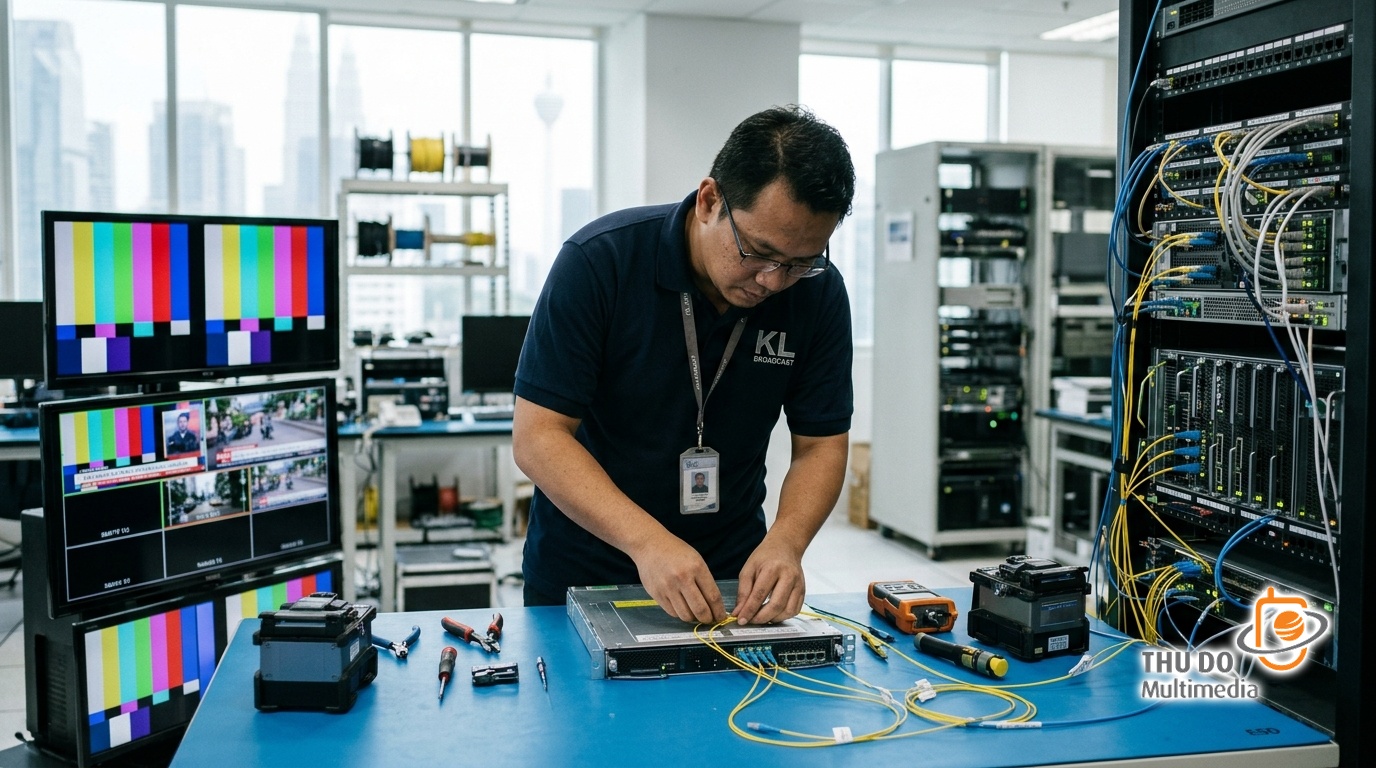
Bandwidth Optimization & Architecture for 4K Live Broadcasts
Designing a resilient end-to-end transport and packaging pipeline for high-resolution live feeds requires meticulous tuning across every node: from SRT (Secure Reliable Transport) ingest and the Hardware Transcoding Matrix to the Dynamic Manifest Packager and the CDN Edge. In emerging markets where last-mile stability fluctuates wildly, adaptive bitrate (ABR) ladders cannot rely on Western network assumptions. Broadcasters must restructure their ladders, often dropping minimum 4K thresholds from legacy 22 Mbps down to a leaner 12-15 Mbps using advanced rate-control algorithms that maintain visual fidelity without triggering client-side buffer stalls.
Moreover, integrating modern transport protocols such as HTTP/3, QUIC, and chunked transfer encoding via CMAF (Common Media Application Format) is vital for reducing first-frame latency and combating packet jitter over unstable local cellular loops. By breaking video segments into smaller, independently decodable chunks and streaming them over multiplexed QUIC connections, platforms can maintain smooth playback even when packet loss spikes by 5% to 10% on congested local masts. This architectural rigor directly supports low latency video encoding standards for 4K OTT, ensuring that millions of concurrent fans experience zero lag during critical moments of a live broadcast.
Strategic Migration Framework: Transitioning from HEVC to AV1 and Beyond
Migrating legacy workflows to next-generation compression formats requires a pragmatic, phased roadmap rather than a sudden, disruptive flash-cut. When optimizing HEVC to AV1 migration for live streaming platforms, architects typically deploy a hybrid decoding strategy. Modern Android and iOS mobile devices, alongside recent smart TV models, receive AV1 streams to minimize data consumption and eliminate licensing fees, while legacy hardware seamlessly falls back to HEVC or AVC manifests generated concurrently by the transcoding farm.
When analyzing cloud transcoding economics, platform directors must balance increased compute costs for AV1 and VVC encoding against massive egress bandwidth savings from regional CDNs. Because egress fees in emerging markets can represent up to 60% of total operational expenditures, investing in high-efficiency encoding pays for itself rapidly—provided the compute infrastructure is optimized. Here, platforms can leverage advanced video management solutions like those offered by VidioPics, which streamline multi-codec packaging and adaptive bitrate distribution, ensuring that regional broadcasters can scale 4K live delivery without overextending their cloud budgets.

Câu hỏi thường gặp
What is the difference between AV1, HEVC, and VVC for 4K live streaming?
HEVC is a mature, widely supported commercial standard with heavy licensing baggage. AV1 is a royalty-free, highly efficient open standard gaining rapid browser and mobile support. VVC offers the absolute highest compression efficiency—cutting bitrates by ~49% over HEVC—but suffers from high encoding complexity and limited hardware decoder availability.
Why is bandwidth optimization critical for 4K live broadcasts in emerging markets?
Emerging markets rely heavily on mobile data networks where last-mile cellular congestion, high transit costs, and variable bitrates lead to buffering. Efficient codecs allow broadcasters to transmit high-resolution 4K streams at lower bitrates, preventing packet loss and ensuring smooth playback without escalating CDN bandwidth expenses.
Is VVC ready for real-time 4K live cloud transcoding?
Currently, real-time VVC software encoding remains impractical for standard live pipelines due to its extreme computational overhead, which requires 5 to 8 times more CPU power than HEVC. It is largely restricted to high-end server farms and is deployed selectively for premium VOD or archival rather than mass-scale real-time 4K live OTT feeds.
How does AV1 benefit mobile-first OTT platforms in bandwidth-constrained regions?
AV1 provides superior compression efficiency compared to HEVC without any patent licensing fees. Because a growing number of modern mobile chipsets and web browsers support hardware-accelerated AV1 decoding, platforms can deliver crisp HD and 4K streams at significantly reduced data caps for mobile users, making it a cornerstone of Bandwidth Optimization in Emerging OTT Markets: Comparing AV1, HEVC, and VVC for 4K Live Broadcasts.
Recent Comments