
AI in OTT Streaming 2026: The Ultimate Guide

Key Takeaways

  • Cost-Slicing Infrastructure: Implementing neural-network-driven transcoding reduces video file sizes by 20% to 40%, drastically lowering CDN bandwidth and storage expenses without sacrificing perceived quality.
  • Proactive Churn Prevention: Predictive algorithms can now identify at-risk subscribers 2 to 3 weeks before their billing cycle renews, allowing operators to deploy targeted retention strategies.
  • Lightning-Fast Content Delivery: Automated machine learning pipelines have slashed sports highlight processing times by 72%, accelerating time-to-market by 3.2x.
  • Accessible Modern Architecture: Transitioning from monolithic systems to modular, API-first ecosystems enables independent operators to launch enterprise-grade streaming platforms in as few as 2 days.

The landscape of digital broadcasting is undergoing a seismic architectural shift, and if you are still relying on static algorithms to run your media platform, you are already falling behind. In our experience working intimately with media architectures, the integration of AI in OTT streaming 2026 represents the absolute baseline for survival in an increasingly saturated market. We are witnessing a fundamental transition away from manual curation and rigid video encoding toward entirely autonomous, self-optimizing media ecosystems. This is no longer about adding a shiny new feature to your software stack; it is about fundamentally re-engineering how video data is processed, analyzed, and delivered to end-users.

Exploring artificial intelligence trends in video streaming 2026

From Add-on to Core Operational Layer

For years, artificial intelligence was treated as a futuristic luxury—a glossy marketing talking point that platforms bolted onto their existing infrastructure to impress stakeholders. Today, that paradigm has completely flipped. When I audit modern streaming architectures, the most successful platforms have repositioned AI as their central nervous system. It is no longer just powering the frontend user interface; it operates deep within the backend, managing complex content supply chains, autonomous production workflows, and real-time delivery optimization. This operational shift is driven by necessity. The sheer volume of digital media being produced daily is staggering, leading to an industry-wide crisis we call “content clutter.” Platforms are literally drowning in their own massive libraries, rendering incredible films and series completely invisible to the end-user without an intelligent mechanism to surface them.

The battle against this content clutter requires a fundamentally new approach to how we structure media platforms. You cannot simply apply a machine learning model to a messy, monolithic database and expect miraculous results. True AI readiness demands an incredibly solid data foundation. In our daily operations, we constantly emphasize that AI thrives exclusively on scalable compute capacity, modular microservices architecture, and deeply structured metadata. If your legacy system relies on hard-coded categories and rigid content delivery networks, your new AI tools will suffocate. The transition requires operators to audit their current data pipelines comprehensively, break apart those archaic monolithic structures, and build open, API-driven ecosystems where data can flow freely between recommendation engines, encoding servers, and user interfaces.

We see this beautifully illustrated in the rapid evolution of interactive viewing experiences, particularly within live sports broadcasting. Broadcasters are no longer just sending a flat video feed to subscribers; they are deploying advanced computer vision models that “watch” the game in real-time. These models track player movements, calculate ball speeds, and instantly overlay dynamic statistical graphics directly onto the user’s screen. By combining a clean, modular backend with high-speed compute, platforms can generate a highly interactive, lean-forward viewing experience that keeps audiences glued to their screens far longer than traditional passive broadcasts.

The Core of Engagement: personalized content recommendation algorithms OTT

Moving Beyond Basic “Recommended For You” Rows

I remember when displaying a simple “Recommended For You” carousel—based entirely on broad genres like “Action” or “Comedy”—was considered the pinnacle of platform personalization. That era is definitively over. Today’s sophisticated engines do not just look at what a user clicked; they construct a highly complex, multi-dimensional “content DNA” for every individual viewer. By analyzing incredibly subtle behavioral signals—such as the exact second a viewer skipped an intro, how often they rewind a specific dialogue scene, the time of day they prefer short-form versus long-form content, and their hyper-specific sub-genre affinities—the platform begins to understand the psychological drivers behind a user’s viewing habits. It is a transition from guessing what a user might like to mathematically predicting what they need to watch next to stay engaged.

To execute this level of prediction, platforms are embracing the strategy of granular content personalization. Rather than treating a two-hour movie as a single block of data, AI neural networks segment that long-form video into hundreds of micro-moments. A single film might contain a high-octane car chase, a romantic subplot, and a dramatic monologue. By breaking the content down into these microscopic scenes and tagging them individually, platforms can target users with unprecedented precision. However, this entire system collapses without pristine data hygiene. Even the most advanced neural network on the planet will fail spectacularly if the underlying metadata—such as language labels, cast tags, and accurate mood descriptors—is fragmented, misspelled, or incomplete.

The business impact of getting this right is massive. When a user logs into an OTT application after a long workday, they have an incredibly short patience window—often less than 60 seconds—before “browse fatigue” sets in. If they are forced to scroll endlessly through irrelevant titles, they will close the app and move to a competitor. By leveraging deep content DNA and granular scene-level tagging, platforms serve hyper-relevant content the absolute second the app launches. This drastically reduces browse time, directly correlating with a massive increase in average session length and long-term subscriber retention.

Reducing Churn with predictive analytics for streaming services

Shifting from Reactive Dashboards to Proactive Retention

Historically, streaming operators managed subscriber retention by looking in the rearview mirror. They relied on reactive analytics dashboards that simply reported “what happened”—telling executives how many users canceled their subscriptions last month. By the time that data was compiled, the revenue was already lost. The introduction of deep machine learning flips this script entirely, allowing platforms to transition toward proactive, predictive retention. Rather than waiting for the cancellation notification, AI models continuously monitor the microscopic behavioral signals that indicate a user is losing interest long before they consciously decide to hit the unsubscribe button.

When our teams evaluate churn intervention strategies, the data is staggering. Modern predictive churn models can accurately flag at-risk subscribers 2 to 3 weeks before their next billing cycle even occurs. They achieve this by analyzing complex patterns: a gradual decline in weekly viewing frequency, an uptick in erratic payment behavior, or a sudden, sharp drop in average session length. For example, if a user who typically watches four hours of content every weekend suddenly drops to twenty minutes of aimless scrolling before logging off, the AI identifies this interaction anomaly immediately. This 14-to-21-day intervention window is the holy grail for customer success teams, providing ample time to deploy targeted, automated campaigns to save the account.

With this predictive data in hand, operators can execute highly actionable intervention strategies rather than sending out generic, desperate email blasts. If the AI detects a user is churning due to perceived lack of content, the system can autonomously trigger targeted push notifications highlighting a new series that perfectly matches their unique content DNA. If the algorithm determines the user is churning due to price sensitivity, it can instantly deliver a customized retention offer—like a temporary subscription discount or a free tier upgrade—directly to their inbox. By intercepting these users before they officially uninstall the application, OTT platforms transform their analytics from a simple reporting tool into an active, automated revenue-saving engine.

Infrastructure Optimization and AI driven video compression technologies

Ensuring Flawless Playback at Lower Costs

Behind the glossy user interface of any premium streaming platform lies the brutally expensive reality of video delivery infrastructure. Transcoding raw video files into multiple resolutions and delivering them across global content networks has traditionally eaten into profit margins. For years, the industry relied on fixed-bitrate ladders, applying a static level of compression across an entire video regardless of what was happening on screen. Today, we are seeing a massive shift toward content-aware encoding. In this model, AI neural networks analyze the video feed frame-by-frame, continuously adjusting the compression parameters based on scene complexity. An explosive, fast-moving action sequence receives higher bitrates to preserve crisp details, while a quiet, static shot of a dark room is heavily compressed.

The financial implications of this technological leap are profound. Our research shows that implementing AI-based transcoding reduces output video file sizes by 20% to 40% while maintaining the exact same level of perceived human visual quality. When you are operating an OTT platform that streams petabytes of data globally, slicing your file sizes by nearly half results in a colossal reduction in CDN bandwidth and cloud storage costs. Furthermore, this dynamic compression works in tandem with predictive traffic routing. During high-demand live events—like a global sports finale—AI continuously monitors server loads, anticipates peak viewer surges before they happen, and autonomously reroutes CDN traffic to prevent network bottlenecks and catastrophic server crashes.

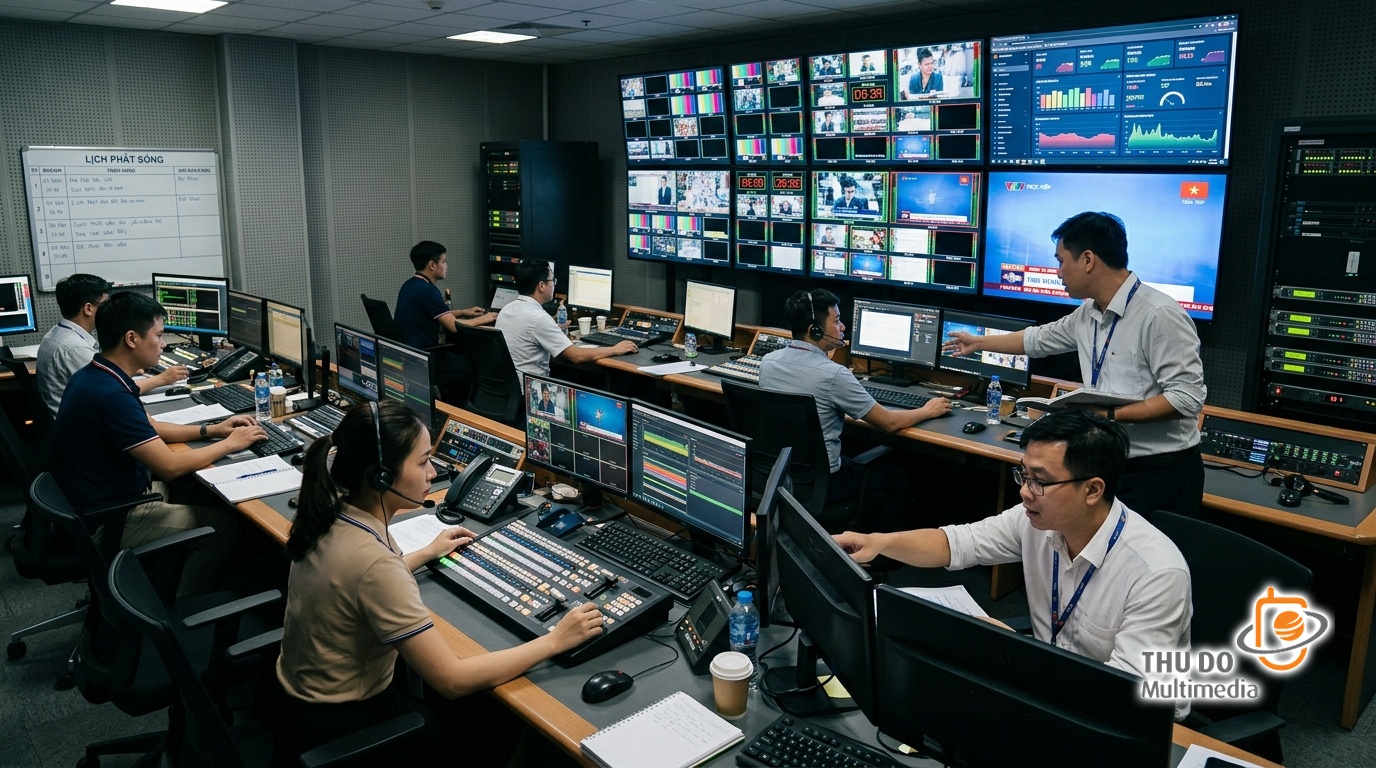
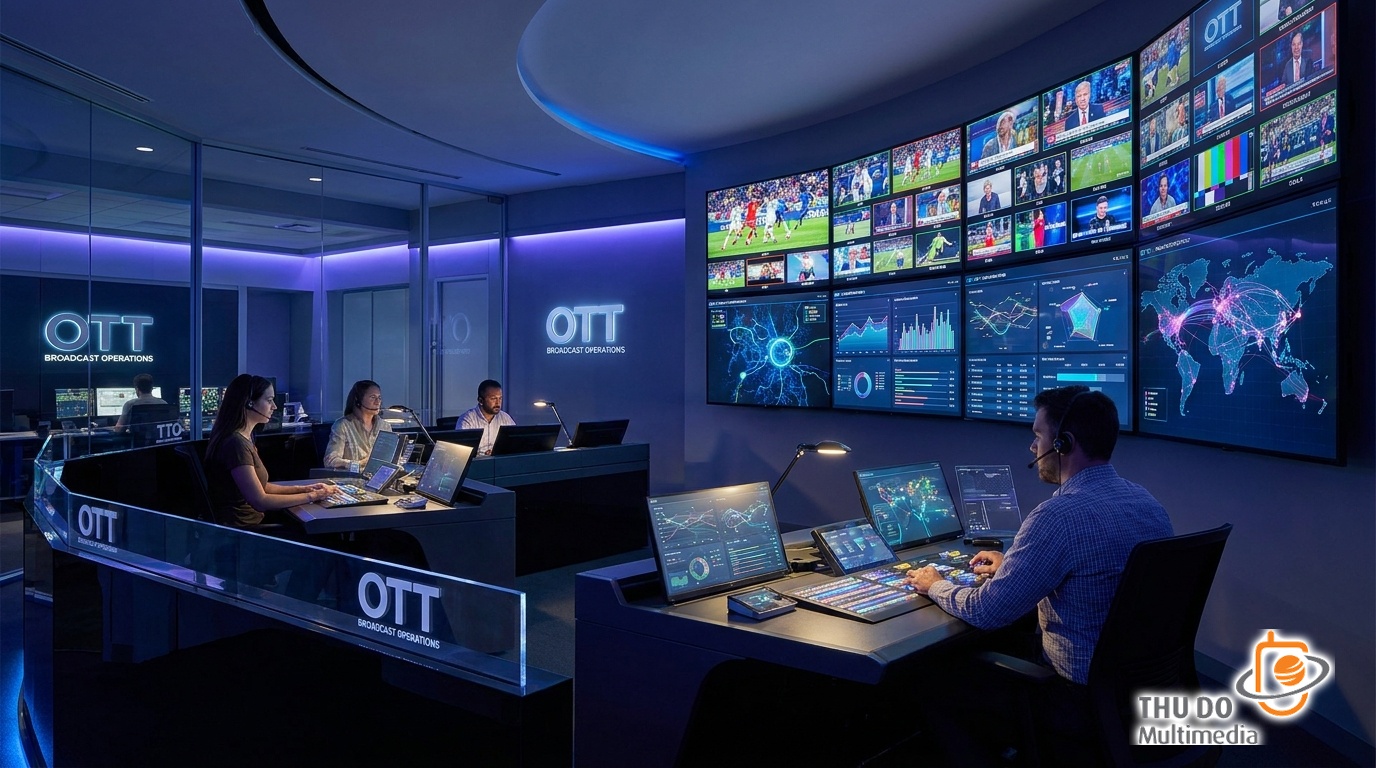
Beyond just compression, these neural networks are revolutionizing quality assurance through Automated Stream Quality Monitoring. In legacy systems, platforms literally hired rooms full of human operators to stare at screens, waiting for a feed to drop or buffer. This manual approach is fundamentally unsustainable at scale. Modern AI infrastructure autonomously scans thousands of concurrent live streams in real-time, instantly detecting black screens, frozen frames, audio desynchronization, and macroblocking. By identifying and resolving these micro-interruptions milliseconds before the human eye can even register them, platforms guarantee a flawless playback experience while completely eliminating the overhead of manual monitoring centers.

Automated video metadata tagging AI and Searchability

Turning Raw Video into Searchable Assets

One of the most physically exhausting and resource-draining tasks in media management is the manual logging of video assets. Historically, interns and metadata specialists would spend thousands of hours watching content just to write down timestamps, cast members, and basic plot tags. That manual bottleneck is entirely eliminated through computer vision and deep learning. Today, AI algorithms can ingest a raw video file and instantly scan every single frame, turning a massive block of unsearchable pixels into a highly structured, queryable database. These systems auto-generate granular categories, identify specific actors’ faces, recognize background objects (like specific car brands or landmarks), and even detect the emotional tone of a scene based on lighting and musical cues.

This automated metadata enrichment does not just save hundreds of hours of manual labor; it radically transforms the end-user experience by making massive libraries infinitely more searchable. When a user searches for “uplifting romantic scenes in Paris,” the platform no longer relies on a broad movie title description. Instead, it queries the deep, AI-generated metadata tags to instantly pull up the exact timestamped scenes that match that specific mood and location. This turns an OTT platform’s massive, dormant back-catalog into highly active, highly monetizable inventory, surfacing niche content to users exactly when they want it.

Furthermore, this raw asset processing extends brilliantly into global localization via AI Voice Translation and Dynamic Subtitle Generation. We are now deploying algorithms that automatically detect spoken dialogue, generate hyper-accurate text transcripts, and sync captions perfectly to the lip movements on screen. Going a step further, AI can now translate that audio into dozens of natural-sounding localized languages, complete with emotional inflection. These automated linguistic workflows allow content creators and OTT owners to push a single piece of content to a global market instantly, completely bypassing the massive delays and costs associated with traditional manual dubbing studios.

Maximizing Revenue and machine learning in subscription video on demand

Smarter Ads and Fraud Protection

The financial architecture of modern media requires extreme agility, and static monetization models simply cannot keep pace with changing consumer habits. Artificial intelligence fundamentally transforms how platforms generate revenue across all tiers, dynamically optimizing SVOD (Subscription), AVOD (Advertising), and TVOD (Transactional) models in real-time. Instead of blindly forcing commercial breaks at standard 10-minute intervals, AI models analyze the emotional arc and pacing of a specific show to decide the exact right moment to serve an ad—ensuring it occurs during a natural scene transition rather than cutting off a crucial piece of dialogue. This deeply reduces viewer frustration and prevents user drop-off during commercial breaks.

Simultaneously, we are seeing a massive evolution in targeted advertising. The AI curates specific ad inventory based on a user’s current mood, their geographical location, and their real-time engagement behavior. By ensuring that a viewer who exclusively watches premium automotive content receives high-end car advertisements rather than generic fast-food commercials, platforms eliminate “ad fatigue.” This hyper-targeting not only vastly improves the user viewing experience but drives exponentially higher ROI for advertisers, allowing OTT operators to command premium rates for their ad slots.

Protecting this bottom line is equally crucial, and AI is playing a relentless defensive role. Premium AI fraud detection layers continuously monitor the platform for suspicious bot traffic, unauthorized password sharing, and real-time piracy streams. Working seamlessly in tandem with advanced security protocols like AES 256 encryption and multi-DRM integrations (such as Widevine, FairPlay, and PlayReady), these machine learning models immediately throttle or block bad actors without impacting legitimate subscribers. Additionally, by utilizing AI in content production—such as auto-generating sports highlights which leads to a 72% reduction in video processing time and allows platforms to push clips 3.2x faster—operators dramatically lower their operational costs, freeing up massive amounts of budget to reinvest directly into premium content acquisition.

Preparing for the future of over the top media platforms 2026

Building an AI-Ready Streaming Architecture

The blueprint for independent operators looking to thrive in the next decade is incredibly clear: flexibility is your greatest asset. At NovaStream, when we architect our premium white-label OTT streaming platforms, we mandate a strict departure from locked-down, proprietary SaaS ecosystems that trap your data. To truly leverage machine learning, you must build upon unified subscriber databases and open REST APIs. This allows independent operators to plug-and-play the absolute best-in-class AI microservices—whether that is a third-party churn prediction engine or an advanced transcoding tool—without having to tear down their entire infrastructure every time the technology evolves.

It is also important to bridge the disconnect between enterprise hype and mid-market reality. While massive corporations like Netflix are spending hundreds of millions on autonomous generative AI content production, independent platforms do not need Hollywood-sized budgets to win. By breaking down rigid monolithic architectures and organizing their metadata cleanly, mid-market OTT platforms can leverage enterprise-level concepts like granular content segmentation, automated metadata tagging, and predictive churn modeling using highly accessible, cost-effective cloud services. The technology has democratized; what matters now is how cleanly your platform is structured to receive it.

The speed at which operators can now move is unprecedented. By utilizing modern AI-driven architectures, comprehensive white-label OTT platforms can now be launched in as few as 2 days, complete with core features, advanced DRM security, and predictive recommendation engines fully operational from minute one. As we look ahead, the mandate is absolute. Integrating deeply woven artificial intelligence is no longer an optional luxury for the elite few; it is the fundamental baseline requirement for maintaining profitability, drastically scaling global operations, and surviving the fiercely competitive streaming wars.


FAQs: People Also Ask

Q: What is the most common use of AI in OTT platforms?
A: The most common application of AI in OTT is content personalization. Streaming platforms utilize machine learning to analyze user viewing patterns, engagement times, and skips to dynamically adjust content recommendations, increasing overall session length and viewer retention.

Q: How does AI improve video streaming quality and reduce buffering?
A: AI optimizes streaming through adaptive bitrate technology and content-aware encoding. By analyzing video frame-by-frame, AI neural networks adjust compression levels based on scene complexity, reducing video file sizes by 20-40% without losing quality, which heavily mitigates buffering on weak networks.

Q: How do streaming services use AI to reduce subscriber churn?
A: Streaming services use predictive analytics to analyze user interaction signals—such as drops in viewing frequency or session length. These AI models can identify subscribers who are likely to cancel up to 2-3 weeks in advance, allowing platforms to automatically deploy targeted retention offers or personalized content emails.

Q: Can independent OTT operators afford to implement AI technology?
A: Yes. While massive generative AI tasks are currently reserved for enterprise budgets, independent operators can leverage highly accessible AI tools for automated metadata tagging, churn prediction, and AI-assisted video transcoding, provided they have a modern infrastructure with open APIs and clean data.

Q: How do OTT platforms balance AI personalization with user data privacy?
A: OTT platforms achieve this by relying on anonymized data and aggregated behavioral signals rather than personally identifiable information (PII). By adhering to strict data handling practices and utilizing secure on-premise or cloud environments, platforms can personalize feeds while maintaining legal compliance and user trust.

Ultimately, the successful deployment of AI in OTT streaming 2026 will not be measured by how many flashy algorithms a platform boasts, but by how invisibly and effectively those tools work together to create an undeniably superior, frictionless experience for every single viewer.

AI in OTT Streaming 2026: Redefining the Media Era

Key Takeaways:
* The Rise of Agentic AI: OTT platforms are shifting from single-function features to autonomous AI agents capable of orchestrating complex, multi-step broadcasting workflows without human intervention.
* Exponential ROI and Efficiency: Implementing AI for real-time video processing reduces manual operational time by 72% and accelerates dynamic highlight generation by up to 3.2x, saving millions in compute and labor costs.
* Hyper-Personalization Meets Privacy: Deep behavioral tracking is evolving into individual “content DNA,” balanced carefully against stringent GDPR and CCPA regulations through anonymized data processing.
* Global Reach at Zero Marginal Cost: Generative AI now enables real-time dubbing and perfectly synced subtitle generation across over 150 languages, eliminating the need for expensive traditional localization studios.

In our experience engineering enterprise-grade broadcasting systems, we have watched the streaming landscape undergo a monumental technological metamorphosis. As we look at the role of AI in OTT streaming 2026, it is no longer just a futuristic buzzword used to impress investors; it is the fundamental architectural pillar dictating which media companies survive and which perish. The days of relying on static, monolithic algorithms are over. Today, we are designing ecosystems where artificial intelligence actively watches, learns, adapts, and manages video delivery in real time, dramatically altering how audiences consume entertainment. This evolution demands a strategic overhaul of backend infrastructure, content delivery networks, and monetization engines, pushing platforms to adopt highly autonomous, self-healing systems.

The future of AI in OTT platforms 2026: From Static Features to Agentic Workflows

The most profound shift we are witnessing in the OTT space is the rapid evolution from isolated, single-task tools to “Agentic AI.” For years, streaming architectures relied on fragmented artificial intelligence features—such as a localized recommendation engine or a basic metadata tagger. However, Agentic AI fundamentally changes this dynamic by operating as an autonomous project manager. Instead of waiting for a human operator to click a button to “generate a description,” an AI agent executes massive, complex workflows independently. It can scan an incoming video file, check the metadata against compliance databases, flag any missing maturity ratings, autonomously generate localized descriptions, format promotional artwork for different screen sizes, and seamlessly route the finalized package to a human executive solely for final approval.

To contextualize this shift, the streaming industry has globally adopted a rigorous 4-tier AI framework to maintain operational control while maximizing efficiency: Assist, Approve, Automate, and Orchestrate. At the “Assist” level, algorithms merely recommend actions to human operators. The “Approve” tier drafts complex tasks—like compiling promotional trailers—and pauses for human sign-off. “Automate” allows the system to autonomously execute high-volume, low-risk actions, such as dynamically adjusting thumbnail brightness based on user devices. Finally, the “Orchestrate” level represents true Agentic AI, where the system coordinates multiple sprawling workflows simultaneously, managing everything from server load balancing to global content publishing without human initiation.

In real-world applications, this transition to Agentic AI has birthed entirely new operational interfaces, such as conversational operations. We are now integrating natural language processing directly into backend OTT management systems. A broadcasting operator can simply send a message via Slack or a WhatsApp integration stating, “Prepare the new sci-fi series for our European launch tomorrow,” and the Agentic AI immediately orchestrates the entire pipeline. It triggers subtitle generation for European languages, allocates CDN resources for anticipated regional traffic spikes, and builds customized email marketing segments, transforming what used to be a week-long multi-departmental slog into a three-minute automated process.

Top artificial intelligence video streaming trends 2026

As the technology matures, the separation between premium streaming services and legacy broadcasters is becoming heavily defined by their adoption of advanced algorithmic trends.

Hyper-personalized content recommendations OTT AI

The traditional “Recommended for You” carousel, built on broad genre matching and generalized collaborative filtering, is officially obsolete. To deploy truly personalized content recommendations OTT AI systems must now analyze viewing habits at a granular, micro-moment level. Modern algorithms dissect individual scenes, color palettes, pacing, and even the emotional tone of the content a user interacts with. By tracking specific behavioral cues—such as a user consistently rewinding highly choreographed fight scenes or skipping through romantic subplots—the AI builds a highly complex, multi-dimensional “content DNA” unique to every single subscriber on the platform.

When we analyze the data behind these deep-learning recommendation engines, the impact on retention is staggering. By moving away from manual curation and relying on self-learning algorithms, OTT platforms can adapt to viewer mood swings and geographic preferences in real-time. If a user’s viewing history indicates they prefer shorter, comedic content on weekday mornings but lean towards long-form, intense dramas on Sunday evenings, the UI dynamically restructures itself to match that exact psychological state. This level of hyper-personalization directly correlates to increased average watch time and drastically reduced bounce rates.

A prominent real-world example of this is how major platforms now A/B test localized thumbnails dynamically. If the AI detects that a user engages more with artwork featuring secondary characters rather than the main protagonist, it will retroactively swap the thumbnails of the user’s entire suggested library to match that psychological preference, drastically improving click-through rates.

Machine learning in streaming media 2026 for Interactive Viewing

Computer vision and machine learning are rapidly transforming video consumption from a passive, lean-back experience into an intensely interactive, lean-forward engagement. Utilizing machine learning in streaming media 2026 means that the video player itself is “aware” of what is happening inside the frame. Neural networks continuously process visual data in milliseconds, identifying objects, actors, locations, and even specific branded products within the video stream, turning static pixels into clickable, interactive metadata layers.

The deep analytical power of this technology becomes overwhelmingly evident when we examine live sports broadcasting. We have seen live sports highlight generation completely revolutionized by these models. According to recent industry benchmarks, utilizing AI for real-time video processing reduces manual operational time by a massive 72% and accelerates dynamic highlight creation by 3.2x. For an enterprise sports network, this means saving millions of dollars in compute power and human editing hours. Instead of a team of editors scrubbing through footage, the AI tracks player movements, crowd cheering volumes, and referee whistles to stitch together a perfect highlight reel before the game has even concluded.

In practice, this opens up unprecedented avenues for “second-screen” interaction and fan engagement. Viewers can now point their mobile devices at their smart TV during a live football match, and the machine learning model will instantly overlay real-time player statistics, running speeds, and historical analytics directly onto their phone screen. This not only gamifies the viewing experience but also provides broadcasters with entirely new, highly lucrative interactive ad inventory.

Backend Infrastructure & Delivery: AI driven video compression OTT

While front-end features capture user attention, the true battlefield for OTT dominance lies in backend delivery efficiency and cost reduction.

Content-Aware Encoding and Adaptive Bitrate

Delivering high-definition 4K video across fragmented global networks without buffering is an infrastructural nightmare, which is why AI driven video compression OTT technologies have become indispensable. Traditional encoding applies a uniform compression rate across an entire video file, which wastes immense bandwidth on visually simple scenes (like a black screen or a static sky) and starves complex scenes (like a fast-paced explosion) of necessary data. Content-aware encoding solves this by using AI to analyze the visual complexity of every single frame, dynamically adjusting the compression ratio on the fly. This allows platforms to save massive amounts of Content Delivery Network (CDN) bandwidth costs without sacrificing a single pixel of visual quality.

The analytical depth of this AI-driven approach extends far beyond the video file itself; it actively monitors the viewer’s real-time environment. Advanced adaptive bitrate streaming algorithms utilize predictive modeling to assess the exact health of a user’s network connection, seamlessly shifting data loads whether the user is commuting on a volatile 5G cellular network or streaming from a weak rural Wi-Fi connection. By anticipating packet loss before it happens, the AI proactively downgrades the bitrate in undetectable increments, effectively eradicating the buffering wheel.

We have witnessed the profound impact of anomaly detection during major live events, such as the World Cup or global music premieres. Predictive AI models continuously scan the network architecture, anticipating peak traffic loads and geographically routing data across different server clusters before a bottleneck occurs. This prevents the catastrophic black screens and stream crashes that have historically plagued massive live broadcasts, ensuring seamless delivery at scale.

Driving Revenue: predictive analytics in streaming services

In an era of intense subscriber churn and fragmented viewership, relying on historical data to drive revenue is no longer viable; platforms must anticipate user actions before they happen.

Smarter Targeted Advertising & Dynamic Decisioning

The integration of predictive analytics in streaming services has fundamentally cured “ad fatigue,” transforming advertising from a nuisance into a highly contextualized experience. AI now acts as an intelligent matchmaker between brands and viewers. Instead of relying on demographic stereotypes, the AI leverages deep behavioral segmentation and real-time mood tracking to serve ads that resonate with the viewer’s current psychological state.

This deep analytical capability is supercharged when combined with Server-Side Ad Insertion (SSAI). The AI does not merely decide which ad to show; it dynamically calculates the precise optimal timing, pacing, and frequency of the ad break to maximize return on investment (ROI) without triggering user abandonment. By placing the ad perfectly between scene transitions rather than abruptly cutting off dialogue, the AI preserves the narrative flow, drastically improving brand perception and ad-completion rates.

In real-world applications, this means a user watching an intense fitness documentary on a Saturday morning will receive an interactive, shoppable ad for running shoes precisely when their engagement peaks, whereas the same user watching a relaxing comedy on a Tuesday evening will be served ads for local food delivery. This level of dynamic decisioning maximizes Cost Per Mille (CPM) rates for broadcasters while keeping audiences engaged.

Churn Prediction and Fraud Protection

Beyond generating new revenue, predictive analytics is the ultimate defense mechanism for preserving existing subscriber bases. Advanced AI models constantly monitor millions of data points for early indicators of disengagement—such as a gradual decrease in login frequency, shorter viewing sessions, or a sudden lack of interaction with recommended content. By identifying users who are statistically likely to unsubscribe before they actually click “cancel,” the system can automatically trigger customized retention workflows, such as sending highly personalized push notifications or offering a dynamically calculated subscription discount.

Equally critical is the role of AI as a relentless digital watchdog against revenue leakage. Modern OTT platforms utilize multi-layered security algorithms to detect complex fraud and piracy in real time. The AI continuously analyzes login patterns, instantly flagging unusual geographic jumps that indicate account sharing or identifying the behavioral signatures of bot traffic attempting to scrape content.

For example, if an AI detects that a premium live stream is being illegally rebroadcast, it can execute dynamic watermarking and targeted geo-blocking within seconds, neutralizing the threat without requiring human intervention. This proactive defense is vital for protecting exclusive licensing agreements and maintaining platform integrity.

The Expanding Role of generative AI in media and entertainment 2026

While early AI models focused purely on distribution and metadata, generative algorithms are now actively participating in the creation and localization of the media itself.

Automated Metadata, Tagging, and Content Discovery

The days of human editors manually filling out endless spreadsheets with video tags are entirely over. The application of generative AI in media and entertainment 2026 has fully automated the ingestion process. AI vision models now scan thousands of hours of video frames per minute, auto-generating incredibly rich metadata architectures. They recognize faces, identify specific emotional tones (e.g., “melancholic,” “uplifting”), flag explicit content for maturity ratings, and generate hyper-accurate, SEO-friendly synopses.

This robust metadata generation is the foundational bedrock for natural language search capabilities. Because the generative AI has tagged the content with such immense depth, users can bypass rigid genre menus and simply use voice search to say, “Find me a 90-minute action movie set in space,” or “Show me family-friendly Tamil content with strong female leads.” The AI comprehends the conversational intent and instantly curates a custom playlist, radically reducing user scroll time and friction.

From an operational standpoint, this automation solves the massive “Content Creation Gap.” Generative AI is now actively used to assemble dynamic promotional trailers by analyzing the most emotionally resonant clips from a film and stitching them together, fully scored with AI-generated background music. This allows OTT platforms to continuously A/B test fresh marketing materials without incurring additional editing costs.

Dynamic Localization: Smart Voice Translation & Subtitles

Perhaps the most economically disruptive force of Generative AI is its ability to instantly globalize localized content. As showcased heavily at recent industry summits like IBC 2026, AI tools are now capable of executing live dubbing and real-time subtitle generation across over 150 languages. This completely bypasses the traditional, painfully slow, and highly expensive localization pipeline of hiring voice actors and recording studios.

Delving into the data, these generative models do not simply provide robotic, one-to-one literal translations. They understand colloquialisms, cultural nuances, and pacing. The AI generates natural-sounding synthetic voices that clone the original actor’s emotional cadence and perfectly syncs the dynamic subtitles to match the exact timing of the dialogue.

In practice, a production house can upload a Spanish-language drama on Friday and have it seamlessly dubbed and subtitled in Japanese, Arabic, and Hindi by Saturday morning. This enables platforms to push localized content to global audiences instantly, expanding market reach with zero manual localization effort and exponentially increasing international revenue potential.

Overcoming Architecture Hurdles: Migrating to an AI-Native OTT Stack

Integrating these transformative technologies is impossible if your platform is built on outdated foundations; modern AI requires a modernized, native architectural stack to function.

Data silos represent the single largest hurdle for legacy streaming platforms. Artificial intelligence is entirely useless without clean, structured, and properly labeled data layers. When user behavioral data, video metadata, and billing information are locked in separate, fragmented databases, AI models cannot establish the necessary correlations to drive Agentic workflows. Modernizing monolithic backends means migrating to highly modular microservices, where machine learning models can actively integrate, communicate, and operate across the entire technology stack seamlessly.

At OmniStream, we designed the OmniStream AI Orchestrator precisely to solve this migration roadmap. We guide enterprise broadcasters through a step-by-step transformation: first, unifying and cleansing legacy data lakes; second, deploying API-driven microservices to replace rigid monolithic architectures; and finally, layering Agentic AI protocols over the new infrastructure. This ensures a frictionless transition where AI serves as the core nervous system of the platform, launching complex streaming architectures in a matter of days rather than months.

Crucially, this architectural shift must deeply integrate AI ethics and privacy compliance. As platforms harvest massive amounts of behavioral data to feed hyper-personalization engines, they must navigate strict regulations like GDPR and CCPA. We implement stringent data anonymization protocols and aggregated signal processing, ensuring that the AI learns from vast demographic trends without compromising individual user privacy. Balancing hyper-personalization with transparent, ethical data handling is not just a legal requirement; it is the ultimate foundation for maintaining long-term subscriber trust.


Frequently Asked Questions (FAQs)

What is Agentic AI in the context of streaming media?
Unlike basic AI features that perform a single, isolated task (like generating a video description), Agentic AI orchestrates complex, multi-step workflows autonomously. For example, an AI agent can automatically scan a video file, check metadata compliance, flag missing fields, generate multi-language translations, format promotional artwork, and prepare the video for global publishing, routing it to a human executive only for final approval.

How does AI improve OTT content recommendations?
AI moves far beyond simple genre tags by analyzing granular viewing habits—such as pause, rewind, skip patterns, and even scene preferences—to build a unique, multi-dimensional “content DNA” for every individual user. This allows the platform to suggest highly personalized content that matches the viewer’s current mood and behavioral context, drastically reducing scroll time and increasing subscriber retention.

How is AI used to reduce buffering in video streaming?
AI utilizes content-aware encoding and adaptive bitrate technology to monitor a user’s network connection and hardware in real time. It analyzes the visual complexity of every single frame and adjusts data compression instantly. This ensures a smooth, high-quality stream without buffering, regardless of whether the user is connected to a volatile 5G network or a weak rural Wi-Fi signal.

How does AI reduce subscriber churn in OTT?
By leveraging predictive analytics, AI continuously monitors user behavior for early signs of disengagement, such as shorter watch sessions, skipping content, or decreased login frequency. Once a user is statistically flagged as likely to churn, the system automatically triggers automated retention strategies, such as sending personalized content recommendations or offering custom subscription discounts before the user actually cancels.

How is Generative AI changing video localization?
Generative AI allows OTT platforms to automatically translate, subtitle, and dub video content into over 150 languages in near real-time. Moving beyond robotic translations, it uses natural-sounding, emotionally accurate synthetic voices and perfectly syncs captions to the dialogue. This enables streaming services to reach massive global audiences instantly, bypassing the extensive costs and delays of traditional manual dubbing studios.


The integration of AI in OTT streaming 2026 represents an undeniable paradigm shift in digital broadcasting. By migrating from legacy systems to fully autonomous, Agentic AI architectures, media companies are not just upgrading their software—they are fundamentally redefining how the world experiences entertainment.

OTT Market Southeast Asia 2026: The Growth Guide

Key Takeaways
* Explosive Valuation: The regional streaming ecosystem is aggressively expanding, currently boasting 61 million paid accounts and tracking toward a massive $139 billion valuation by 2033.
* The “Local” Overtake: Domestic content has officially reached parity with global heavyweights; local programming now commands up to 46% of user engagement in key markets like Thailand and Indonesia.
* Strategic Consolidation: Platform survival now relies on complementary bundling (e.g., K-dramas paired with C-dramas) rather than pure library exhaustion, fundamentally changing subscriber acquisition.
* AI-Driven Infrastructure: Advanced generative AI and adaptive streaming frameworks are drastically lowering localization costs by up to 80%, allowing rapid cross-border expansion for mid-tier platforms.

Welcome to the trenches of the most dynamic video entertainment economy on earth. When we analyze the trajectory of the OTT market Southeast Asia 2026, we are no longer looking at a passive region simply absorbing Western syndication. We are witnessing a ferocious, highly sophisticated battleground where hyper-local cultural nuances dictate multi-billion-dollar technology investments. Gone are the days when a global platform could simply flip a switch, offer a translated interface, and expect instant market penetration. Today, success requires a surgical approach to content acquisition, resilient delivery infrastructure, and a deep understanding of mobile-first consumption habits.

In our experience advising digital media conglomerates, we have seen countless aggressive market entries falter because they treated the region as a monolith. The reality is far more complex. To truly dominate this space, stakeholders must pivot away from isolated subscriber acquisition models and embrace strategic bundling, localized co-production, and hybrid monetization.

Executive Summary: Navigating the OTT Market Southeast Asia 2026

The streaming landscape in the “Big Five” Southeast Asian nations—Indonesia, Thailand, the Philippines, Malaysia, and Singapore—has officially reached its local inflection point. We are currently tracking a record-breaking 61 million paid premium VOD accounts, driven by a staggering 19% year-over-year surge. This is not merely a post-pandemic retention anomaly; it is a structural shift in how the rising Gen-Z middle class allocates its digital entertainment budget. The market trajectory is undeniable, with financial projections from the MARC Group forecasting the regional ecosystem to hit an astronomical $139 billion by 2033, expanding at a compound annual growth rate (CAGR) of 23%.

Diving deeper into these metrics reveals a profound transformation in viewer psychology. For the first time in streaming history, the “global content fits all” mandate is actively failing. In 2026, cultural resonance vastly outweighs sheer library volume. Audiences are actively migrating away from platforms that solely push dubbed Western catalogs, gravitating instead toward services that reflect their immediate cultural zeitgeist. This behavioral shift is forcing global incumbents to completely rewrite their content acquisition playbooks, moving from blanket licensing deals to localized co-production mandates.

At StreamEdge Solutions, our proprietary OmniStream OTT platform has processed petabytes of regional viewer data, and the insights point to one undeniable reality: the era of isolated platform wars is dead. We are now operating in an age of strategic bundling and complementary catalog alliances. Consumers are aggressively fighting subscription fatigue, demanding unified billing and consolidated viewing experiences. Platforms that stubbornly refuse to integrate with local telecommunications providers or forge cross-platform bundles are seeing churn rates spike, while those embracing collaborative ecosystems are capturing the lion’s share of the region’s digital ad spend.

Key Growth Drivers and Market Demographics in 2026

To understand the mechanics of regional growth, we must dissect the unique demographic engines powering subscription surges. Southeast Asia is characterized by a massive, mobile-native youth population whose viewing habits dictate the UI/UX evolution of every major platform. These users demand instant playback, highly interactive interfaces, and content that moves at the speed of social media.

The Undisputed Engine: Indonesia’s Strategic Surge

Indonesia stands as the undisputed titan of the region, housing an incredible 26.9 million of Southeast Asia’s 61 million premium subscribers. The sheer scale of the Indonesian market makes it the ultimate kingmaker for any platform operating in the Asia-Pacific territory. What fascinates us most about Indonesia is the fierce loyalty to homegrown narratives. Local Indonesian content has successfully captured an unprecedented 30% viewership share, officially matching the historical dominance of Korean dramas.

Consider the strategic masterclass executed by Vidio. Backed by the massive conglomerate Sinar Mas, Vidio has fiercely defended its position as the number one service in Indonesia by monthly active users (MAUs). They achieved this not by outbidding global giants for Hollywood blockbusters, but by cornering the market on local passions. By securing exclusive broadcasting rights for Liga 1 (the top-tier domestic football league) and pairing it with hyper-local, youth-oriented soap operas, Vidio created an inescapable cultural moat. This dual-pronged strategy of live local sports and bespoke domestic drama proves that highly targeted, culturally embedded content always wins the retention battle.

Thailand as the Region’s “Micro-Hub”

If Indonesia is the scale engine, Thailand has emerged as the creative “micro-hub” for Southeast Asia. Major players like Netflix and iQIYI are no longer just licensing Thai content; they are actively treating Bangkok as a primary anchor for regional production. Between 44% and 46% of users in Thailand actively engage with domestic content over imported libraries, forcing international platforms to heavily subsidize local studios to remain relevant.

The cross-border success of Thai entertainment is entirely rewriting regional export models. Genres like Thai Boys’ Love (BL) and hyper-stylized regional horror are outperforming high-budget international content across the entire Mekong region and beyond. We have watched Thai BL series generate massive, highly engaged digital fandoms that drive immense social media velocity, translating directly into subscriber acquisition. For global investors looking to enter the market, establishing a production beachhead in Thailand is no longer optional; it is the most efficient gateway to capturing the broader pan-Asian youth demographic.

The Competitive Landscape: Who Controls the 85% Viewing Share?

The battle for screen time is fiercely concentrated, with just six platforms—Netflix, Viu, Vidio, iQIYI, WeTV, and Disney+—controlling over 85% of the total regional viewing share. This oligopoly forces new entrants and smaller distributors to navigate a highly complex, fortified ecosystem.

Global Incumbents vs. Regional Titans

Netflix continues to lead the pan-regional charge with 12.8 million subscribers, maintaining roughly a 50% viewing share by aggressively pivoting toward locally funded originals. Disney+, conversely, has adopted a strategy of chasing high-ARPU (Average Revenue Per User) customers by investing heavily in star-studded Korean dramas. However, the true disruptors are the regional freemium masters. Viu has brilliantly captured the pan-regional number two spot with 9.9 million subscribers. By leveraging sophisticated ad-supported (AVOD) funnels and pricing their premium tiers 30-50% below global incumbents, Viu has successfully monetized the highly price-sensitive middle and lower-middle classes.

Simultaneously, platforms like iQIYI and WeTV are dominating a highly lucrative niche: the C-Drama and “Donghua” (Chinese anime) fandoms. These platforms have recognized that while K-dramas have broad appeal, the dedicated, obsessive communities surrounding Chinese fantasy and romance series are highly willing to pay for early access and VIP features. This fragmentation of fandoms means that global platforms can no longer rely on a singular “hit show” to carry an entire quarter; they must constantly feed multiple, distinct subcultures simultaneously.

The Era of Strategic Bundling and Alliances

The most pivotal competitive shift occurred recently at the APOS summit in Bali, where Viu and iQIYI announced a groundbreaking subscription bundle. This alliance represents a seismic shift in corporate philosophy. Rather than bleeding capital trying to out-acquire each other, these platforms recognized the power of complementary catalogs. By pooling Viu’s dominant K-Drama library with iQIYI’s premium C-Drama offerings, they created an unbeatable “bundled value” proposition.

We actively advise our enterprise clients at StreamEdge Solutions to study this alliance closely. It signals the definitive end of blind pan-regional ambition. The future belongs to territory-specific deal-making, where platforms act as aggregators of distinct cultural tastes rather than solitary walled gardens. Competing on library exhaustion is a losing game; competing on bundled, frictionless consumer value is the blueprint for 2026.

Content Acquisition and Programming Shifts

The mechanics of how content is bought, sold, and developed have undergone a radical transformation. Traditional content distribution pitches that treat Southeast Asia as a monolithic dumping ground for legacy catalogs are failing spectacularly in 2026.

From Licensing to Co-Production Mandates

Platform executives are no longer interested in simply renting content; they demand deep involvement in the development process to ensure exact local market fit. While Korean Dramas still wield immense power—accounting for a massive 35% of total regional viewing hours—platforms are now actively seeking K-drama-adjacent local originals. They want the high production value and emotional pacing of a Seoul-produced romance, but cast with local Manila or Jakarta stars and steeped in domestic cultural nuances.

For content distributors and studios, this means pitches must be hyper-localized. You cannot sell a “Southeast Asian” show; you must sell a show designed specifically to bridge a content gap in the Malaysian market, or a format tailored exclusively for Indonesian Gen-Z viewers. Co-production mandates allow platforms to share financial risk while ensuring the final product possesses the authentic cultural DNA required to trigger viral, organic growth.

The Rise of Microdramas and Short-Form Content

Parallel to the demand for high-end drama is a behavioral shift toward mobile-first, short-form viewing that bridges the gap between social media platforms like TikTok and structured premium video services. Audiences are increasingly rejecting hour-long episodic commitments during their daily commutes, favoring highly condensed, serialized narratives.

Platforms are drastically adapting their user experiences to accommodate this rapid-consumption format. Features like Viu Shorts are actively modifying the traditional OTT interface to support vertical scroll-based discovery, instant frictionless playback, and continuous viewing loops. This presents a massive challenge for legacy streaming catalogs that are locked into traditional 45-minute horizontal formats. Platforms must now re-edit, re-format, or entirely commission new microdramas to satisfy the algorithmic, dopamine-driven viewing habits of the modern mobile subscriber.

Technological Infrastructure and Monetization Models

Beneath the surface of content wars lies the brutal reality of regional technology infrastructure. Delivering high-definition, buffer-free video across archipelagos with wildly fluctuating network qualities requires immense technical sophistication.

The CTV Boom vs. The Mobile-First Reality

We are currently witnessing a fascinating dual-growth phenomenon in device consumption. While mobile phones remain the undisputed primary screen for the vast majority of the population, Connected TV (CTV) viewership has unexpectedly surged, jumping 14% in the last quarter alone. This CTV boom is actively shifting content demands back toward “family-viewing” formats, particularly in the Philippines and Indonesia, where multi-generational households dominate.

Despite the rise in smart TVs, the baseline technical requirements for regional success remain incredibly stringent. In our deployments of the OmniStream OTT Platform, we emphasize that features like offline viewing capabilities, ultra-fast video start times, and highly responsive adaptive bitrates are not “premium extras”—they are absolute survival requirements. If an app buffers for more than three seconds on a congested Jakarta 4G network, the user will instantly churn to a competitor.

Hybrid Monetization (AVOD + SVOD) and AI Integration

Subscription fatigue is a global reality, but in the highly price-sensitive markets of Southeast Asia, it is the primary barrier to scale. Consequently, ad-supported (AVOD) tiers have become the ultimate growth lever. The integration of hybrid AVOD and SVOD models has directly driven a 5.8% increase in regional online video ad spend in 2026. Platforms are effectively using free, ad-supported access as a massive top-of-funnel acquisition tool, slowly migrating engaged users toward premium, ad-free tiers bundled with their mobile data plans.

Furthermore, the operational economics of running these platforms are being revolutionized by artificial intelligence. Generative AI is no longer a buzzword; it is a critical cost-reduction engine. By utilizing advanced AI for automated content tagging, predictive churn analysis, and specifically, localized dubbing, platforms are seeing up to an 80% reduction in translation workflows. This allows a mid-tier platform to acquire a hit Thai drama and flawlessly dub it into Bahasa Indonesia and Tagalog within days, rather than months, unlocking unprecedented cross-border scalability.

Conclusion: The 2026 Playbook for OTT Success in Southeast Asia

Surviving and scaling in the OTT market Southeast Asia 2026 demands a complete abandonment of Western-centric streaming philosophies. The winning playbook is defined by three core tenets: aggregation over exclusivity, culturally embedded co-production over passive licensing, and fluid hybrid monetization over strict subscription paywalls.

The platforms that currently control the 85% market share understand that they are not fighting a single regional war; they are engaged in six distinct, fragmented battles. To win the “trenches,” operators must deeply respect hyper-local tastes, invest heavily in resilient, adaptive streaming technologies like those developed by our team at StreamEdge Solutions, and constantly innovate their user interfaces to match the speed of mobile-first consumers. The $139 billion future belongs to those who recognize that in Southeast Asia, local relevance is the ultimate premium feature.

Frequently Asked Questions

Q: Which OTT platform is most popular in Southeast Asia?
Netflix currently commands the pan-regional market leadership with over 12.8 million subscribers and holds roughly 50% of the total viewing share. However, the ecosystem is fiercely competitive. Viu securely holds the number two spot with 9.9 million subscribers by dominating the AVOD funnel. Furthermore, domestic giants often win their home turf; for instance, the local platform Vidio actually outranks Netflix in monthly active users within Indonesia due to its stronghold on live domestic sports.

Q: What is the primary business model for OTT platforms in Southeast Asia?
The region operates heavily on a “Freemium” and hybrid monetization structure. Because the vast majority of consumers are highly price-sensitive, rigid paywalls fail at scale. Platforms like Viu, WeTV, and increasingly global players offer robust ad-supported tiers (AVOD) alongside premium, ad-free subscriptions (SVOD). These premium tiers are frequently bundled directly with local mobile data plans to remove friction from the billing process.

Q: What type of content gets the most views in Southeast Asia?
While Korean Dramas remain an absolute powerhouse, driving roughly 35% of all cross-border streaming hours, local content is rapidly claiming the throne. In key markets like Indonesia and Thailand, between 44% and 46% of users now engage primarily with domestic content. Hyper-local genres—specifically Thai Boys’ Love (BL) series, regional folklore horror, and live domestic sports—are currently the most potent drivers of new subscriber acquisition.

Q: How fast is the Southeast Asia streaming market growing?
The market is experiencing explosive, sustained growth. By early 2026, premium VOD subscriptions across the “Big Five” Southeast Asian nations surged by 19% year-over-year, reaching 61 million active paid accounts. Long-term financial projections from industry analysts estimate the regional OTT ecosystem will achieve a staggering $139 billion valuation by 2033, expanding at a robust 23% compound annual growth rate (CAGR).

Mastery of Low Latency Live Streaming OTT in 2026

Mastery of Low Latency Live Streaming OTT in 2026

Key Takeaways:
* The ROI of Speed: A single buffering incident can cause up to 40% of viewers to abandon a stream, making latency optimization a critical business revenue driver, not just an engineering metric.
* Protocol Evolution: Standard HTTP streaming has evolved. We are moving from 30-second delays down to sub-second realms using chunked CMAF and WebRTC.
* The Player Bottleneck: Advanced server architecture is useless if the client-side video player is poorly tuned; default player buffers can inadvertently add up to 6 seconds of unwanted delay.
* Future Standards: Emerging technologies like Media over QUIC (MoQ) and Wi-Fi 7 are poised to redefine the absolute floor of glass-to-glass delivery times.

In our experience working with digital broadcasters, the pursuit of low latency live streaming OTT is no longer a luxury reserved for niche applications; it is the fundamental baseline for modern audience retention. When viewers are watching a highly anticipated sports final or participating in a live virtual auction, a delay of even a few seconds can ruin the experience, leading to spoilers on social media before the goal is even seen on screen. We have witnessed firsthand how bridging the gap between business objectives (viewer retention and monetization) and technical architecture (encoding, packaging, and delivery) transforms standard broadcasting into highly engaging, interactive digital ecosystems.

What is Low Latency Live Streaming OTT?

To truly master this domain, we must first dissect the fundamental difference between glass-to-glass latency and player latency. Glass-to-glass latency represents the total elapsed time from the exact millisecond light hits the camera sensor at the live event to the moment those pixels illuminate the viewer’s screen. Player latency, on the other hand, is the specific portion of that delay intentionally injected by the viewer’s device to build a safety buffer against network fluctuations. Understanding this distinction is crucial because platform operators often blame their content delivery networks (CDNs) for delays, when in reality, the viewer’s local device is simply hoarding video chunks before playback begins.

When we break down the spectrum of latency tiers, the numbers reveal a dramatic evolution in streaming capabilities. Classic broadcast streaming (Linear/FAST channels) typically operates with a 15 to 30-second delay. As we move down the tier list, standard low latency sits between 5 to 15 seconds, which is adequate for concerts or sermons. Near-real-time streaming brings this down to 2 to 5 seconds, an absolute necessity for live sports and watch parties. Finally, ultra-low latency operates under 1 second (essential for auctions and betting), while true real-time latency operates under 200 milliseconds for two-way telehealth and video conferencing.

The business justification for investing in these faster tiers is rooted deeply in viewer behavior and platform monetization. Data indicates that a single buffering issue or noticeable delay behind real-world events can drive up to 40% of viewers to click away from a stream entirely. If your platform relies on ad insertions, subscriptions, or live micro-transactions, losing nearly half your audience due to a sluggish feed is a catastrophic revenue leak. By aligning engineering investments with these harsh business realities, OTT providers can confidently justify the higher compute costs associated with specialized live streaming architectures.

However, we must also address the pervasive “zero-latency” myth that often circulates in high-level marketing meetings. True zero latency is scientifically impossible due to the absolute laws of physics. For instance, the speed of light across a coast-to-coast internet hop in the United States takes approximately 40 milliseconds one-way. This means that an 80-millisecond round-trip is the absolute physical floor before we even account for camera capture, video encoding, network routing, and local device decoding. Setting realistic expectations around a sub-200ms target prevents engineering teams from chasing scientifically impossible goals.

Core Protocols: Evaluating low latency HLS vs DASH and Beyond

For massive audience scaling, the industry heavily relies on HTTP-based streaming, and the debate surrounding low latency HLS vs DASH is central to modern platform design. Historically, standard HLS (HTTP Live Streaming) and MPEG-DASH required players to download entire video segments—often 6 to 10 seconds long—before playback could commence, resulting in massive 30-second delays. The revolutionary shift occurred with the introduction of chunked transfer encoding and the Common Media Application Format (CMAF). By breaking these large segments into tiny, self-contained “chunks” that can be transmitted and played while the rest of the segment is still being encoded, we successfully brought HTTP streaming latency down from 30 seconds into the highly competitive 1 to 3-second range.

Moving backward in the streaming pipeline to the ingest phase (how the video gets from the camera to the server), Secure Reliable Transport (SRT) has emerged as the gold standard for remote production. Developed by Haivision, SRT routinely operates with a latency of just 1 to 2 seconds while providing aggressive packet-loss recovery and AES encryption. In our fieldwork dealing with unstable mobile internet connections at remote sports venues, SRT has consistently outperformed older protocols by dynamically adapting to network jitter, ensuring that a pristine master feed reaches the cloud encoder without dropping frames.

Despite these advancements, we cannot ignore the enduring legacy of RTMP (Real-Time Messaging Protocol). Even though Flash is dead and modern browsers natively reject RTMP playback, it remains the dominant protocol for contribution feeds. Millions of content creators utilizing software like OBS Studio or Wirecast still push RTMP to ingest servers because it reliably offers a 1 to 5-second ingest latency and is universally supported by almost every encoder hardware on the market. The modern workflow, therefore, involves ingesting via RTMP or SRT, and immediately transcoding the feed into Low-Latency HLS or DASH for mass global distribution.

Why WebRTC for OTT live broadcasting is the Future of Interactivity

When the business requirement shifts from passive viewing to hyper-interactivity, HTTP-based protocols simply cannot keep up, which is why WebRTC for OTT live broadcasting has become an absolute necessity. WebRTC (Web Real-Time Communication) routinely achieves sub-500ms latency because it fundamentally bypasses traditional TCP web architecture, utilizing UDP (User Datagram Protocol) to stream data directly between peers or through specialized servers without waiting for packet acknowledgments. This lightning-fast delivery is the only way to successfully host live sports betting, real-time virtual auctions, and interactive telehealth sessions where a two-second delay could mean losing a financial bid or missing a critical medical cue.

To scale WebRTC successfully, engineers must deeply understand the underlying server topologies: P2P (Peer-to-Peer), MCU (Multipoint Control Unit), and SFU (Selective Forwarding Unit). While P2P works beautifully for a 1-on-1 video call, it completely collapses under the weight of audience scale because the broadcaster’s upload bandwidth is consumed by every single viewer. In 2026, the SFU is the undisputed default for scaling interactive streams. An SFU acts as an intelligent traffic router; it takes one incoming stream from the broadcaster and efficiently routes it to hundreds of participants without burning massive server CPU for transcoding, allowing interactive rooms to comfortably scale up to 500 concurrent participants.

For massive events that require both interactivity for a select group and massive scale for the general public, top-tier broadcasters are adopting a sophisticated hybrid approach. We often design systems where the “VIP” layer—such as event hosts, live commentators, and select interactive audience members—communicates via a real-time WebRTC room. Simultaneously, that composite WebRTC feed is captured and handed off to a Low-Latency HLS packager to be fanned out to millions of passive viewers. This gives the core participants zero perceptible delay, while the mass audience enjoys a stable 3-second feed at a fraction of the CDN cost.

Designing an ultra-low latency streaming architecture

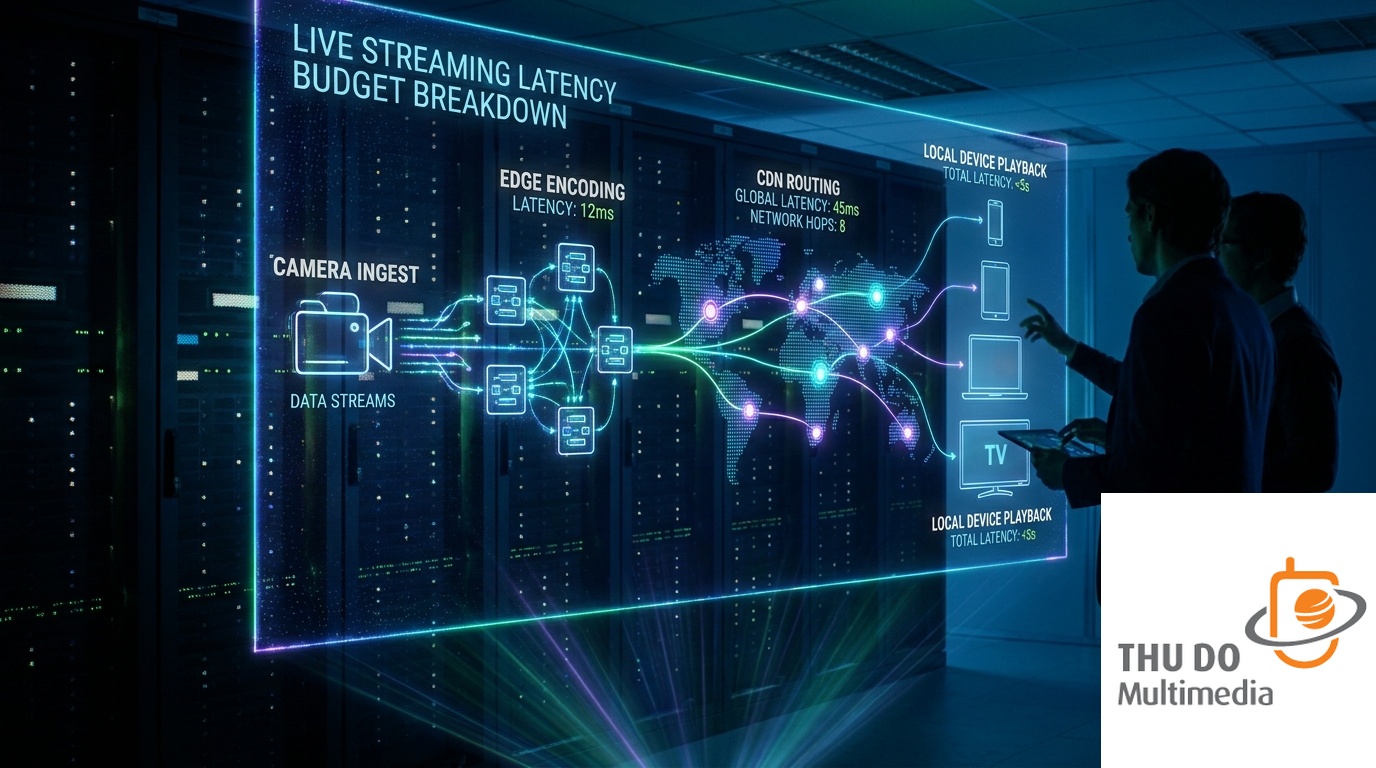
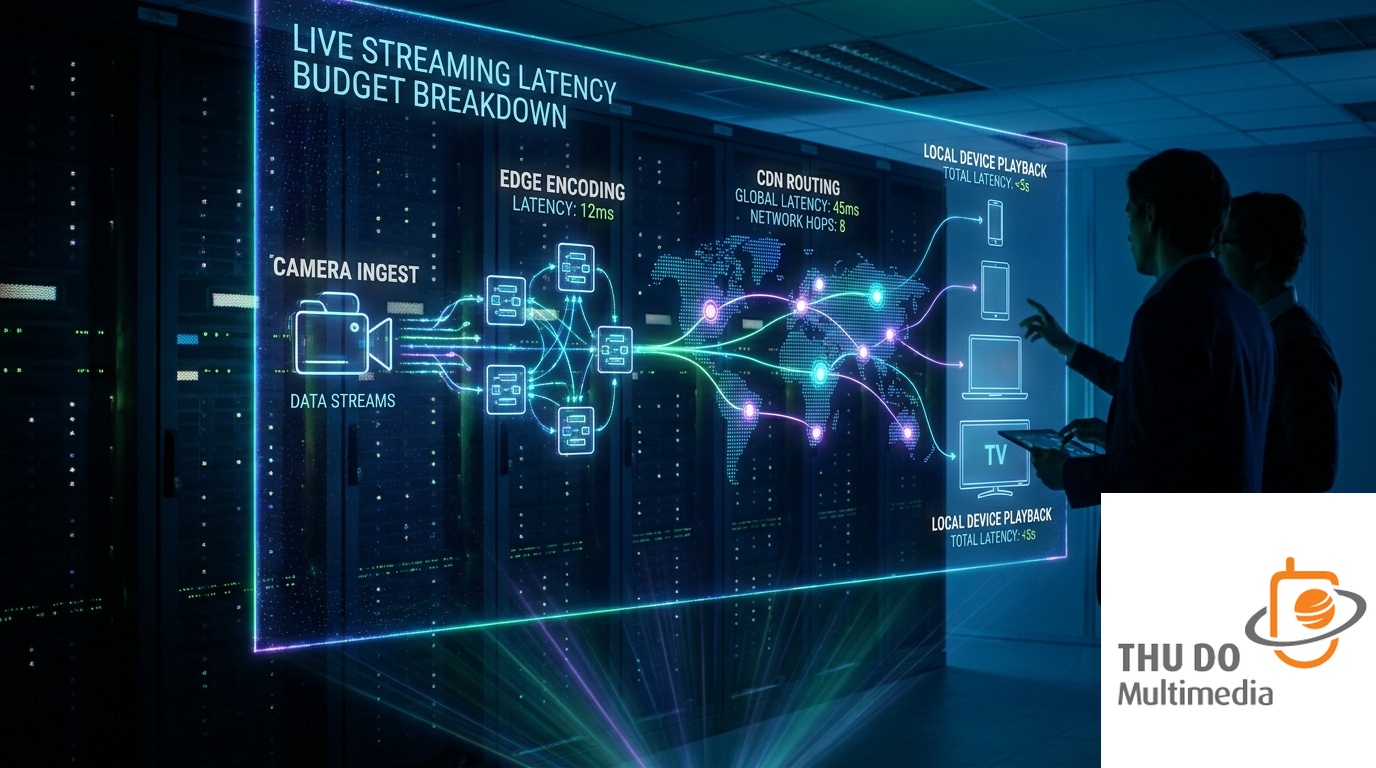
Building an ultra-low latency streaming architecture requires a forensic examination of the “latency budget”—the exact number of milliseconds spent at every single stage of the video pipeline. Let us look at the raw data: a standard workflow might spend 20 to 1,000ms on capture and encoding, 200 to 6,000ms on packaging, 20 to 300ms traversing the network to the CDN, 50 to 500ms during CDN fan-out, a massive 20 to 30,000ms sitting in the player buffer, and finally 10 to 60ms decoding on the screen. To achieve near-real-time streaming, architects must ruthlessly shave milliseconds off each of these six pillars, realizing that a bottleneck in just one area destroys the entire glass-to-glass target.

The choice of video codec plays a deeply complex role in this latency budget, often presenting a fierce trade-off between bandwidth savings and compute time. For example, High-Efficiency Video Coding (HEVC/H.265) cuts video bitrates by 40% to 50% compared to the older H.264 standard, which drastically speeds up network transit times. However, HEVC requires roughly twice the compute power to encode. Taking it a step further, the AV1 codec cuts bitrates by an astonishing 48% to 50% (as measured by Netflix), but it demands up to four times more software encode processing. If your origin server lacks dedicated hardware acceleration for AV1, the time spent encoding the video will completely negate the time saved during network delivery.

To combat processing delays, modern infrastructures rely heavily on Edge packaging. Instead of sending a single, massive master stream to a centralized cloud server in Virginia for packaging and then routing it to viewers in Tokyo, we push the packaging logic to the extreme edges of the network. Utilizing serverless technologies like Cloudflare Workers or AWS Lambda@Edge, the raw feed is ingested, wrapped into CMAF chunks, and packaged geographically closest to the viewer. This highly distributed architecture is the secret to keeping global p95 latency (the latency experienced by 95% of your users) consistently under the 2-second mark.

reducing latency in live video streaming via CDNs

The cornerstone of reducing latency in live video streaming at scale relies heavily on the strategic deployment and configuration of Video Content Delivery Networks (CDNs). A Video CDN acts as a massive global caching layer; instead of a million viewers asking your single origin server for the live video feed, they ask the CDN edge server physically located in their own city. This edge caching completely prevents origin server overload and drastically cuts down network transit time. When chunks are cached locally, the “last mile” delivery to the viewer’s router is executed in mere milliseconds, maintaining the integrity of the live feed.

Relying on a single CDN is highly risky for premium OTT broadcasters. During massive audience spikes—such as the final minutes of a World Cup match—individual network nodes can easily become congested, causing micro-stutters and latency spikes. This is where active Multi-CDN strategies come into play. By employing intelligent, real-time traffic routing, the streaming platform monitors the specific performance and buffer rates of various CDNs (like Akamai, Fastly, and CloudFront) on a viewer-by-viewer basis. If CDN A begins to experience congestion in London, the system autonomously and instantly routes all new London-based viewers to CDN B, preserving the low latency experience without human intervention.

Furthermore, we must implement strict origin shielding. In a low-latency environment using chunked transfer encoding, millions of tiny HTTP requests are generated every second. If a new CDN edge node spins up and does not have the latest chunk cached, it will request it from the origin. Without a shield, a sudden surge in audience numbers could result in a “thundering herd” of requests hitting the master origin server simultaneously, causing a total stream collapse. An origin shield acts as a massive shock absorber—a mid-tier caching layer that aggregates all requests from edge nodes into a single origin request, keeping the master encoder running flawlessly at sub-second speeds.

Actionable end-to-end latency optimization for live video

One of the most glaring gaps we observe in the streaming industry is the disconnect between server engineers and client-side developers, which makes end-to-end latency optimization for live video incredibly difficult. You can build the fastest CMAF pipeline in the world, but a naive video player will destroy it. For instance, the default settings on popular open-source players like HLS.js are aggressively tuned for stability, not speed. A default player reading a perfectly optimized 2-second LL-HLS feed will intentionally wait to download three full segments before rendering a single frame, forcing a 6 to 10-second delay. Tuning the player’s chunk size (down to 200ms) and live sync duration (target buffer of 0.9 to 1.2 seconds) is absolutely mandatory.

Equally important is the alignment of your Adaptive Bitrate (ABR) encoding ladders. Viewers constantly experience bandwidth fluctuations, moving from 5G cellular to localized Wi-Fi. If your encode ladder is not perfectly aligned with identical Keyframe intervals (typically every 1 to 2 seconds), the player cannot seamlessly switch from a 1080p feed to a 480p feed. When keyframes are misaligned, the player is forced to pause, flush its existing buffer, and download a new segment from scratch. This single event causes a jarring buffering wheel and permanently injects an additional 3 to 5 seconds of latency into that specific viewer’s session.

To truly maintain these systems, platforms must conduct rigorous network auditing, which forms the basis of best practices for real-time OTT streaming. Operators must stop looking at “average” latency metrics, as averages heavily mask disastrous viewer experiences. Instead, engineering teams must monitor p95 and p99 latency metrics (the worst 5% and 1% of viewer experiences). Tail-end variances—where a small pocket of users experiences 15-second delays on a 2-second feed—are exactly what cause mass viewer churn and negative app store reviews. Continuous end-to-end monitoring ensures that latency drift is caught and rectified at the player side before the viewer hits the exit button.

Top scalable low latency streaming solutions on the Market

For brands looking to launch rapidly, choosing fully managed enterprise OTT platforms is often the most financially sound route. We highly recommend leveraging scalable low latency streaming solutions like OTTEngine, Muvi Live, or Dacast. OTTEngine, for instance, is purpose-built to handle the heavy lifting of multi-CDN routing, edge packaging, and player tuning right out of the box. By utilizing a platform like OTTEngine, media brands can launch interactive sports broadcasts or live commerce events in weeks rather than months, completely bypassing the grueling process of hiring bespoke engineering teams to manually configure WebRTC topologies and CMAF chunks.

For organizations with deep internal development resources building custom applications, specialized developer and engineering tools provide granular control over the latency budget. Platforms such as Wowza, Red5 Pro, and Dolby Millicast offer powerful SDKs and server infrastructures specifically designed for sub-second streaming. Red5 Pro is particularly renowned for its ability to autoscale WebRTC clusters across various cloud providers (AWS, Google Cloud, Azure), allowing developers to build interactive fan-wall experiences that dynamically scale up to millions of concurrent connections without breaking the 500ms barrier.

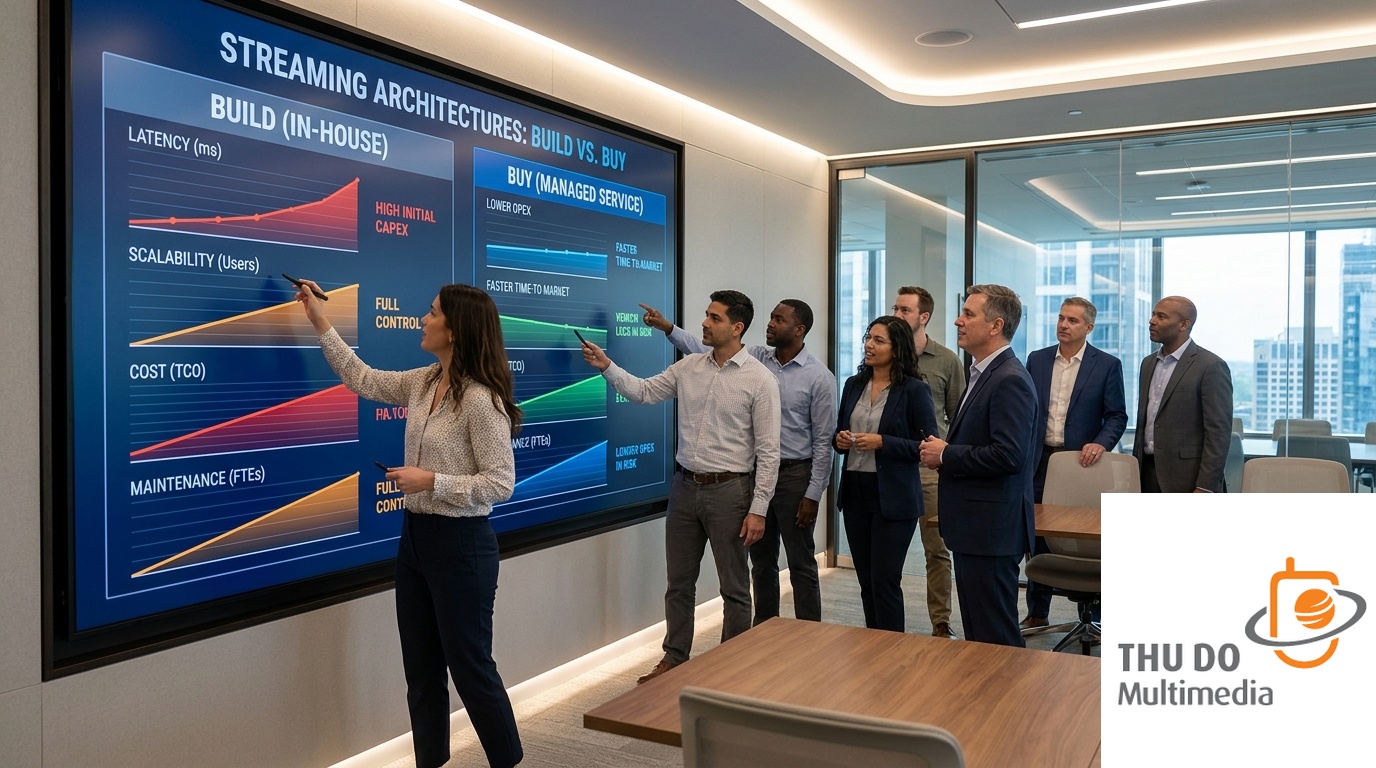
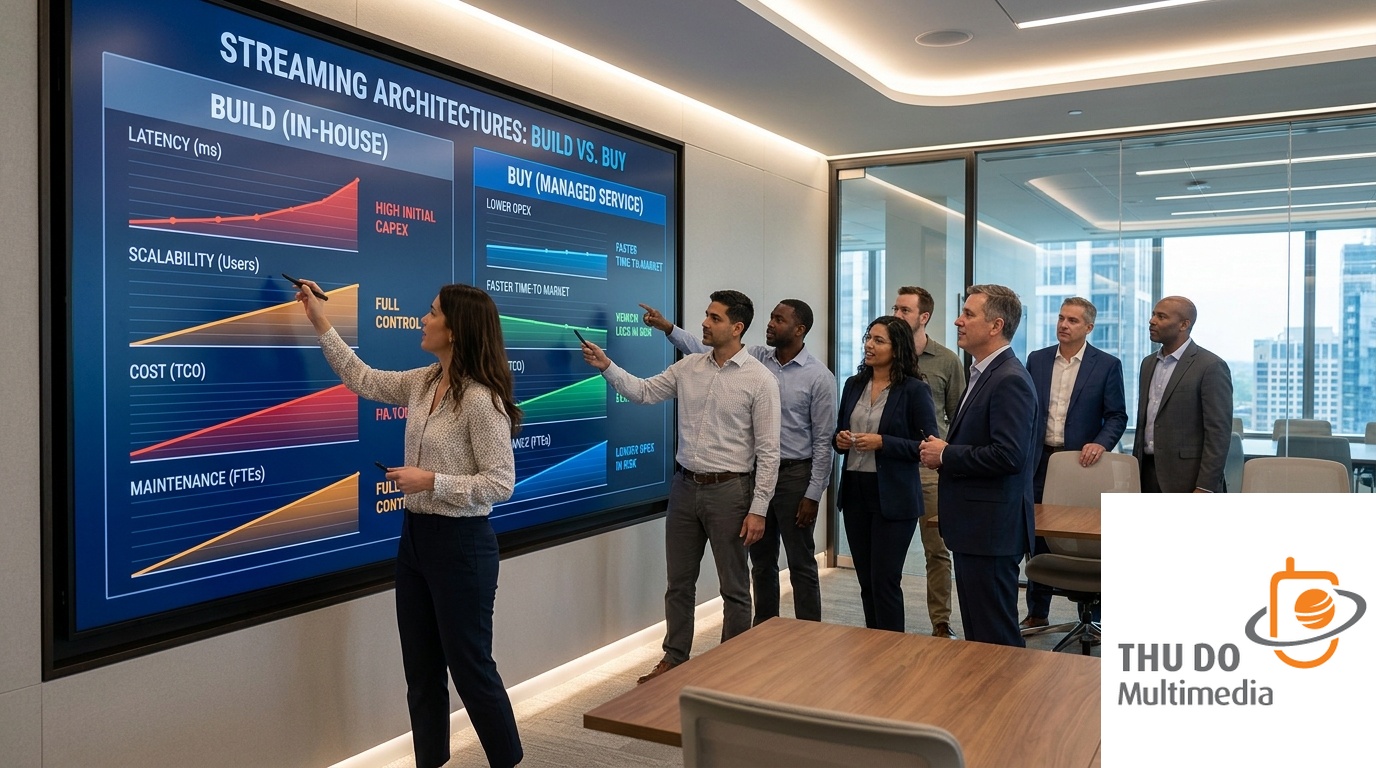
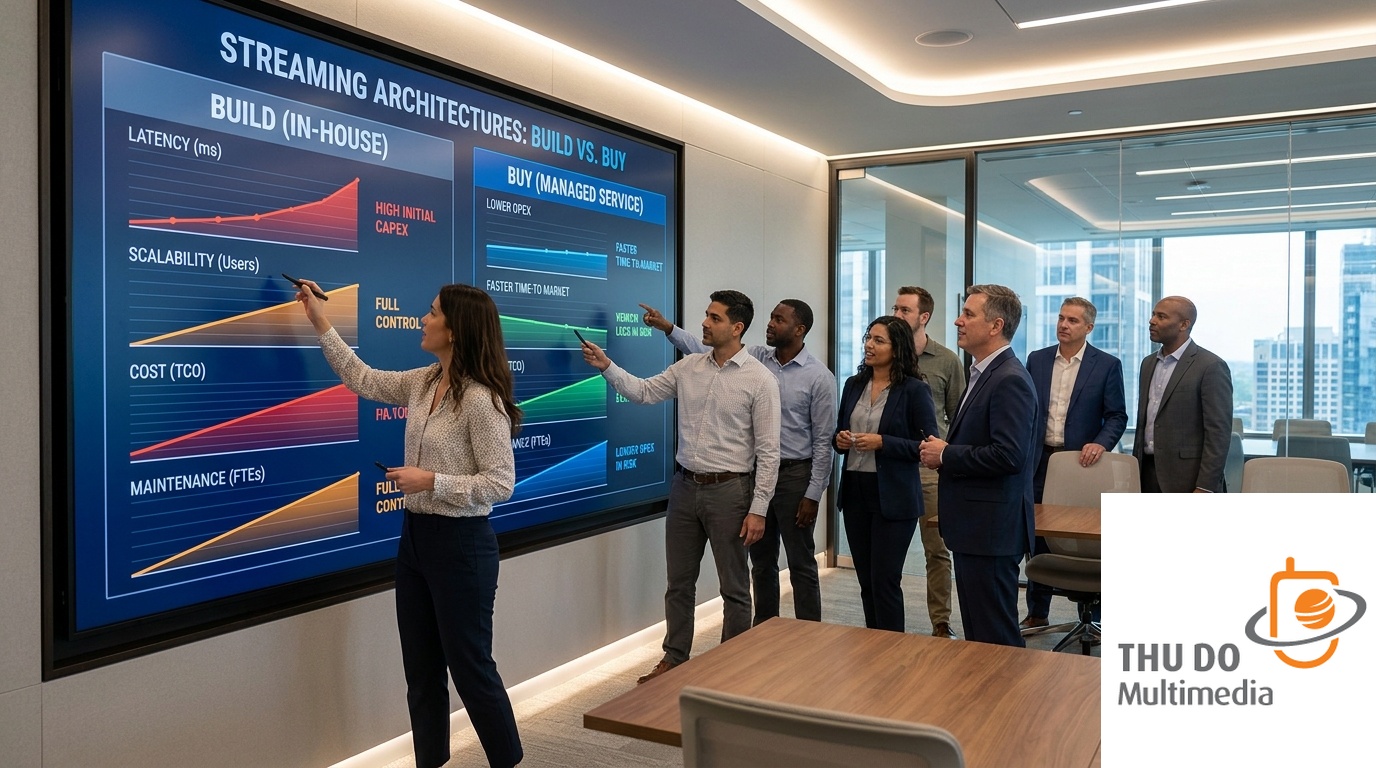
Ultimately, brands must navigate the complex “Build vs. Buy” decision. A key factor in this checklist should be raw infrastructure and delivery costs. While building a custom WebRTC solution gives you absolute architectural freedom, the software compute costs for transcoding AV1 and the per-gigabyte egress costs from public clouds can quickly bankrupt a project. Conversely, utilizing a white-label SaaS like OTTEngine often provides predictable, bundled hourly CDN costs per viewer, offering a clear and tangible ROI framework for Chief Financial Officers who need to map latency improvements directly to subscription revenues.

Media executives reviewing streaming architecture and cost analytics dashboards

The Future of OTT: 5G, Wi-Fi 7, and Media over QUIC (MoQ)

Looking strictly at the horizon, network innovations are radically altering the “last mile” delivery bottlenecks. The widespread rollout of Private 5G networks in stadiums and Wi-Fi 7 in smart homes is drastically reducing localized packet loss and network jitter. Wi-Fi 7, with its Multi-Link Operation (MLO) capabilities, allows a smart TV to simultaneously receive video data over multiple frequency bands (2.4 GHz, 5 GHz, and 6 GHz). This means that even if someone starts downloading a massive file on the same home network, the live streaming feed will dynamically route around the congestion, preserving the ultra-low latency buffer without a single dropped frame.

Perhaps the most exciting paradigm shift on the horizon is the emergence of Media over QUIC (MoQ) and WebTransport. While WebRTC rules the sub-second space today, it is notoriously difficult to cache at the edge. MoQ is positioned as the next massive global standard, allowing publish/subscribe media delivery over HTTP/3. By utilizing the underlying QUIC protocol, MoQ provides multiplexed, secure, and rapid transport that can theoretically combine the sub-second speed of WebRTC with the massive CDN scalability and caching capabilities of HLS. We are aggressively watching MoQ, as it has the potential to completely replace older transport methods by 2028.

Finally, the integration of inline Artificial Intelligence is beginning to fit neatly inside these microscopic latency budgets. Historically, adding real-time translation, closed captioning, or video super-resolution required delaying the feed by several seconds to give cloud servers time to process the AI models. Today, hardware-accelerated Edge AI and Neural Processing Units (NPUs) built directly into modern viewing devices allow broadcasters to send lightweight, low-resolution streams at lightning speeds, while the viewer’s local device utilizes AI to intelligently upscale the video to 4K and generate real-time captions locally, effectively bypassing the cloud latency penalty entirely.


Frequently Asked Questions

What is the difference between standard and low latency in OTT streaming?
Standard latency prioritizes absolute video stability and maximum resolution by intentionally delaying a live broadcast by 15 to 30 seconds. This large buffer ensures smooth playback even on terrible internet connections. Low latency significantly reduces this gap to 2 to 5 seconds by utilizing chunked media formats. This near-real-time viewing tier is heavily suited for live sports, gaming, and interactive chats where viewers need to react to moments as they happen.

How do you achieve zero-latency live streaming?
From a strictly scientific standpoint, true “zero latency” is impossible due to the physical distance data must travel and the time required for glass-to-glass processing. However, broadcasters can achieve ultra-low latency of under 500 milliseconds by utilizing UDP-based protocols like WebRTC. To the human eye and brain, a 500ms delay is largely imperceptible, creating a flawless illusion of true real-time communication.

Which is better for live streaming: WebRTC or LL-HLS?
The choice depends entirely on your business use case and audience scale. WebRTC is vastly superior for highly interactive, sub-second streams such as live auctions, telehealth, or two-way video conferencing. However, WebRTC is difficult and expensive to scale to millions. LL-HLS (Low-Latency HLS) is better for broadcasting to massive, passive audiences (like the Super Bowl or a global concert) where a 2 to 5-second delay is perfectly acceptable in exchange for immense CDN scalability and lower compute costs.

Why does latency spike during a live OTT broadcast?
Latency spikes are rarely caused by a single point of failure. They are typically triggered by untuned client-side player buffers reacting poorly to network dips, “last mile” Wi-Fi congestion on the viewer’s end, or origin server overload when millions of requests hit the system simultaneously. Employing a multi-CDN strategy paired with aggressive origin shielding is the most effective architectural defense against these mid-stream latency spikes.

How does video codec choice (HEVC, AV1) affect live streaming latency?
Advanced codecs drastically alter the latency budget equation. Codecs like HEVC and AV1 reduce the final file size (bitrate) by roughly 40% to 50% compared to the older H.264 standard, which greatly accelerates network delivery speed. However, they are incredibly complex and require significantly more hardware processing power to encode in real-time. If a broadcaster’s ingest servers lack proper hardware acceleration, the time spent encoding these advanced codecs will inadvertently add massive latency right at the beginning of the workflow.

Mastering the intricacies of low latency live streaming OTT requires a holistic, deeply integrated approach from the camera lens all the way to the viewer’s screen. By aligning the right protocols, utilizing scalable platforms like OTTEngine, and meticulously tuning the final playback experience, modern broadcasters can deliver flawless, interactive realities that captivate audiences worldwide.

Sigma OTT named among Hà Nội’s major industrial products in 2024

Sigma OTT named among Hà Nội’s major industrial products in 2024

The Hà Nội People’s Committee honored 36 major industrial products, including the Sigma OTT ecosystem by Thủ Đô Multimedia, as one of three recognised digital technology products.

The Hà Nội People’s Committee has held a ceremony honouring 36 major industrial products, including the Sigma ecosystem by Thủ Đô Multimedia, which was recognised as one of three major high-tech digital products from the capital city. This accolade highlights the significant impact of Sigma on the development of Việt Nam’s digital media landscape.

The Role of Hà Nội’s Major Industrial Products Programme in Supporting Sigma OTT

The major industrial products programme aims to promote high-quality industrial goods from Hà Nội-based enterprises, helping them enhance market competitiveness through cooperation and promotional support. Sigma OTT, as a recognised product, benefits from this initiative by gaining broader exposure and enhanced credibility.

In 2024, the selected products, including Sigma, will receive advertising across Hà Nội’s media platforms and have priority access to trade promotion programmes. This recognition encourages businesses to produce high-value goods and improve their efficiency and market integration. Hà Nội’s major industrial enterprises generate nearly VNĐ200 trillion annually, contributing 35 per cent of the city’s industrial output. Sigma OTT’s inclusion underscores its pivotal role in driving innovation and growth.

Sigma OTT: A Milestone in Việt Nam’s Digital Media Revolution

Sigma Ecosystem, developed by Thủ Đô Multimedia in 2018, has become a significant name in Việt Nam’s digital media sector. It offers a comprehensive ecosystem for distributing multimedia content, eliminating the need for multiple foreign solutions and reducing costs for content distributors. This innovative platform supports industries such as television, online education, and healthcare, making it a versatile solution in the digital age.

The Sigma OTT ecosystem streamlines content delivery, enabling seamless integration with existing infrastructures. By offering features tailored to industry-specific needs, Sigma empowers content creators and distributors to maximise efficiency and revenue.

Representative of Thủ Đô Multimedia (centre) received the award. Photo courtesy of the firm

Innovative Features Driving Industry Standards

One of Sigma OTT’s key innovations is the Sigma Multi-DRM digital content security solution, which was globally recognised in 2020. This cutting-edge technology addresses critical issues like copyright infringement and content protection for TV and internet streaming. By ensuring robust digital rights management, Sigma provides unmatched security for valuable multimedia assets.

Beyond its security features, Sigma also incorporates advanced analytics, offering insights into user behaviour and engagement. This data-driven approach allows businesses to tailor their content strategies and optimise viewer experiences. These features have positioned Sigma as a leader in the digital content distribution sector.

Global Expansion and Recognition

The international success of Sigma highlights its growing influence in the global digital media market. With clients in Thailand, the US, and India, Sigma has demonstrated its ability to adapt to diverse market needs while maintaining high standards of performance and reliability.

Sigma OTT Go Global
Sigma OTT Go Global

CEO Nguyễn Ngọc Hân noted that Sigma OTT’s global recognition has helped Thủ Đô Multimedia build a strong reputation. “This achievement motivates our team to continue creating leading IT solutions and positioning Việt Nam on the global digital technology map,” he said. Sigma OTT’s success not only elevates Thủ Đô Multimedia but also showcases Việt Nam’s capacity to compete in the international arena.

See details at: en.nhandan.vn

Looking ahead, Thủ Đô Multimedia aims to further innovate and strengthen its position in the digital technology space. Sigma will continue to evolve with new features and capabilities, addressing emerging challenges in content distribution and security. The company is committed to contributing to Việt Nam’s technology sector while expanding Sigma OTT’s global reach.

Sigma OTT with AI Technology

By collaborating with industry leaders and participating in international events, it seeks to foster innovation and set new benchmarks in the digital media industry. This forward-thinking approach ensures that Sigma OTT remains at the forefront of technological advancements, paving the way for future successes.

Read more: Thu Do Multimedia Korea Vietnam Content Forum

Sigma OTT’s Impact on the Digital Ecosystem

Sigma not only enhances content distribution but also creates opportunities for partnerships across industries. By providing a reliable and scalable solution, it enables businesses to focus on creating quality content while minimising operational challenges. This impact extends beyond entertainment to sectors such as education and healthcare, where Sigma OTT’s robust platform facilitates seamless communication and learning experiences.

In conclusion, Sigma OTT’s recognition as one of Hà Nội’s major industrial products reflects its transformative impact on Việt Nam’s digital landscape. With continued innovation and global expansion, Sigma is poised to remain a cornerstone of digital content distribution for years to come.

See details at: bizhub.vn

BOOK MEETING WITH US TO OPERATING OTT SOLUTION


4 New Trends In Digital Television Industry That You Can’t Miss

4 New Trends In Digital Television Industry That You Can’t Miss

The digital television industry is growing and changing rapidly. If you are interested in the growth of digital television, let’s explore 4 new development trends in the global digital television industry with Thu Do Multimedia!

The Importance of Digital Television in the Age of Technology

Digital television is playing an increasingly important role in the context of rapidly developing technology, especially in the digital era. The transition from analog television to digital television not only brings many technical benefits but also changes the way television content is produced, distributed and consumed.

High resolution, sharp images and vivid sound have enhanced the viewer experience, especially with content such as sports, movies and entertainment programs. This meets the increasing demand of consumers for quality and diversity in entertainment content.

Definition and Benefits of Digital Television

Digital Television (DTV) uses digital signals to transmit and receive images and sound, providing higher quality than analog television.

It allows for the transmission of multiple channels in the same frequency band, saving spectrum space and providing new services such as multiplexing, electronic program guides (EPGs), and additional languages.

Multi-Platform Television Trends

The development of technology has promoted the multi-platform television model, allowing content to be accessed through many different devices such as mobile phones, tablets, and smart TVs. This model not only helps viewers watch content on demand but also creates opportunities for content producers to interact with viewers more effectively.

Convenience: Viewers can watch their favorite shows anytime and anywhere.


Interaction: Platforms like Facebook and YouTube allow audiences to interact directly with content, helping to build a loyal audience.

Digital Television Trends that have been growing in recent years and will continue to “break the ice” in the near future

1. Growth of OTT Television

    The over-the-top market size is estimated to reach USD 0.58 trillion in 2024 and is expected to reach USD 1.99 trillion by 2029, growing at a CAGR of 28.19% during the forecast period (2024-2029).

    Over-the-top OTT Market Analysis

    Over the top (OTT) is a film and television content platform that is delivered over a high-speed internet connection instead of a cable or satellite provider-based platform.

    The adoption of OTT has significantly supported the video, music, podcast and audio streaming categories. The increased adoption can be attributed to its narrow genre selection, packaging flexibility, wider device availability, internet penetration and lower costs.

    Growth of OTT Television
    OTT software growing at a CAGR of 28.19% during the forecast period (2024-2029)

    Mordor Intelligence report, The constant shift towards commoditization of sports and entertainment services, along with competition from OTT providers, is expected to drive the OTT industry forward. Traditionally, sports and entertainment channels have been subscribed to cable and satellite TV. However, the development of OTT platforms is disrupting this model by providing a variety of sporting events, live broadcasts, and entertainment content directly to consumers.

    The growth of smart devices and the development of the internet are the main factors driving the growth of OTT platforms. The penetration of smartphones, tablets, and smart TVs has brought more avenues to access OTT. These devices connect to the internet, allowing customers to watch their favorite movies and music easily.

    Moreover, the availability of high-speed internet connections along with 4G/5G broadband mobile networks provide a smooth experience for customers when accessing OTT platforms.

    The combination of smart devices and high-speed internet also helps increase convenience and personalization for users. OTT platforms will recommend and analyze user data to make suggestions about different movie playlists, singers, trends, etc. for each person.

    These factors have promoted the development of OTT, attracting many subscribers and boosting revenue from subscription fees and advertising. Therefore, television companies and television stations have realized the importance of OTT and launched their own streaming services or cooperated with existing OTT platforms to develop in this open industry.

    Along with development, there are always problems to solve

    Online video piracy is an important issue affecting the OTT market. Piracy is the theft of digital content and its illegal distribution and consumption on the internet. This problem directly affects the revenue of production enterprises and official distributors. The revenue loss is huge. It undermines the business models of OTT providers, who rely on subscription fees or advertising revenue to stay in business.

    2. Real-Time Interaction Trends in Digital Television

    In digital television, real-time interactivity is becoming an important trend. Modern platforms allow audiences to directly participate in the program through activities such as voting, discussion and sharing opinions on social media channels or related applications.

    Real Time Interaction Trends
    Real-time interactivity is becoming an important trend

    For example, reality TV shows such as “The Voice” or major sporting events often integrate online voting features, allowing viewers to participate in deciding the results or interact with the host.

    The impact of this trend on the viewer experience is very positive, as it creates a sense of connection and direct participation in the content they are watching. Interactivity helps make TV content more engaging, while also providing a sense of intimacy and personalization, making the audience feel like they are part of the program, rather than just passive observers.

    Specific Figures on the Increase in Viewership in Interactive Television Programs

    Audience Growth

    The programs “Happy Lunch” on VTV6 and “Healthy Living Every Day” on VTV2 have recorded a significant increase in the number of viewers participating in interactions, showing the appeal of these programs to the public.

    Popular interactive features

    Features such as Time Shift and content storage allow viewers to not miss their favorite programs, thereby increasing audience participation. For example, Viettel TV service allows users to store content for 7 days and rewind 2 hours before.

    Audience participation increases

    Globally, many TV channels such as BBC, CNN, and NBC have also applied the interactive TV model through mobile applications and online platforms, allowing viewers to participate in polls, votes, and discussions on hot issues.

    Demand for high quality

    Today’s audiences not only want to watch but also want to interact with content. This leads to producers having to invest in richer and more diverse content to meet this demand.

    In short, the increase in viewers of interactive TV programs not only reflects changes in content consumption habits but also shows that audiences increasingly want to participate and influence the content they watch. The above statistics prove that interactive TV is becoming an important trend in the modern media industry.

    OTT Applications Integrating with SmartTVs to Increase Interaction

    In the context of increasingly developing digital TV, many OTT (Over-The-Top) applications have been integrated into SmartTVs to enhance user experience and increase high interactivity.

    1. VTV Plus
      This application allows users to connect to the Internet to watch a variety of high-quality copyrighted TV content. VTV Plus supports multi-screen interaction, allowing viewers to participate in activities such as voting and sending feedback directly during programs.
    2. FPT Play
      FPT Play not only provides live TV channels but also allows users to review broadcast programs. The application integrates many interactive features, including commenting and sharing content on social networks.
    3. Netflix
      Although primarily a video-on-demand service, Netflix also offers interactive programs such as “Bandersnatch”, where viewers can choose the direction of the story. This creates a unique and personalized experience for the audience.
    4. YouTube
      The platform allows users to watch videos and participate in livestreams with the ability to comment directly. YouTube also integrates the Super Chat feature, allowing viewers to send paid messages during live broadcasts.

    The real-time interaction in digital television feature has been widely applied in domestic and foreign television platforms. However, in the future, this feature will be further upgraded, bringing a more “classy” interaction to viewers.

    3. Blockchain Technology in Digital Television Copyright Protection

    Along with the development of the OTT platform is the increasing problem of copyright infringement. Therefore, DRM service providers always enhance the strongest copyright protection feature for producers.

    Blockchain Technology in Digital Television Copyright Protection
    Blockchain is expected to increase to 163.83 billion USD in 2029

    New discovery, Blockchain technology has emerged as an effective solution to protect content copyright in the digital television field.

    According to a report by Grand View Research, the global blockchain market reached 5.92 billion USD in 2021 and is expected to increase to 163.83 billion USD in 2029. This growth reflects the potential for widespread application of blockchain technology in many fields, including television.

    Mr. Han said: “If you don’t know about the Internet, you are standing outside the current situation. However, in about 10 years, if you don’t know about blockchain, we will be like people who have not used the Internet for the past 20 years”.

    How Blockchain Can Prevent Digital TV Piracy

    Content Authentication and Protection

    Blockchain allows for the recording of information about the author, creation date, publication date, and ownership of digital television content. This helps authenticate the integrity of the content and prevent unauthorized changes after broadcasting, thereby protecting the rights of producers and authors.

    Ownership Management

    With blockchain, managers can easily manage intellectual property rights on a distributed database. Allowing for secure, transparent storage and limiting copyright disputes.

    Creating NFTs for Exclusive Content

    Blockchain technology also allows for the creation of non-fungible tokens (NFTs) to represent television works. Each NFT will ensure the uniqueness of the work, helping to protect intellectual property rights and prevent unauthorized copying. Producers can issue NFTs as “tickets” for online events or exclusive content, creating a new business model.

    Blockchain technology offers many benefits in protecting digital television copyright, from content authentication to ownership management and transaction automation. With the continuous development of this technology, it promises to become an important tool in protecting intellectual property in the television industry in the future.

    Read more: Thu Do Multimedia speaks about Blockchain technology

    4. Personalizing Customer Experience on Digital Television Platforms

    Artificial intelligence (AI) technology is increasingly being chosen and widely applied in digital television. Bringing many benefits, performance and breakthrough new features in the future.

    Inevitable trend

    According to Master Nguyen Truong Giang, Director of the Television Technical Center, the application of AI in digital television is not only feasible but also an inevitable trend. AI can be applied in all stages from content ideation to program production techniques.

    Improving content quality – Automation

    AI helps automate many tasks in content production, such as converting speech to text, automatically creating metadata, and analyzing big data. This not only saves time but also improves accuracy in the production process.

    Analyzing user data – Audience and content
    AI supports the collection and analysis of user behavior data on platforms such as VTVGo and VTV.vn. This helps producers better understand audience preferences, thereby developing more appropriate and effective content.

    Creating virtual MCs

    image 18

    Vietnam Television has applied AI to create virtual MCs, simulating the intonation, voice and expression of real editors. This helps save time and costs in program production.

    Many major TV stations in the world such as in the US, India, and Korea have started using AI MCs for their programs since 2022, showing the popularity of this technology globally.


    The application of AI in television is expected to continue to grow strongly in the coming years, with the ability to improve user experience and increase production efficiency.

    Leading the digital television trend – Thu Do Multimedia

    The above 4 future development trends of the digital television industry are trends that have been and are being strongly applied in 2024, but are still predicted to continue to grow and make further breakthroughs in the future 2025 – 2029.

    Foreseeing these trends, Thu Do Multimedia has pioneered in technology and led the trend to have smart solutions to support digital content production businesses to develop strongly when applied to businesses and organizations.

    Comprehensive OTT solution for digital television

    We provide television producers and publishers with a comprehensive OTT solution, allowing businesses to not spend a lot of time searching for different technologies from many suppliers. Key elements of Thu Do Multimedia’s OTT solution include:

    Multi-platform content distribution: Sigma OTT allows streaming on multiple devices such as phones, tablets, smart TVs, making it easy for producers to reach all audiences

    High security with Sigma DRM: Digital rights management (DRM) technology helps protect content from copyright infringement while keeping content quality unaffected during broadcast. This is especially important for content providers with strict security requirements.

    Dynamic ad insertion (DAI): Sigma OTT supports inserting ads based on users or the content they are viewing, effectively generating ad revenue without interrupting the user experience.

    User interaction with Sigma Interactive: helps enhance the user experience by creating direct interactions during broadcast, thereby creating a sense of participation and increasing engagement with content.

    Optimize delivery with Sigma Multi CDN: This solution optimizes content delivery across multiple CDN networks, ensuring content is delivered in the highest quality even under unstable network conditions.

    Thanks to these solutions, Thu Do Multimedia not only provides an efficient streaming platform but also helps content and television producers optimize costs, enhance user experience, and comprehensively protect content copyright.

    Details about Sigma DRM applying Blockchain in the digital television industry

    According to Mr. Han – CEO of Thu Do Multimedia, by combining Sigma DRM to protect copyright and blockchain – helping to instantly record the remuneration of parties involved in creating works, it will help solve the painful problem of copyright infringement and transparency of remuneration in the online environment.

    image 19
    Mr.Han told about Blockchain trends in digital television

    Copyright infringement in the digital environment (digital television) often occurs because these are intangible goods that are characterized by being cross-border and easy to share. Therefore, it is very easy to create a copy with unchanged content quality through peer-to-peer sharing with zero marginal cost.

    “Content creators and publishers have almost no control over how their products are shared online,” said Mr. Han.

    According to the CEO of Thu Do Multimedia, with the application of blockchain, each time digital content is shared, it will be recorded by the system. The use of content is done by smart contracts with a certain network fee, so the marginal cost will increase.

    Blockchain technology will not only be applied to copyright protection of television but also music content, electronic publications or more broadly, all industries related to creativity.

    Digital content copyright protection: Sigma DRM is designed to protect copyright for television services and digital content. This solution has been certified to meet international security standards of Cartesian and is applied to many television services in Vietnam such as VTVcab On, TV360, Gojapan, and Nexta.


    Violation Detection: Sigma DRM uses AI technology to detect and warn of device tampering or security vulnerability exploitation within 1/1000 of a second, helping to protect content quickly and effectively

    “Blockchain can also create new business models by allowing users to transfer or charge for copyrighted content they own after using it. This is completely possible when Thu Do Multimedia’s Sigma DRM digital content copyright protection solution is integrated with blockchain technology,” said Mr. Han.

    Previously, Thu Do Multimedia has also successfully applied blockchain to Fado Go – an e-commerce platform co-founded by this company. In the case of Fado.vn, blockchain is applied to accumulate points (Loyalty Points) for customers and record the frequency of using the utilities to buy and transport goods from Fado. Customers will have complete peace of mind, because Blockchain will help prevent anyone from illegally using their reward points other than them.

    Multi-dimensional – multi-platform interaction with Sigma Interactive

    Sigma Interactive, part of the OTT solution ecosystem of Thu Do Multimedia, is a powerful tool that helps enhance multi-dimensional and multi-platform interaction between content producers and audiences. This solution not only enhances user experience but also expands the accessibility of digital content on different devices.

    This is a new trend in digital television, we have a prominent feature compared to competitors which is a diverse interaction model. Regardless of what content producer or publisher you are, we can easily meet this feature for your business. Whether it is sports, movies, online learning, etc., Sigma Interactive can be easily integrated into the system.

    Thu Do Multimedia’s experts have extensive experience in developing interactive applications, helping to ensure product quality and their popularity with end users.

    Conclusion:

    The digital television industry is changing dramatically thanks to four leading trends: OTT, Blockchain, interactive television, and artificial intelligence (AI). The application of these technologies not only helps businesses optimize user experience but also enhances security, personalizes content, and develops more effective advertising methods.

    Thu Do Multimedia, with a comprehensive OTT solution set such as Sigma DRM and Sigma Interactive, is a reputable partner supporting businesses in the digital television industry to constantly innovate and develop. By combining these advanced solutions, businesses will be able to meet market needs and expand their reach in the future.

    Contact us today to get your questions answered.

    Contact Now