
Transitioning Legacy SDI Broadcasting to SMPTE ST 2110 is the definitive architectural leap from rigid coaxial cables to flexible, uncompressed IP media networks. This transformation allows modern broadcasters to handle massive ultra-high-definition video flows, remote production environments, and software-defined studio workflows with unprecedented agility.
- Key Takeaways (Tóm tắt ý chính):
- Independent Essence Routing: SMPTE ST 2110 separates video (-20), audio (-30/31), and metadata (-40) into independent elementary streams over COTS (Commercial Off-The-Shelf) IP networks.
- Sub-Microsecond Synchronization: IEEE 1588 Precision Time Protocol (PTP), governed by SMPTE ST 2059-2, ensures deterministic, zero-frame-slip audio-video alignment.
- Resilient Redundancy: SMPTE ST 2022-7 mandates seamless protection switching via duplicate Path A and Path B network topologies to eliminate packet loss risks.
Introduction to Legacy Broadcast Modernization
For decades, Serial Digital Interface (SDI) served as the undisputed backbone of the television industry. From standard-definition analog handoffs to 3G-SDI pipelines pushing 1080p60 signals, coaxial cables and monolithic routers defined how studios operated. However, as media organizations push past 4K and evaluate 8K resolutions, high frame rates (HFR), and immersive audio formats, traditional baseband architecture faces insurmountable physical limits. Cabling bulk becomes unmanageable, resolution scaling requires wholesale hardware rip-and-replace cycles, and rigid point-to-point routing lacks the dynamic agility demanded by modern multi-platform distribution. This economic and physical inflection point makes legacy broadcast infrastructure modernization not just an option, but an existential necessity for forward-thinking engineering teams.
At the center of this industrial revolution is the SMPTE ST 2110 suite of standards. Unlike legacy SDI, which multiplexes video, audio, and ancillary data into a single interleaved stream over a single coaxial cable, ST 2110 treats every media component as an independent, uncompressed essence. These elementary streams travel natively across standard, high-bandwidth Ethernet networks. In our experience working with Tier-1 broadcast facilities, adopting this standard unlocks the foundational pathway toward complete virtualization, remote production (REMI), and cloud-adjacent workflows. Broadcasters are no longer bound by the physical constraints of copper patch bays and fixed-size router frames.
The economic and operational drivers forcing engineering managers to rethink their facilities are rooted in agility and total cost of ownership (TCO). According to recent broadcast technology reports, facilities transitioning to IP-based infrastructures reduce physical footprint and power consumption profiles by over 30% once coaxial cable trays are eliminated. Furthermore, software-defined control planes enable studios to repurpose physical spaces within minutes, routing signals dynamically across global wide-area networks (WANs) without dispatching field engineers to rewire patch panels.
This article serves as your definitive, engineering-first roadmap. We will navigate past the marketing buzzwords and examine the exact network topologies, timing protocols, and phased migration frameworks required to move away from rigid coaxial routing toward a software-defined, highly scalable IP ecosystem. Whether you are planning a greenfield studio build or executing a complex hybrid retrofit, the strategies detailed below provide a rigorous blueprint for success.
Understanding the ST 2110 IP Video Production Ecosystem
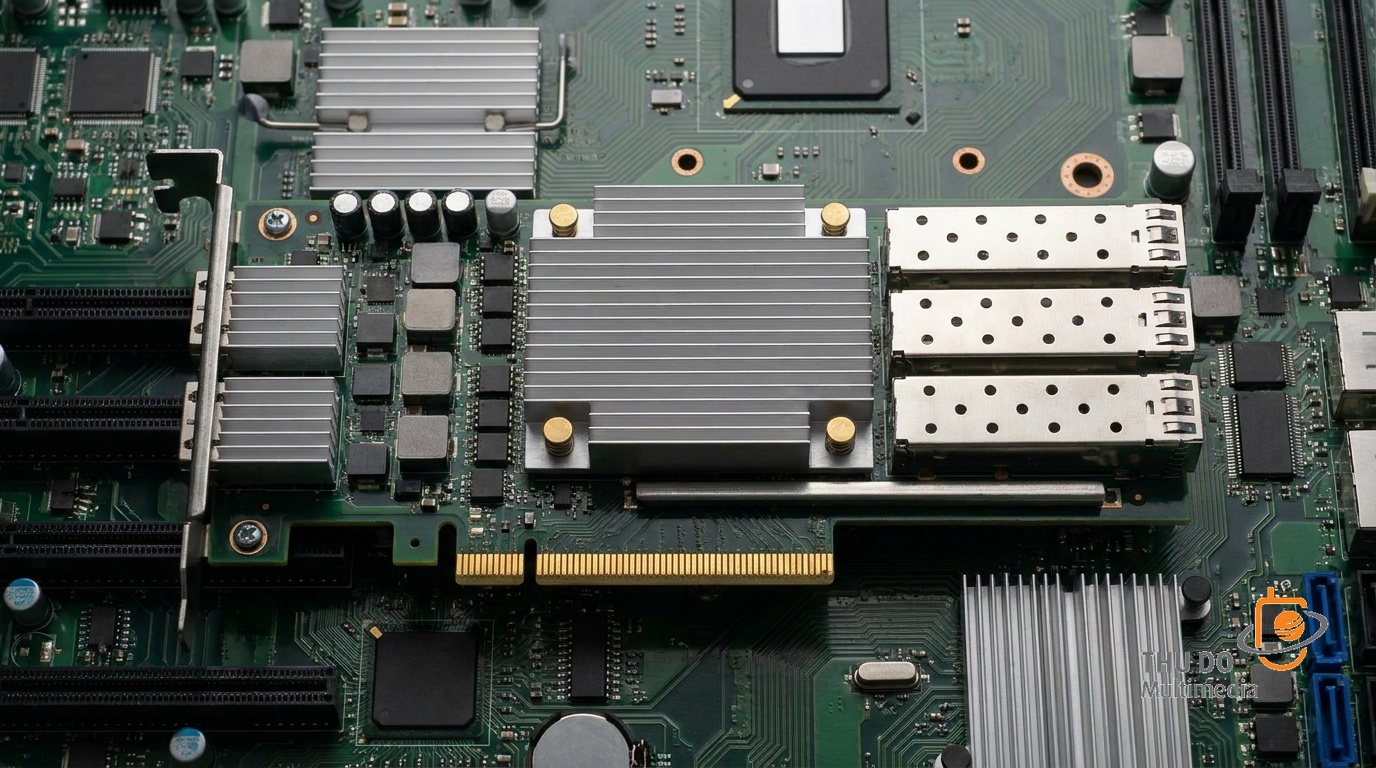
To successfully deploy an ST 2110 IP video production ecosystem, technical directors must first deconstruct the core elementary streams that replace traditional multiplexed SDI signals. The standard breaks media production down into modular layers: SMPTE ST 2110-20 handles uncompressed active video, ST 2110-30 and ST 2110-31 manage pulse code modulation (PCM) digital audio channels, and ST 2110-40 carries ancillary data, timecode, and metadata. Additionally, ST 2110-22 introduces support for lightly compressed video payloads when ultra-high-bitrate 4K or 8K signals must be squeezed across constrained network trunks. Each of these essences exists as a standalone IP packet flow, completely independent of the others until re-associated at the destination receiver.
The glue that binds this distributed ecosystem together is network timing and synchronization. In legacy SDI environments, video sync was locked to a centralized Black Burst or Tri-Level Sync generator wired analog-style to every piece of gear. In an ST 2110 facility, synchronization is achieved via IEEE 1588 Precision Time Protocol (PTP), specifically adhering to the SMPTE ST 2059-2 profile. PTP distributes nanosecond-accurate timing packets across the Ethernet switch fabric, allowing independent video, audio, and metadata packets originating from different rooms—or different cities—to align perfectly at the playout switcher or multi-viewer without frame-slipping or lip-sync degradation.
Comparing monolithic SDI routing switchers to distributed Commercial Off-The-Shelf (COTS) IP switch fabrics reveals a radical shift in system engineering. A traditional 288×288 SDI router is a massive, single-point-of-failure hardware appliance with fixed input/output ports. Conversely, a Spine-Leaf COTS IP fabric scales modularly. Need more bandwidth? You simply add leaf switches or trunk up to 40GbE and 100GbE interfaces. As noted by industry consultants, this distributed architecture eliminates the dreaded “forklift upgrade” cycle, allowing facilities to scale port density organically by simply plugging in new edge devices.
Decoupled essences radically alter how media is processed and managed. For instance, a live sports production can ingest four independent video streams while routing fifty discrete audio channels to an independent mixing console across the building, all sharing the same physical fiber backbone. This granular control reduces processing latency, minimizes hardware overhead, and empowers operations teams to build customized routing workflows tailored to specific live events on the fly.
Key SDI to IP Broadcast Transition Challenges
Embarking on an SDI to IP broadcast transition challenge requires acknowledging that moving from baseband video to enterprise IT networking is as much a cultural shift as it is an engineering project. For decades, traditional broadcast engineers mastered coaxial impedance, SDI eye patterns, and hardware patch bays. Introducing IP networking demands fluency in Layer 3 routing, VLANs, multicast group management (IGMPv3), and traffic engineering. This human skill-gap is frequently cited by chief engineers as the primary hurdle during early migration phases. Upskilling staff through specialized networking certifications and hands-on laboratory testing is mandatory before touching live production infrastructure.
Unlike standard enterprise IT networks—which happily tolerate minor packet retransmissions, buffering, and latency spikes—broadcast environments demand strict deterministic behavior. A live television broadcast operates with zero tolerance for dropped frames, jitter, or unpredictable packet delay variation (PDV). If an IT network drops a data packet, TCP retransmits it. In a real-time uncompressed 3Gbps or 10Gbps ST 2110 video stream, dropped packets manifest immediately as macroblocking, frozen frames, or audio clicks. Consequently, network architects must enforce rigorous Quality of Service (QoS) policies, precise buffer allocations, and robust traffic shaping across every switch in the facility.
Financial hurdles also shape the migration calculus. While the long-term benefits of IP-based broadcasting workflows deliver massive operational efficiencies, the initial capital expenditure (CAPEX) for enterprise-grade spine-leaf core switches, Grandmaster PTP clocks, hardware gateway devices, and software orchestration layers can be intimidating for CFOs. Broadcasters must carefully balance these upfront infrastructure costs against future savings in cabling weight, power draw, and multi-vendor operational flexibility.
Furthermore, legacy equipment compatibility remains a persistent engineering friction point. Very few broadcast facilities possess the capital budget to scrap every camera, switcher, and monitor overnight. Bridge technologies are mandatory. Facilities must deploy robust hardware gateway devices capable of ingesting legacy baseband SDI signals and packetizing them into compliant ST 2110 streams, ensuring a smooth operational bridge during multi-year facility modernizations.
Strategic Planning for SDI to SMPTE 2110 Conversion
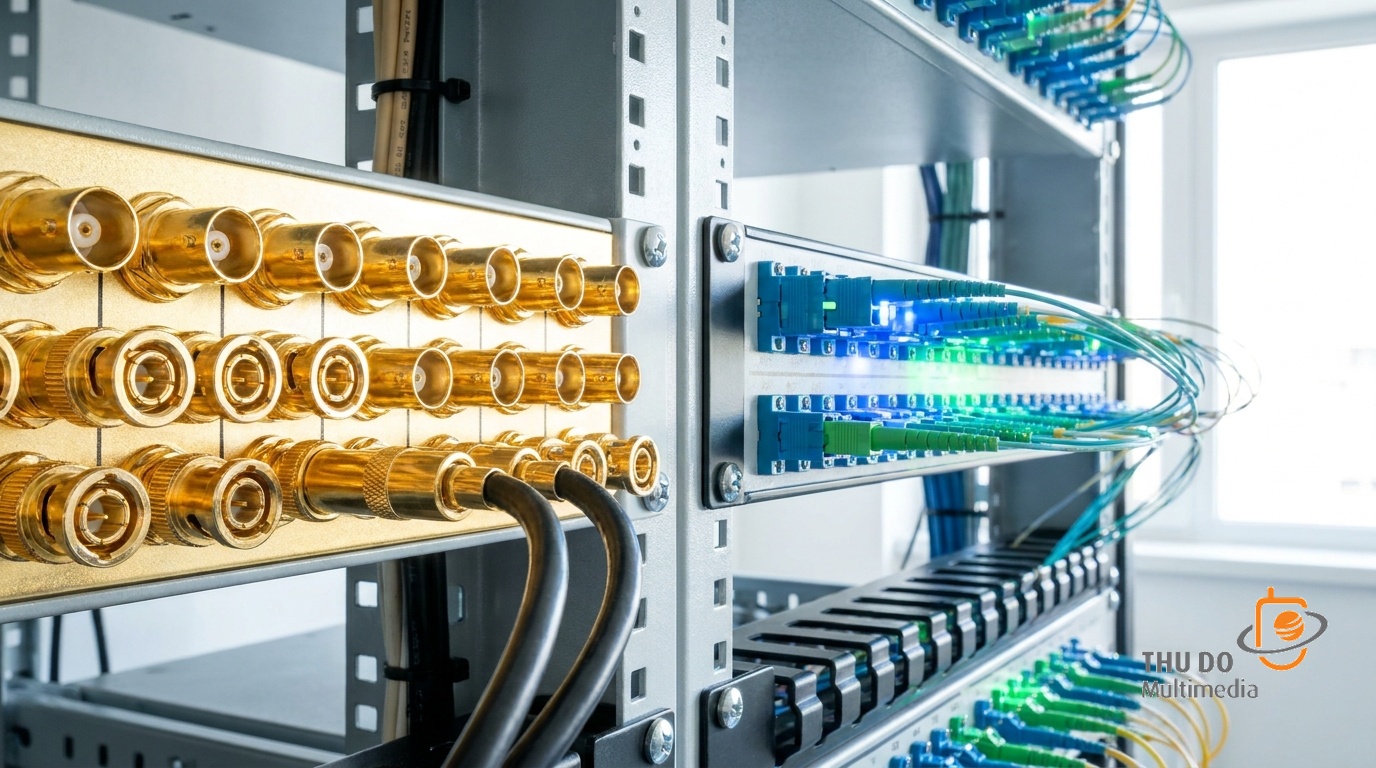
Successful execution of planning SDI to SMPTE 2110 conversion begins long before any hardware is unboxed; it demands a meticulous, facility-wide signal-flow audit. Engineering teams must catalog every existing routing matrix, multi-viewer, camera chain, and terminal device, mapping their exact bandwidth requirements, signal formats, and control protocols against future IP capabilities. This audit exposes hidden signal dependencies and helps identify legacy devices that require immediate retirement versus those that can be preserved via edge gateways.
Redundancy is non-negotiable in live broadcasting. To ensure 24/7/365 uninterrupted on-air reliability, facilities must implement the SMPTE ST 2022-7 standard for seamless protection switching. This architecture mandates two completely independent, physically separated network infrastructures—commonly designated as Path A and Path B. Identical ST 2110 media packets are transmitted simultaneously across both networks. The receiving destination device continuously monitors both streams; if packet loss or fiber cuts occur on Path A, the receiver instantly switches to Path B on a packet-by-packet basis without dropping a single video frame.
Network topology selection dictates the ceiling of your facility’s operational capability. Industry consensus heavily favors a Spine-Leaf network architecture. In this configuration, every leaf switch (which connects edge devices and gateways) connects to every spine switch (which forms the high-speed core backbone). This topology guarantees non-blocking, predictable low-latency performance with predictable microsecond-level path delays, ensuring that massive uncompressed media streams route seamlessly across the facility without bandwidth throttling.
Finally, device interoperability across multi-vendor hardware is managed via AMWA NMOS (Networked Media Open Specifications). Specifically, NMOS IS-04 handles automatic device discovery and registration, while IS-05 manages connection management. Implementing an open NMOS orchestration layer ensures that cameras from Manufacturer A, switchers from Manufacturer B, and multiviewers from Manufacturer C can discover, talk to, and route signals to one another seamlessly through a unified software control dashboard, preventing proprietary vendor lock-in.
Step-by-Step Implementation Guide for Hybrid Workflows
Executing a flawless implementation guide for migrating an active broadcast facility requires adopting a phased hybrid approach. Trying to perform a hard weekend cutover from SDI to native IP is a high-risk gamble that rarely succeeds without incident. Instead, engineering teams should execute a deliberate three-phase migration strategy:
- Phase 1: Edge Integration & Hybrid Islands. Deploy hardware gateway appliances at the periphery of your facility. These gateways ingest legacy SDI camera signals, tape decks, and graphics generators, packetizing them into compliant ST 2110 streams. These IP streams are routed into a newly constructed core IP switch fabric, while existing downstream SDI production switchers continue operating normally via downstream SDI-to-IP conversion outputs.
- Phase 2: Core Modernization & Central Routing. Upgrade your central routing and multi-viewer infrastructure entirely to the ST 2110 COTS IP fabric. At this stage, the core of the facility operates natively in IP, while remaining legacy SDI equipment is treated as edge extensions connected via bidirectional gateways.
- Phase 3: Full Native IP Operation & Decommissioning. As legacy peripheral cameras and terminal gear reach their natural end-of-life, replace them with native ST 2110 endpoints. Decommission remaining SDI routers, coaxial patch bays, and conversion gateways, achieving a 100% pure IP media workflow.
Rigorous testing and validation protocols must accompany every phase. Engineers must utilize advanced network analyzers to perform deep-packet inspection, verify PTP Grandmaster clock lock stability across all nodes, and execute bandwidth utilization stress tests under full-load conditions. Documenting comprehensive configuration templates for switch port profiles, IGMP snooping parameters, and orchestration layers ensures repeatability across multiple control rooms.
“Transitioning to SMPTE ST 2110 is not merely about replacing cables with Ethernet wires; it is a fundamental re-architecting of how media facilities think about signal flow, timing, and software-defined scalability.”
— Lead Broadcast Infrastructure Architect
Unlocking the Benefits of IP-Based Broadcasting Workflows
When the migration dust settles, the long-term benefits of IP-based broadcasting workflows dramatically justify the engineering complexity and capital investment. The most immediate physical transformation is ultra-high scalability. Where traditional SDI required massive, heavy bundles of coaxial copper cables routed through congested under-floor cable trays, an ST 2110 facility transmits thousands of uncompressed video, audio, and data streams over lightweight, high-capacity fiber-optic trunk lines. A single duplex fiber cable no thicker than a pencil can carry multiple uncompressed 4K video feeds simultaneously.
Format independence is another massive operational advantage. In a legacy SDI infrastructure, upgrading a control room from 1080i to 1080p60 or 4K often meant replacing entire router mainframes, distribution amplifiers, and cable plants because the physical layer bandwidth caps were hard-coded. In an IP-based ST 2110 ecosystem, bandwidth is elastic. Broadcasters can seamlessly transition from HD to 4K, 8K, or HDR workflows simply by updating endpoint encoder/decoder configurations and scaling switch port speeds, leaving the core fiber cabling infrastructure completely untouched.
Remote production (REMI) and distributed facility collaboration are also revolutionized by IP transport. Because ST 2110 streams map natively onto standard IT transport layers, media can be securely hauled across wide-area networks (WANs) and dark fiber links from remote sports stadiums or satellite bureaus directly into the main studio production hub with minimal latency. This capability allows broadcasters to centralize expensive production personnel and control rooms in headquarters while deploying minimal camera crews on location, slashing travel and logistics budgets.
Finally, software-defined control planes enable unprecedented studio agility. Instead of physical patch bays and hard-wired routing, production engineers use software orchestration dashboards to reconfigure studio spaces, assign multi-viewer layouts, and route complex signal chains in seconds. This flexibility allows a single physical studio stage to transition rapidly from a morning news broadcast to an evening sports panel and a late-night talk show with zero physical hardware intervention.
Câu hỏi thường gặp
- Q1: What is the main difference between SDI and SMPTE ST 2110?
- Answer: SDI transmits uncompressed video, audio, and metadata multiplexed over a single physical coaxial cable in a rigid point-to-point architecture. SMPTE ST 2110 transports these elements as independent, uncompressed elementary streams over professional IP networks, offering massive scalability, flexibility, and remote production capabilities.
- Q2: Why is PTP timing critical in an ST 2110 broadcast facility?
- Answer: Unlike SDI where timing is embedded directly into the video signal, IP networks packetize data. Precision Time Protocol (PTP / ST 2059-2) ensures that independent video, audio, and data packets are synchronized down to the nanosecond so they can be accurately re-aligned at the destination without frame slipping or lip-sync errors.
- Q3: How can a broadcaster migrate from SDI to IP without going off-air?
- Answer: Broadcasters typically use a phased transitioning baseband SDI to ST 2110 strategy. This involves deploying a hybrid infrastructure where edge gateway devices convert legacy SDI signals into IP streams, allowing existing SDI equipment to co-exist with a new core IP network until a complete cutover is feasible.
- Q4: What network architecture is best suited for an ST 2110 broadcast deployment?
- Answer: A Spine-Leaf network architecture is the industry standard for ST 2110 deployments. It provides non-blocking, predictable low-latency performance with redundant paths, ensuring that high-bandwidth uncompressed media streams can route seamlessly between any source and destination in the facility.
Recent Comments