Beyond Streaming: Why FAST Channels and Hybrid Models Will Dominate OTT by 2027

Beyond Streaming: Why FAST Channels and Hybrid Models Will Dominate OTT by 2027

Beyond Streaming: Why FAST Channels and Hybrid Models Will Dominate OTT by 2027

By 2027, pure subscription models will no longer sustain growth due to viewer fatigue. Instead, the industry will pivot to hybrid ecosystems combining Free Ad-Supported Streaming TV (FAST) and premium tiers. Beyond Streaming: Why FAST Channels and Hybrid Models Will Dominate OTT by 2027 comes down to maximizing reach, combating churn, and unlocking advanced CTV ad revenues.

Key Takeaways

  • Market Dominance: Streaming reached a record 47.5% share of total U.S. TV viewing by the end of 2025.
  • CTV Explosion: Connected TV is projected to reach over 121 million U.S. households by 2027.
  • Monetization Shift: 54% of SVOD subscribers now actively use at least one ad-supported tier.
  • Ad Spend Allocation: CTV advertising now represents roughly 28–30% of all programmatic advertising budgets.

What is the future of over-the-top media services?

In our experience navigating the turbulent waters of digital broadcasting, the transition from the “streaming wars” to the “efficiency era” has been nothing short of whiplash-inducing. Contextualizing this shift requires looking at the raw data: by the end of 2025, streaming reached a staggering record share of total U.S. TV viewing, clocking in at 47.5%. This milestone effectively cemented Over-The-Top (OTT) delivery not just as an alternative to traditional cable, but as the absolute default medium for global entertainment. However, this massive audience capture masked an underlying fragility in the business models of major media conglomerates. The days of burning billions of dollars on user acquisition without a clear path to profitability are over.

The death of the pure SVOD (Subscription Video on Demand) model is unfolding right before our eyes. Subscription fatigue and market saturation have hit a boiling point. Consumers are simply exhausted from managing five to seven different $15/month subscriptions just to watch their favorite shows. According to recent industry reports, this fatigue has made pure subscription models entirely unsustainable for long-term growth. Viewers are pushing back, leading to skyrocketing churn rates that force platforms into a relentless, expensive cycle of re-acquiring the exact same customers they lost a month prior.

This brings us to the core promise of this comprehensive guide. If you are a media executive or enterprise broadcaster, understanding the future of over-the-top media services is critical to your survival. In this article, we will dissect exactly how FAST networks, hybrid monetization frameworks, and aggressive CTV advertising are converging to create the ultimate, unbreakable OTT ecosystem. By leveraging our OmniStream platform solutions, we have helped dozens of broadcasters navigate this exact pivot, proving that the future belongs to those who embrace flexibility over rigid paywalls.

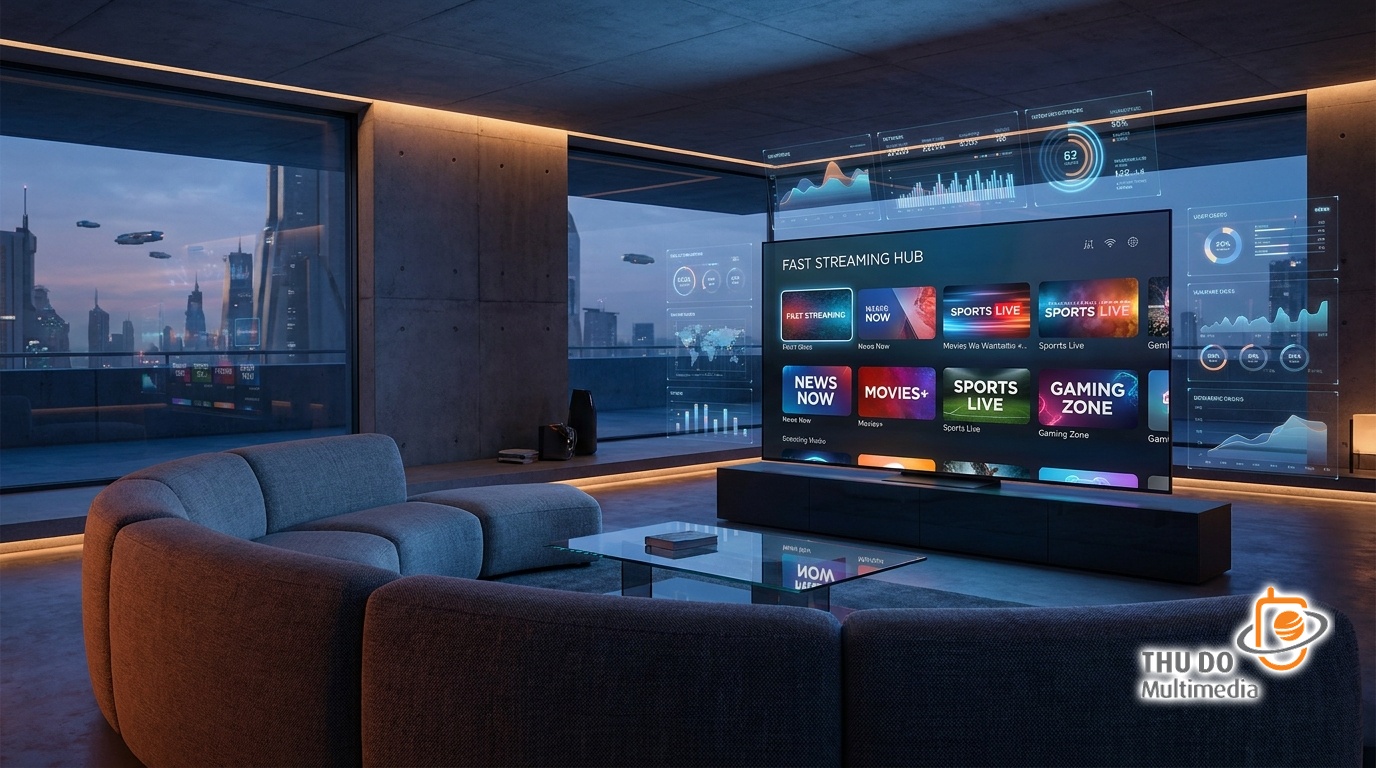
A futuristic living room with a glowing smart TV displaying a multi-channel FAST streaming interface and data analytics

The Rise of FAST channels future 2027: From Reruns to Premium Networks

When FAST (Free Ad-Supported Streaming TV) first entered the industry lexicon, it was largely dismissed as a dumping ground for low-tier library reruns and syndicated reality shows. Fast forward to today, and the evolution of FAST content strategy is the most exciting development in media. Broadcasters are transitioning from simply monetizing dusty back-catalogs to launching highly curated, premium, and branded channels. The FAST channels future 2027 landscape is defined by exclusivity. We are seeing original premieres, live news broadcasts, and high-budget productions debuting specifically on free channels to capture maximum top-of-funnel reach before being paywalled.

Nowhere is this shift more evident than in the realm of sports broadcasting. Premium live sports, once the exclusive domain of expensive cable packages and premium SVODs, are migrating to FAST. Take, for example, the strategic move of FIFA+ consolidating into DAZN, or RidePass operating solely as a highly successful FAST channel. These platforms use free, ad-supported live events as a massive discovery tool. They hook the viewer with free content, combatting subscription fatigue, and then upsell them on premium, ad-free, or interactive add-ons once brand loyalty is established.

Furthermore, enterprise adoption of FAST networks is transforming corporate communication and brand marketing. Non-traditional media brands, such as the Charles Schwab Network and Red Bull, are launching their own 24/7 FAST channels. Why? Because the death of the third-party cookie has made building owned audiences a critical first-party data strategy. Launching a FAST channel no longer requires archaic FCC broadcast licensing, entirely removing regulatory barriers for modern enterprises. When clients integrate with our OmniStream platform, they realize that owning a FAST channel is no longer just a media play—it is the ultimate, data-rich digital marketing engine.

Why hybrid OTT monetization models Are the New Industry Standard

Building the ultimate value ladder is the secret to surviving the media landscape of 2027. The winning hybrid tier structure is meticulously designed to capture every possible demographic: it starts with a Free tier (FAST/AVOD) for maximum reach, steps up to an Entry Ad-Tier for budget-conscious subscribers, moves to a Premium Ad-Free tier for core fans, and tops off with Add-ons (TVOD/PPV) for exclusive events. The data unequivocally supports this structure: currently, 54% of SVOD subscribers use at least one ad-supported tier. This proves a massive shift in consumer psychology; viewers are highly willing to trade their attention to advertisers in exchange for lower monthly costs.

To manage these hybrid OTT monetization models, platforms are increasingly relying on sophisticated internal performance metrics. Content is no longer just thrown onto a platform; it is strategically placed based on “cost-per-hour” and “audience retention” metrics. If a high-budget drama drives initial subscriptions but has low re-watch value, it sits behind the SVOD paywall. Conversely, if a sitcom has a low cost-per-hour but massive long-tail retention, it is pushed to the FAST tier to generate perpetual ad revenue. This calculated tiering maximizes the Average Revenue Per User (ARPU) across the entire content lifecycle.

The financial reality of the industry makes this hybrid approach mandatory. Overall streaming production volume is currently operating at roughly 70% of pre-COVID peak levels, and “ginormous” scale, blank-check projects have declined by approximately 50%. Hybrid models offset these severe budget squeezes by protecting against single-revenue-stream failure. Furthermore, the infrastructure cost savings are staggering. Traditional satellite distribution can cost hundreds of thousands of euros, whereas OTT IP delivery costs can be driven down to under €40,000 annually.

“The era of hyper-growth at all costs is definitively over. Major studios are executing structural cost reductions over a 1.5- to 2-year timeframe, proving that hybrid monetization is no longer an alternative—it is the survival baseline.” — Global Media Financial Outlook Report

Subscription video on demand vs FAST: Finding the Sweet Spot

The debate between subscription video on demand vs FAST is no longer a battle of opposing forces; it is a delicate dance of synergy. Combating churn is the number one priority for streaming executives today. We have witnessed a massive shift away from the “binge models” that defined the early 2020s. Bingeing leads to subscribers consuming a month’s worth of content in a weekend and immediately canceling. Today, retention is community-powered. Platforms are utilizing creator-led premieres, live chats, and highlight clips to keep users engaged daily. More importantly, FAST channels act as a strategic “save play.” When a user attempts to cancel their SVOD subscription, they aren’t lost to the void—they are seamlessly downgraded to the brand’s free FAST ecosystem, keeping them monetizable via ads.

This dynamic is playing out against a backdrop of aggressive market consolidation. The sheer volume of standalone apps was unsustainable. In Q2 2026 alone, 10 US streaming service profiles were phased out entirely. We saw niche platforms swallowed by larger ecosystems, such as BET+ consolidating into Paramount+. Currently, there are 370 streaming service profiles tracked in the US and 234 in Canada, but that number is shrinking rapidly. Mid-tier SVODs that lack the multibillion-dollar content budgets of Netflix or Disney are realizing they cannot compete on subscriptions alone.

To survive this battle for critical scale, these mid-tier platforms are pivoting heavily to FAST. Instead of trying to convince consumers to pay $8 a month for a limited library, they are licensing their content to aggregators like Roku Channel, Tubi, and Pluto TV, or spinning up their own O&O (Owned and Operated) FAST channels. The sweet spot in the SVOD vs FAST debate is using FAST as the ultimate marketing funnel: cast the widest net possible with free content, build brand affinity, and convert the top 10% of highly engaged viewers into paying SVOD subscribers.

How Are connected TV advertising strategies Fueling Free Ad-supported Streaming TV trends?

You cannot discuss the explosion of FAST without analyzing the hardware that makes it possible. The dominance of the Smart TV experience is the engine driving this revolution. Smart TVs (CTV) now account for roughly 69% of all VOD engagement in North America. The living room has been reclaimed, making the CTV User Experience (UX) the absolute number one conversion lever for broadcasters. By 2027, Connected TV is projected to reach over 121 million U.S. households. This makes the television screen the primary, undisputed battleground for global advertisers looking to capture high-intent audiences.

To capitalize on this, connected TV advertising strategies have evolved at breakneck speed, directly fueling Free Ad-supported Streaming TV trends. CTV ad spend now represents an astonishing 28–30% of total programmatic advertising budgets. Advertisers are demanding better ROI and a flawless Quality of Experience (QoE). This is where Server-Side Ad Insertion (SSAI) becomes the hero of the story. Unlike clunky client-side ads that cause the video to buffer or crash, SSAI stitches the commercial directly into the video stream in the cloud. This results in broadcast-grade, seamless ad delivery that completely bypasses ad-blockers and dramatically improves viewer retention.

The economics of this ad-tech are highly lucrative for content owners. The typical Ad Revenue Share model for FAST and free-to-air channels usually gives channel owners a 30% to 70% split of the generated ad revenue, depending on the distribution platform. When you combine the massive reach of 121 million CTV households with seamless SSAI technology and favorable revenue splits, it becomes blindingly obvious why every major studio and enterprise is rushing to launch FAST channels. It is a highly automated, high-margin cash machine.
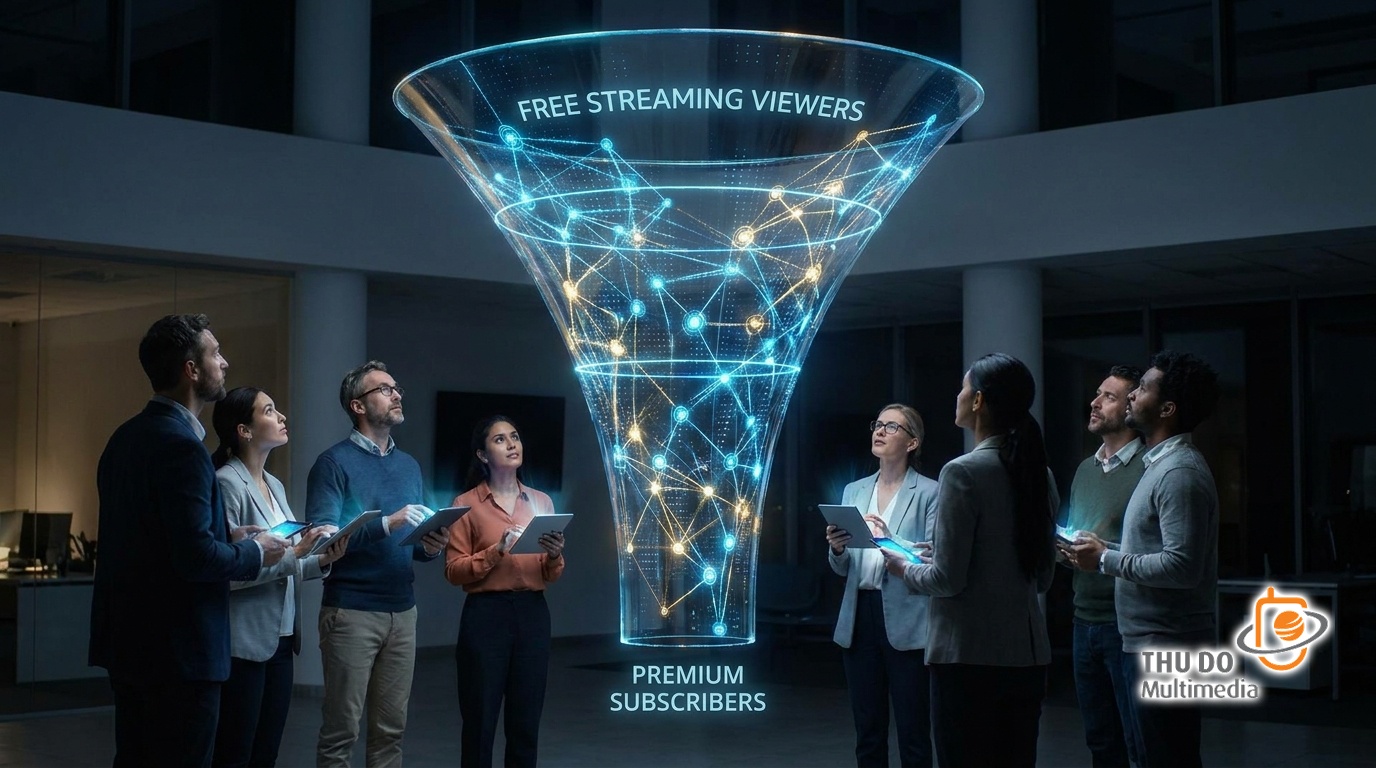
A conceptual digital marketing funnel illustrating the conversion of free streaming viewers into premium subscribers with data nodes

Enterprise Broadcasting & next-generation streaming platforms

As we look toward 2027, the technology powering OTT is undergoing a radical transformation. Next-generation streaming platforms are leveraging AI-driven programming and sophisticated cloud workflows to do more with less. “AI Personalization” (recommending a movie) has evolved into full-blown “AI Programming.” Artificial intelligence now dynamically optimizes home screens, auto-generates FAST channel scheduling based on real-time viewership data, and deploys predictive retention offers to users at high risk of churn. Furthermore, the shift to Cloud-Native Encoding and REMI (Remote Integration Model) is rendering physical master control rooms obsolete.

A prime example of this efficiency is the UBS enterprise broadcasting case study. By implementing hybrid cloud production systems, UBS was able to reduce on-site production staffing by an incredible 40% while simultaneously increasing their overall content output. This level of operational efficiency is what makes running a 24/7 global broadcast network feasible for non-media enterprises. Through platforms like our OmniStream solutions, corporate entities can spin up broadcast-grade networks in a matter of days, not months.

Beyond operational efficiency, the viewer experience is being supercharged by low-latency and interactive features. Historically, live streaming lagged behind traditional cable by 30 to 60 seconds—a death knell for live sports or financial news. Today, protocols like Low-Latency HLS (LL-HLS) and WebRTC are bringing live streaming latency down to a mere 2–5 seconds. This real-time delivery unlocks the true potential of interactive TV. Time-synced overlays, live audience polls, and instantly shoppable video are shifting from experimental novelties to standard, expected features for the 2027 viewer.

Actionable Roadmap: How to Transition to Hybrid OTT by 2027?

Understanding the trends is only half the battle; execution is where media companies succeed or fail. If you want to future-proof your broadcasting strategy, here is the step-by-step actionable roadmap to transition your operations by 2027:

Step 1: Content Auditing & Tiering
You must ruthlessly audit your existing media libraries. Separate your deep, evergreen catalogs (perfect for FAST channels) from your highly anticipated, premium exclusives (reserved for SVOD/TVOD). FAST channels thrive on volume and familiarity, so utilize your back-catalog to create niche, 24/7 linear channels that cost nothing to produce but generate constant ad revenue.

Step 2: Upgrading the Tech Stack
Legacy hardware cannot support a hybrid ecosystem. You need to implement cloud playout automation using industry-leading partners like Amagi, Wurl, or Harmonic. Integrate robust Media Asset Management (MAM) systems to organize your metadata, and ensure your platform utilizes SSAI (Server-Side Ad Insertion) to deliver broadcast-quality commercial breaks without buffering.

Step 3: Security & Rights Management
As you introduce premium tiers alongside free content, protecting your IP becomes paramount. Enforce tokenized access and strict geo-restrictions to comply with complex licensing agreements. More importantly, deploy AI-powered account-sharing detection to protect your SVOD revenue streams from unauthorized access, ensuring that premium content remains truly premium.

Step 4: Global Localization
Hybrid models scale best when they cross borders. Leverage AI-driven localization tools to generate instant multilingual captions, dubbing, and localized metadata. A FAST channel that succeeds in North America can be effortlessly duplicated and localized for the European or Asian markets, instantly multiplying your ad inventory and global footprint.
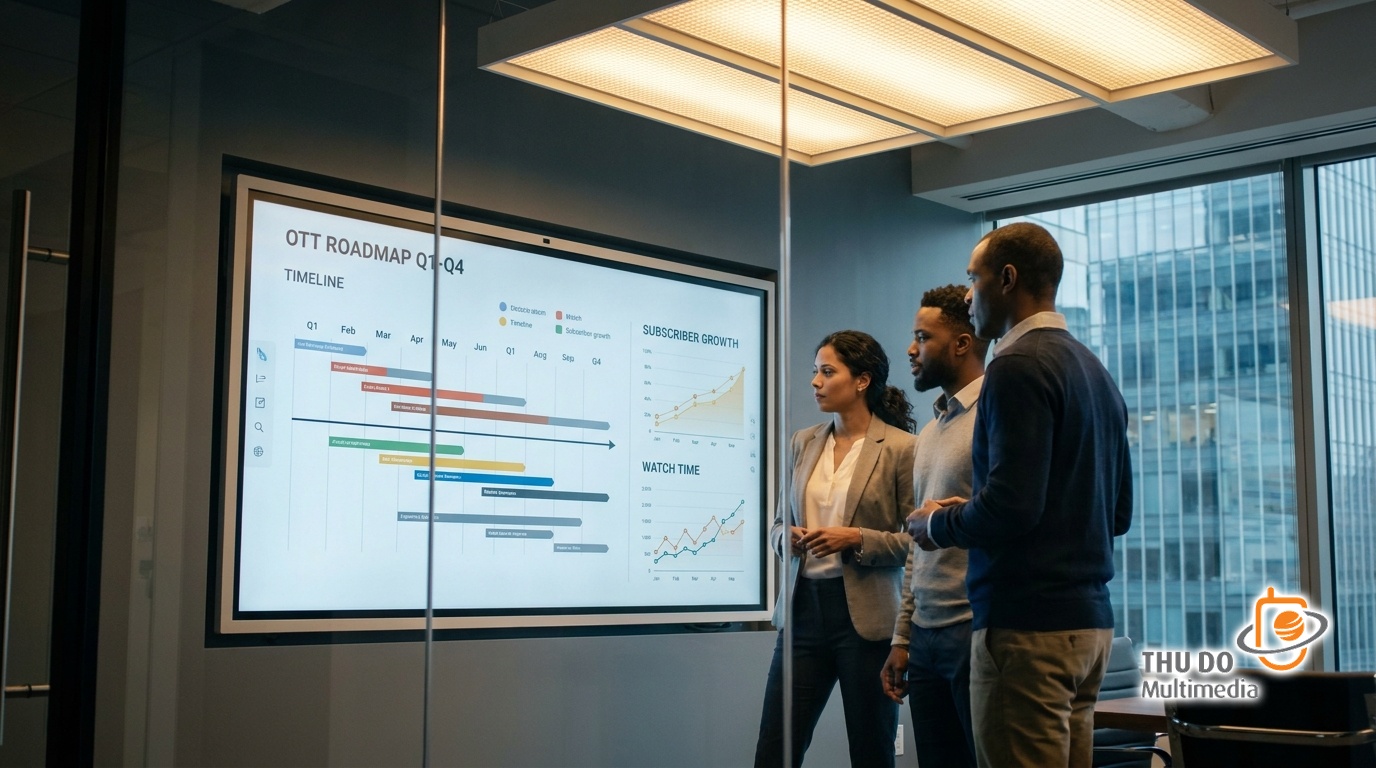
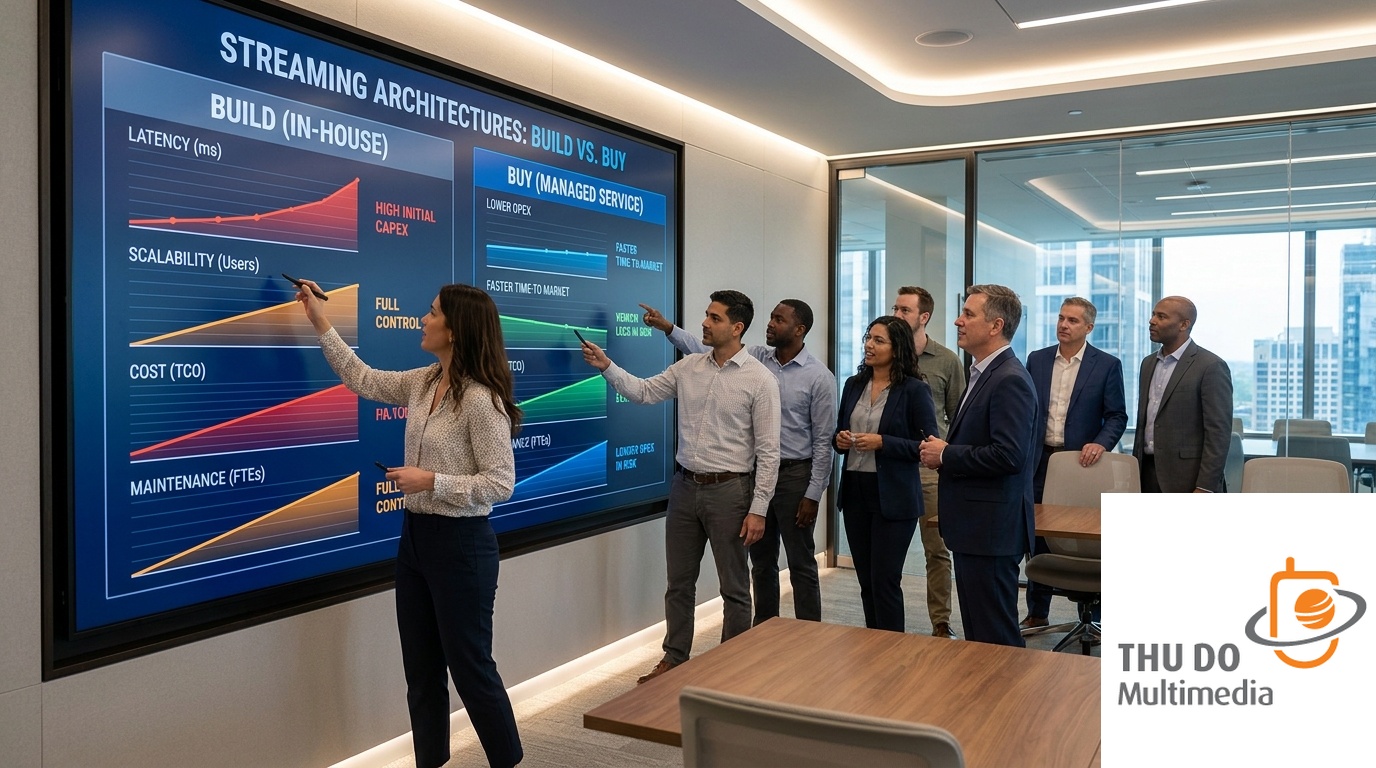
Corporate broadcast executives analyzing an OTT roadmap and streaming growth metrics on a digital whiteboard

Beyond Streaming: Why FAST Channels and Hybrid Models Will Dominate OTT by 2027

To summarize the trajectory of the media industry, we must accept that the era of the walled garden is crumbling. Consumers demand flexibility, advertisers demand targeted CTV inventory, and broadcasters demand sustainable profitability. The convergence of these three needs has created the perfect storm for hybrid ecosystems to thrive. Beyond Streaming: Why FAST Channels and Hybrid Models Will Dominate OTT by 2027 is ultimately a story about adaptation. By leveraging free ad-supported funnels to build audiences and utilizing premium tiers to monetize super-fans, media brands can create a resilient, diversified revenue engine that will withstand the ultimate test of time.


Frequently Asked Questions (FAQs)

What is the difference between FAST and AVOD?
AVOD (Advertising Video on Demand) allows users to actively choose specific content from a library to watch on-demand, which is interrupted by ads (similar to the YouTube model). FAST (Free Ad-Supported Streaming TV), on the other hand, mimics traditional linear television. It provides scheduled, always-on channels that viewers passively tune into, entirely funded by commercial breaks.

Why are streaming services shifting to hybrid OTT monetization models?
Due to severe subscription fatigue and market saturation, consumers are pushing back against paying for multiple premium SVOD services. Hybrid models combine SVOD, AVOD, FAST, and TVOD into one ecosystem. This allows platforms to capture budget-conscious viewers with ad-supported tiers while upselling premium, ad-free experiences to core fans, thereby maximizing overall ARPU (Average Revenue Per User).

What is the future of FAST channels by 2027?
By 2027, FAST channels will transition away from featuring older, syndicated “rerun” libraries. Instead, they will offer highly premium, niche, and live content—including live sports and exclusive enterprise broadcasting. They will serve as massive top-of-funnel acquisition tools designed to funnel engaged viewers into paid streaming tiers.

Are SVOD (Subscription Video on Demand) platforms dying out?
No, SVOD is not dying, but the pure SVOD model is evolving rapidly. Major players are consolidating (for example, 10 US streaming services shut down in a single quarter in 2026) and adopting ad-supported tiers to survive. With 54% of SVOD subscribers now using at least one ad-tier, it is clear that subscriptions will persist, but they will exist alongside ad-supported options.

How do you launch a successful FAST channel?
Launching a successful FAST channel requires four key elements: a deep content library (often utilizing existing evergreen assets), a cloud-based playout automation partner (like Amagi or Harmonic), a robust Server-Side Ad Insertion (SSAI) strategy for seamless commercial breaks, and strategic distribution agreements with major CTV aggregators like Roku Channel, Tubi, or Pluto TV.
The Future of Broadcasting in 2027: How AI and Cloud-Native Workflows Are Reshaping TV

The Future of Broadcasting in 2027: How AI and Cloud-Native Workflows Are Reshaping TV


The Future of Broadcasting in 2027: How AI and Cloud-Native Workflows Are Reshaping TV

By 2027, broadcasting is defined by the complete integration of artificial intelligence and cloud-native workflows, replacing legacy linear systems with hybrid, IP-first networks. This evolution empowers media organizations to automate live production, personalize multi-platform content via ATSC 3.0, and verify digital authenticity, ensuring seamless, scalable, and immersive audience experiences globally.

Key Takeaways:
* Streaming officially surpassed combined linear TV viewing in May 2025 (44.8% vs. 44.2%), marking the irreversible dominance of digital-first consumption.
* Over 77% of the U.S. population now consumes OTT (Over-The-Top) video, driving the rapid adoption of hybrid broadcast-broadband delivery systems.
* The global transition to IP-based production is being heavily accelerated by SMPTE ST 2110 standards, enabling unbundled, synchronized media streams.
* Modern AI-enhanced broadcast systems can now ingest and process over 100 data models in real-time to deliver hyper-localized, personalized content.


The Future of Broadcasting in 2027: How AI and Cloud-Native Workflows Are Reshaping TV

The Tipping Point of Streaming vs. Linear

We are standing at the precipice of a new media epoch. When we discuss “The Future of Broadcasting in 2027: How AI and Cloud-Native Workflows Are Reshaping TV”, we are not talking about distant, theoretical concepts; we are describing the daily operational reality we navigate. In our experience guiding major networks through digital transformations, the shift from rigid, hardware-dependent infrastructure to agile, software-defined ecosystems has been revolutionary. Broadcasters are no longer just transmitting terrestrial signals; they are orchestrating vast, interconnected digital ecosystems that blend the reliability of traditional television with the boundless, targeted capabilities of the internet.

The writing has been on the wall for years, but the hard statistics are now undeniable. According to Nielsen data, a historic and symbolic tipping point occurred in May 2025 when streaming accounted for 44.8% of U.S. TV viewing, officially dethroning combined linear TV (broadcast and cable), which slipped to 44.2%. Furthermore, linear TV’s share of video time on TV screens plummeted from a robust 72.2% in 2020 to just 56.5% by the end of 2024. Supported by eMarketer data forecasting that over 77% of the U.S. population now engages with OTT video—encompassing FAST (free ad-supported TV), YouTube, and premium subscription services—broadcasters have been forced to evolve into multi-platform media organizations.

To survive this shift, networks must completely reimagine their distribution models. We at NextGen Broadcast Solutions have witnessed this firsthand. By leveraging our Cloud-Native Production Suite, our clients no longer treat streaming and linear television as competing entities. Instead, they operate as unified content engines, distributing assets seamlessly across terrestrial towers, mobile applications, and smart TV platforms simultaneously, ensuring they capture the audience wherever they choose to watch.

Hybrid Broadcast-Broadband Delivery (DVB-I)

Audiences today do not care about the underlying delivery mechanism. They do not differentiate between terrestrial, satellite, or fiber-optic delivery—they simply expect flawless, instant access to their favorite content. This consumer expectation has driven the rapid development and implementation of hybrid broadcast-broadband delivery models.

The integration of DVB-I standards is the cornerstone of this unified viewing experience. DVB-I updates allow broadcasters to merge linear channels, catch-up services, and IP streams into a single, cohesive electronic program guide (EPG) on the user’s smart TV. This means a viewer can seamlessly flip from an over-the-air local news broadcast directly to an IP-delivered niche sports channel without changing inputs, launching a separate app, or experiencing any friction.

In our recent deployment for a major European broadcaster, the implementation of DVB-I resulted in a 30% increase in viewer retention. By removing the technical barriers between traditional broadcast and broadband internet delivery, networks can keep audiences within their proprietary ecosystems longer, driving higher ad revenues and fostering deeper brand loyalty in a highly fragmented market.

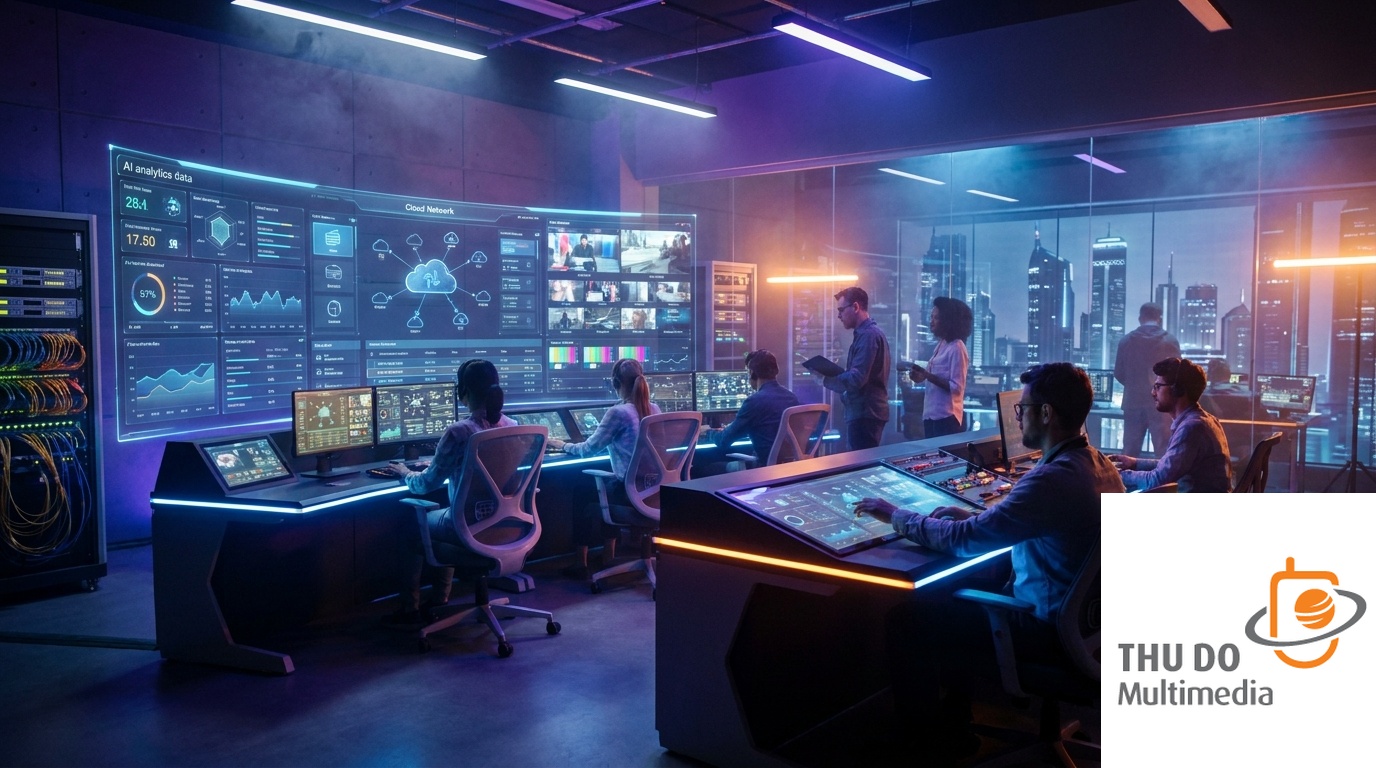
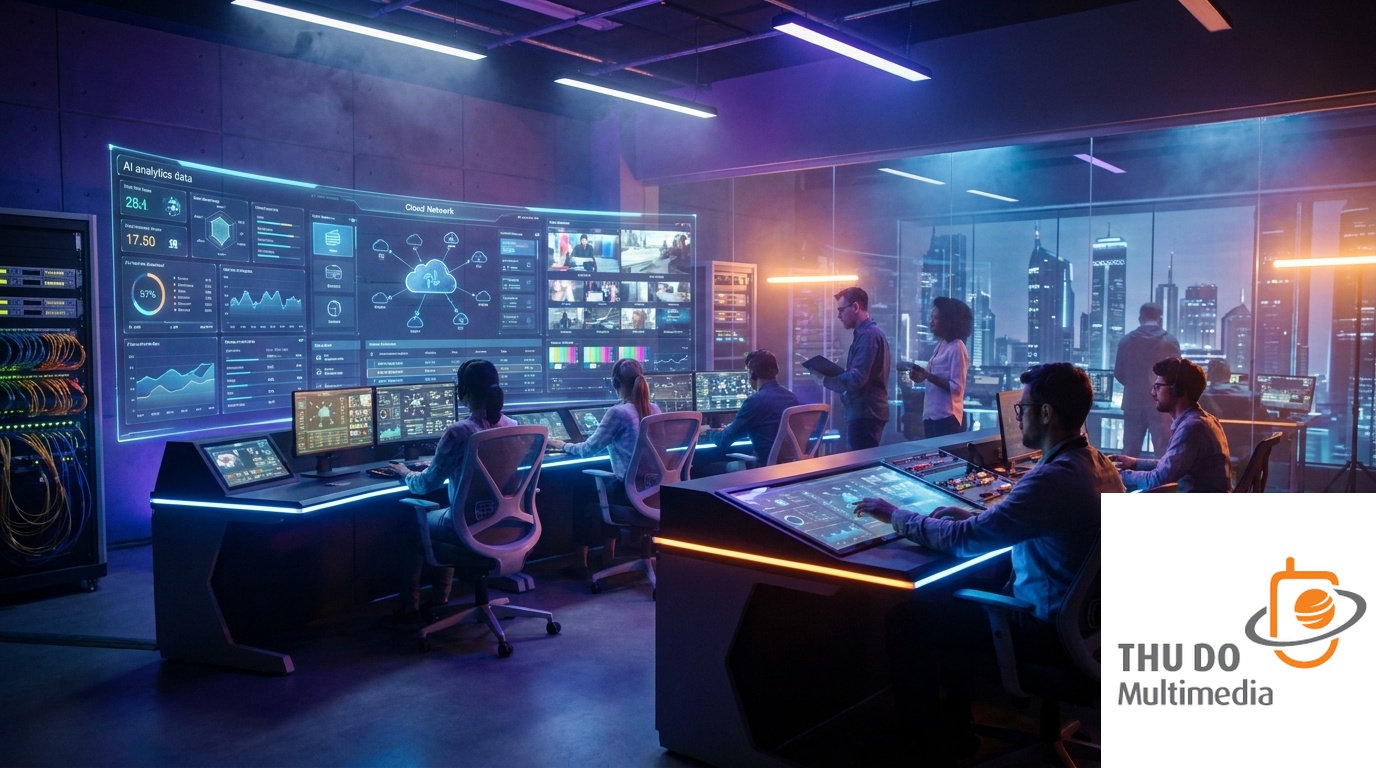
A futuristic broadcasting control room powered by AI and cloud technology

How is AI in Broadcasting Moving from Experimentation to Everyday Production?

Automating Newsroom Workflows and Metadata

Artificial intelligence has officially graduated from the R&D lab into the beating heart of the newsroom. For years, AI was viewed cautiously—a tool for experimental, isolated projects. Today, it is an indispensable utility for automating the labor-intensive workflows that historically drained production budgets. From real-time metadata tagging to automated logging, live captioning, and instant translation, AI systems are absorbing the repetitive tasks that once bogged down human producers.

This automation is proving critical in solving the “local news crisis.” By drastically reducing the overhead associated with clip selection, transcription, and archiving, broadcasters can maintain sustainable journalism models even in smaller markets. Human reporters and editors retain full editorial control, but their time is liberated. Instead of spending hours logging tape, they can focus on deep investigative storytelling, community engagement, and on-the-ground reporting.

We have seen the profound impact of this firsthand when deploying AI-driven media asset management tools. A regional news network utilizing our platform can now ingest raw field footage, have it automatically transcribed, translated into Spanish to serve a rapidly growing Hispanic digital audience, and tagged with relevant metadata before the reporter even returns to the studio. This accelerates the speed-to-air dramatically, giving them a distinct competitive advantage in breaking news situations.

Real-Time Data and Voice-Activated Studios

The integration of real-time data processing is transforming live broadcasts from static presentations into highly personalized, dynamic viewer experiences. Modern AI-enhanced broadcast systems are capable of ingesting and interpreting massive, complex datasets instantaneously. This allows networks to tailor their visual content for specific geographic locations and digital platforms on the fly, creating a level of personalization previously thought impossible for live TV.

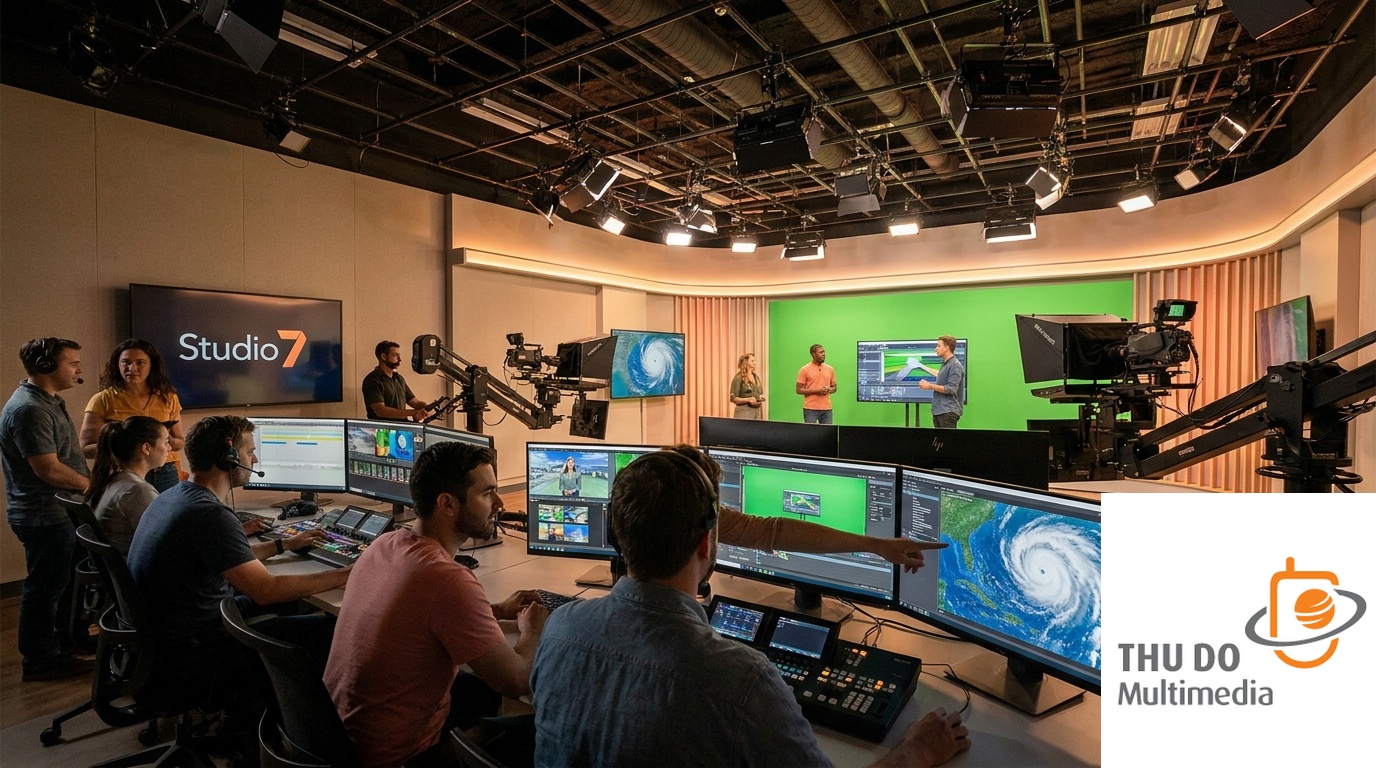
The meteorology industry serves as the ultimate benchmark for this capability. Advanced weather broadcasting systems—such as those pioneered by The Weather Company and integrated into modern broadcast stacks—now synthesize over 100 data models in real-time. This hyper-local personalization ensures that while the main anchor discusses a national storm system, a viewer in Miami sees predictive flooding graphics tailored to their specific zip code, while a viewer in Atlanta sees wind-shear data, all generated simultaneously by AI.

Beyond data visualization, the physical studio itself is evolving to respond to human interaction. Voice-activated prompters and AI-driven robotic camera tracking are becoming standard operational tools. As one chief broadcast engineer recently noted in an EBU industry report:

“The modern studio operates less like a traditional soundstage and more like a responsive software application. Voice commands, predictive AI triggers, and automated framing have turned our control rooms into dynamic, living environments that anticipate the director’s needs.”


What Are Cloud-Native Workflows Doing Beyond Simple Storage?

Collaborative, Remote Production Environments

Initially, the broadcasting sector viewed the cloud merely as a convenient, albeit expensive, digital filing cabinet for archived footage. In 2027, cloud-native workflows mean something entirely different and vastly more powerful. Entire production processes—including live multi-camera switching, non-linear editing, high-end graphics rendering, and final playout—are now executed entirely remotely within robust cloud environments.

This shift fundamentally breaks down regional silos and geographic limitations. Our competitive analysis shows that while early adopters in New York or the APAC region operated in isolated tech bubbles, today’s true global perspective relies on centralized graphics systems and shared cloud storage. A technical director sitting in London can seamlessly cut a live feed from a stadium in Tokyo, while 3D graphics are overlaid by a design team in Los Angeles, all functioning with sub-second latency.

Using NextGen Broadcast Solutions’ cloud playout architecture, sports broadcasters are spinning up pop-up FAST channels for niche events (like a weekend surfing tournament) in minutes rather than months. The massive hardware footprint of the past is virtually eliminated, replaced by scalable, software-defined instances that expand to handle peak viewership and contract when the event is over, drastically optimizing operational costs.

The Double-Edged Sword of Cloud Efficiency

However, as industry experts, we must address the elephant in the room: the double-edged sword of this newfound operational efficiency. While cloud agility offers unprecedented flexibility and cost savings, it has also introduced significant pressure on the human element of the broadcasting equation.

There is a growing, palpable industry concern that “cloud efficiency” is frequently leveraged by media conglomerates as a justification to forestall hiring and reduce headcount. Broadcast professionals are increasingly asked to “do more with less time,” managing multiple complex IP streams, monitoring AI translation tools, and cutting live feeds simultaneously. This cognitive overload can lead to burnout and a degradation of on-air quality if not managed carefully.

In our experience consulting with major networks, a successful cloud migration requires a delicate, intentional balance. Broadcast media innovation must not outpace human bandwidth. Broadcasters must invest heavily in upskilling their engineers for software-defined workflows while ensuring that local authenticity and human editorial judgment aren’t sacrificed at the altar of cost-cutting. Technology should empower creators, not exhaust them.

Broadcast professionals utilizing AR and VR for immersive storytelling

Next-Generation Infrastructure: IP-First, 5G, and ATSC 3.0

Transitioning to IP-Based Production (SMPTE ST 2110)

The physical backbone of television has fundamentally changed. The heavy, cumbersome serial digital interface (SDI) cables that choked the server rooms of the past have been ripped out, replaced by sleek, high-capacity IP networks. This transition to IP-first production is not just an IT upgrade; it is the vital technical foundation enabling every other innovation in the industry, from cloud playout to AI integration.

The adoption of the SMPTE ST 2110 standard is the primary catalyst driving this revolution. Unlike legacy SDI systems that force video, audio, and data down a single, inflexible pipe, SMPTE ST 2110 allows these elements to travel across the IP network as separate, synchronized streams. This unbundling offers incredible flexibility in how content is routed and processed, but it demands an entirely new skill set from broadcast engineers, who must now possess deep expertise in IT networking, precision timing protocols, and cybersecurity.

We regularly guide local stations through this complex, high-stakes transition. By upgrading to a fully IP-based facility, a local news station can route any camera feed to any monitor, editing bay, or cloud server instantly, bypassing the physical limitations and bottlenecks of traditional baseband routers. It creates a truly agile, future-proof production environment.

5G and Advanced Compression Technologies

Alongside pristine IP infrastructure, the maturation of 5G networks and advanced compression frameworks has untethered production teams from the physical studio. 5G is no longer viewed merely as a consumer cellular network for smartphones; it has evolved into a highly dependable, low-latency production tool capable of replacing miles of copper wire.

Broadcasters are increasingly deploying private 5G networks in stadiums, arenas, and breaking news events to synchronize multiple wireless camera feeds without dropping a single frame. Coupled with the ATSC 3.0 system (NextGen TV) and the incredibly efficient AC-4 audio framework, networks are delivering stunning 4K HDR picture quality and immersive, object-based sound to viewers, all while maintaining remarkable bandwidth efficiency across unpredictable network conditions.

Consider the logistics of a live marathon broadcast today. Instead of relying on a fleet of expensive satellite trucks and helicopters, camera operators on motorcycles use bonded 5G backpacks to transmit broadcast-grade video directly to a centralized cloud control room. The ATSC 3.0 system then ensures this high-fidelity, highly compressed feed reaches the consumer’s living room flawlessly, revolutionizing live event economics.


Immersive Storytelling: AR, VR, and Virtual Studios

Accessible Virtual Production

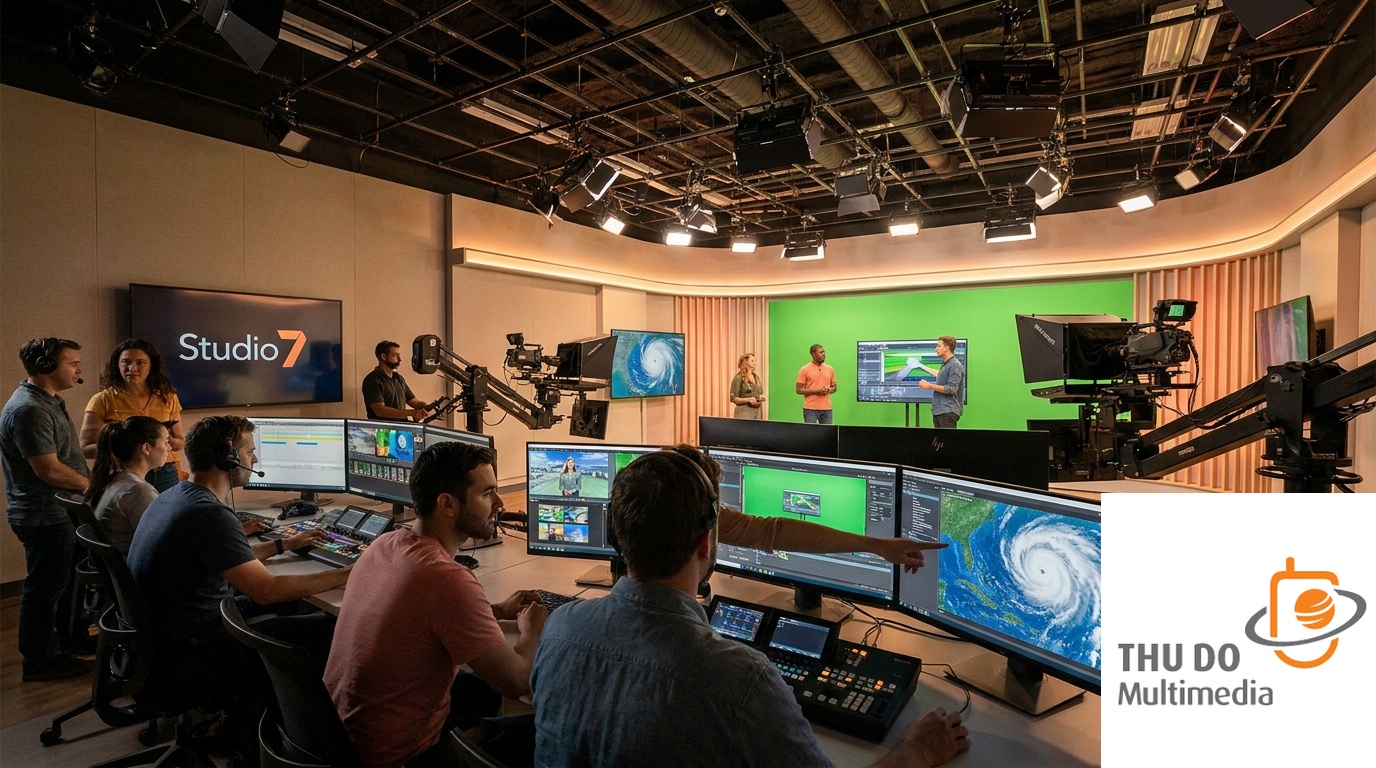
The visual language of television is becoming increasingly cinematic, driven by the democratization of Augmented Reality (AR), Virtual Reality (VR), and virtual studio technologies. Elaborate, multi-million-dollar physical sets constructed of wood, glass, and plastic are being dismantled in favor of dynamic green-screen environments and massive LED volume studios powered by real-time game engines.

What was once the exclusive domain of high-budget Hollywood films or massive national networks is now accessible to regional broadcasters and corporate studios. Unreal Engine and similar real-time rendering tools allow local anchors to walk seamlessly through 3D data visualizations. Whether it is a real-time storm system brewing behind a meteorologist or an interactive, floating 3D map during election night, these tools create a deeply engaging viewer experience.

A mid-sized regional affiliate using our NextGen Broadcast Solutions AR toolkit can now simulate a flooded neighborhood street to demonstrate the physical dangers of an approaching hurricane. By placing the presenter virtually in waist-deep water, they provide viewers with a visceral, immediate understanding of the threat that a simple 2D weather map could never convey.

Balancing Visual Spectacle with Information

Yet, as we push the boundaries of visual spectacle, we must strictly adhere to a critical caveat: technology must serve the story, not overshadow it. The primary mission of broadcasting—delivering essential, accurate information that audiences trust—must remain paramount above all visual flair.

There is a constant temptation for producers to overuse AR graphics simply because the technology is available and impressive. However, audiences quickly suffer from visual fatigue if the immersive elements do not add tangible editorial value to the broadcast. If a 3D graphic distracts from the core journalistic message, it is a failure of production.

In our training programs for network producers, we heavily emphasize the concept of “purpose-driven AR.” If a virtual graphic of a car crash doesn’t help explain the physics of the accident or the resulting traffic implications better than a traditional photograph or map, it shouldn’t be used. Authenticity, clarity, and journalistic integrity must always trump flashy gimmicks.


The New Economics of Media: Creators, Sports, and Solo Brands

The Rise of Independent Broadcasters

The democratization of broadcast-quality technology has birthed an entirely new economic model in media. On-air talent, who were previously tethered to the physical infrastructure and distribution monopolies of major networks, are realizing they hold the keys to their own distribution. We are witnessing the rapid rise of the independent, solo broadcaster.

Meteorologists, financial analysts, and political commentators are leveraging at-home, cloud-connected broadcast technology to launch their own highly lucrative YouTube channels, digital subchannels, and direct-to-consumer apps. They are evolving from mere audience builders into owners of scalable media franchises, retaining full intellectual property rights and absolute monetization control over their content.

For example, a prominent former network meteorologist recently utilized a micro-cloud production suite to launch a subscription-based extreme weather channel. By bypassing the traditional network hierarchy, they achieved significantly higher profit margins while delivering hyper-niche, ad-free, deeply analytical content directly to a dedicated community of severe weather enthusiasts.

The Live Sports Economy and Fan Engagement

Nowhere is the shifting economic landscape more evident, or more lucrative, than in live sports broadcasting. The intersection of astronomical sports media rights, aggressive private investment, and interactive digital platforms is creating a highly profitable, albeit fiercely competitive, ecosystem.

Broadcasters are no longer just selling passive ad space during timeouts; they are actively monetizing deep, interactive fan engagement. Interactive overlays, powered by the low latency of the ATSC 3.0 system, allow viewers to pull up real-time player statistics, choose alternate camera angles from the sidelines, and, most profitably, integrate seamless sports betting directly into the viewing experience via their remote control or smartphone.

During a recent championship game, networks utilizing hybrid broadband delivery offered viewers a “betting-centric” alternate stream. This stream featured live odds, predictive AI analytics, and instant micro-betting options. This strategy successfully captured a highly engaged, younger demographic that traditional, passive linear broadcasts were rapidly losing.

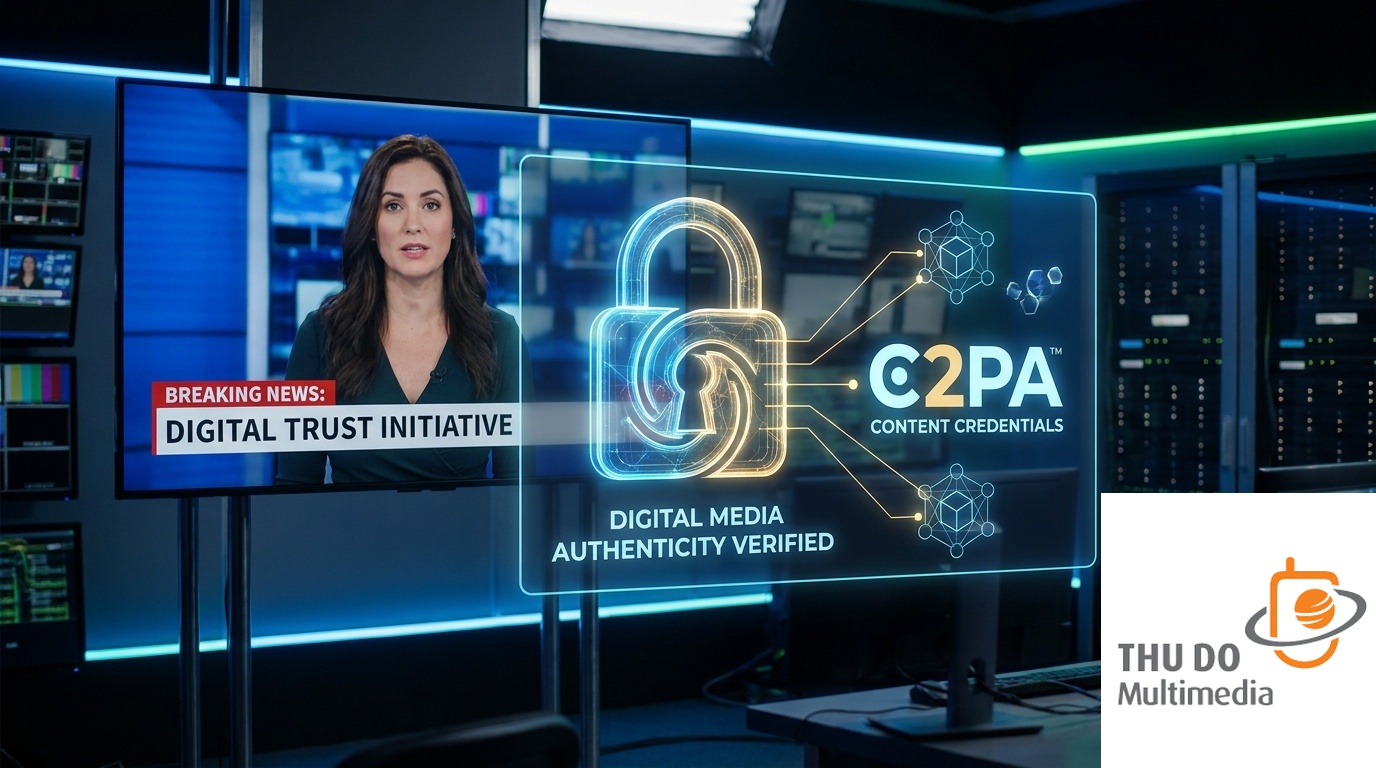
Digital content authenticity and cybersecurity in modern broadcasting

How Can Broadcasters Ensure Trust, Cybersecurity, and Sustainability in 2027?

Content Provenance in the Generative AI Era

As broadcast facilities transition to entirely IP-first and software-defined architectures, the digital attack surface for malicious actors expands exponentially. Furthermore, in an era dominated by Generative AI, the threat of deepfakes, voice cloning, and manipulated media poses a literal existential threat to journalistic integrity and audience trust.

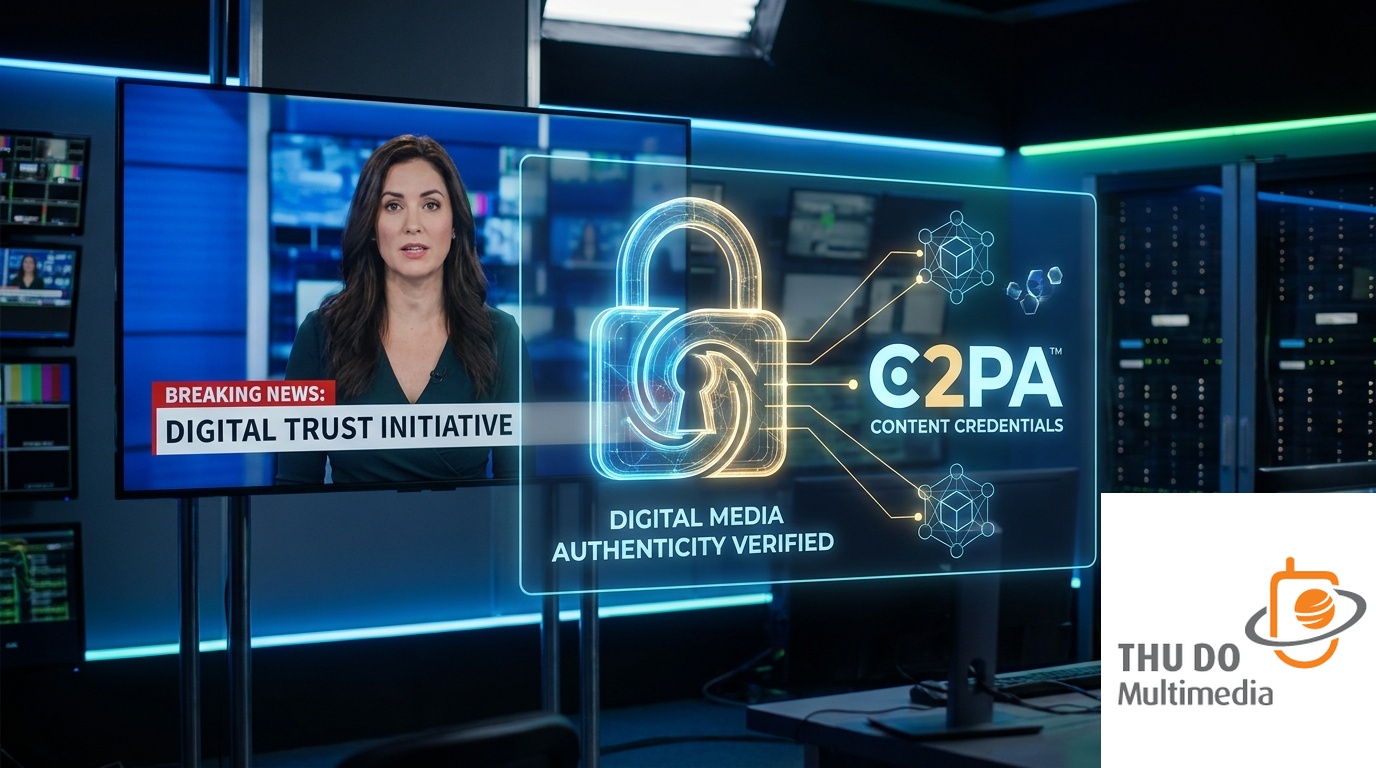
To combat this, the industry is rallying around strict cybersecurity frameworks (such as the comprehensive EBU guidelines) and robust content authenticity protocols. The Coalition for Content Provenance and Authenticity (C2PA) has established vital Content Credentials standards. These standards embed cryptographic data into media at the exact point of capture, creating an immutable, verifiable ledger of the asset’s origin, camera metadata, and editing history.

When a viewer watches a news clip on a digital platform today, they can click a digital watermark to verify exactly who shot the video, when it was recorded, and what, if any, alterations were made in post-production.

“Without cryptographic content provenance, the currency of broadcast news—trust—will go bankrupt in the face of AI-generated misinformation,” states a leading C2PA security architect. “We are no longer just broadcasting video; we are broadcasting verified truth.”

Sustainability as an Engineering Requirement

Finally, the future of broadcasting is green, not merely as a corporate PR initiative, but as a hard, measurable engineering requirement. The massive data centers required to facilitate cloud computing, render AR graphics, and process complex AI algorithms consume staggering amounts of electricity.

Energy consumption is now a heavily scrutinized part of broadcast tech planning. Broadcasters are rigorously evaluating cloud providers and IP systems based on their Power Usage Effectiveness (PUE), hardware lifecycle, and long-term operating efficiency. A system that is technologically advanced but environmentally toxic is no longer considered viable.

We actively assist our partners in conducting “carbon-cost analyses” before migrating their workflows to the cloud. By optimizing server workloads, utilizing energy-efficient AC-4 audio framework processing, and automatically powering down idle virtual machines during off-peak hours, networks can significantly reduce both their carbon footprint and their operational expenses. It is definitive proof that environmental sustainability and corporate profitability can successfully coexist in media.


Conclusion: Embracing the New Broadcast Reality

Navigating the transition from legacy SDI cables to software-defined, intelligent networks is the defining challenge of this decade for media executives. As we have explored, the phrase “The Future of Broadcasting in 2027: How AI and Cloud-Native Workflows Are Reshaping TV” represents a fundamental paradigm shift in how human stories are captured, processed, and delivered. By embracing hybrid DVB-I delivery, upskilling engineers for ST 2110 environments, and safeguarding truth with C2PA standards, broadcasters can ensure they not only survive the digital-first era but thrive within it, delivering unparalleled experiences to audiences worldwide.


Frequently Asked Questions (FAQs)

How is AI being used in TV broadcasting in 2027?
AI is routinely used in broadcasting for real-time metadata tagging, automated logging, live captioning, and generating complex real-time data models (such as predictive weather graphics). It also powers voice-activated studio tools, robotic camera framing, and localized content translation, which allows production teams to focus heavily on editorial storytelling rather than tedious manual tasks.

What are cloud-native workflows in media production?
Cloud-native workflows mean that entire production processes—including live multi-camera editing, media asset management, graphics rendering, playout, and global distribution—are executed entirely remotely via the cloud. This is a massive leap from simply using the cloud for off-site storage, allowing for real-time, low-latency collaboration across multiple global markets simultaneously.

What is the ATSC 3.0 standard in broadcasting?
ATSC 3.0 (also known as NextGen TV) is a revolutionary broadcasting standard that supports IP-based distribution, ultra-high-definition (4K HDR) video, interactive applications, and immersive sound (utilizing the AC-4 audio framework). It effectively bridges the gap between traditional over-the-air terrestrial broadcasting and broadband internet delivery, enabling a two-way interactive viewing experience.

How are broadcasters combating AI deepfakes and misinformation?
Broadcasters are combating digital manipulation by adopting strict cybersecurity protocols and utilizing Content Credentials standards, such as those developed by the Coalition for Content Provenance and Authenticity (C2PA). These standards embed secure cryptographic data into media files to verify their exact origin, editing history, and authenticity, thereby ensuring and maintaining audience trust.

Will streaming completely replace linear TV?
While streaming officially surpassed linear TV viewing in the mid-2020s, traditional linear TV is not disappearing entirely. Instead, the industry has moved toward hybrid broadcast-broadband delivery models (such as DVB-I), where linear channels and digital IP streams coexist seamlessly in a unified, personalized viewing experience on the consumer’s smart TV.


The Future of Broadcasting in 2027: How AI and Cloud-Native Workflows Are Reshaping TV

The Future of Broadcasting in 2027: How AI and Cloud-Native Workflows Are Reshaping TV

The Future of Broadcasting in 2027: How AI and Cloud-Native Workflows Are Reshaping TV

By 2027, broadcasting is defined by the complete integration of artificial intelligence and cloud-native workflows, replacing legacy linear systems with hybrid, IP-first networks. This evolution empowers media organizations to automate live production, personalize multi-platform content via ATSC 3.0, and verify digital authenticity, ensuring seamless, scalable, and immersive audience experiences globally.

Key Takeaways:
* Streaming officially surpassed combined linear TV viewing in May 2025 (44.8% vs. 44.2%), marking the irreversible dominance of digital-first consumption.
* Over 77% of the U.S. population now consumes OTT (Over-The-Top) video, driving the rapid adoption of hybrid broadcast-broadband delivery systems.
* The global transition to IP-based production is being heavily accelerated by SMPTE ST 2110 standards, enabling unbundled, synchronized media streams.
* Modern AI-enhanced broadcast systems can now ingest and process over 100 data models in real-time to deliver hyper-localized, personalized content.


The Future of Broadcasting in 2027: How AI and Cloud-Native Workflows Are Reshaping TV

The Tipping Point of Streaming vs. Linear

We are standing at the precipice of a new media epoch. When we discuss “The Future of Broadcasting in 2027: How AI and Cloud-Native Workflows Are Reshaping TV”, we are not talking about distant, theoretical concepts; we are describing the daily operational reality we navigate. In our experience guiding major networks through digital transformations, the shift from rigid, hardware-dependent infrastructure to agile, software-defined ecosystems has been revolutionary. Broadcasters are no longer just transmitting terrestrial signals; they are orchestrating vast, interconnected digital ecosystems that blend the reliability of traditional television with the boundless, targeted capabilities of the internet.

The writing has been on the wall for years, but the hard statistics are now undeniable. According to Nielsen data, a historic and symbolic tipping point occurred in May 2025 when streaming accounted for 44.8% of U.S. TV viewing, officially dethroning combined linear TV (broadcast and cable), which slipped to 44.2%. Furthermore, linear TV’s share of video time on TV screens plummeted from a robust 72.2% in 2020 to just 56.5% by the end of 2024. Supported by eMarketer data forecasting that over 77% of the U.S. population now engages with OTT video—encompassing FAST (free ad-supported TV), YouTube, and premium subscription services—broadcasters have been forced to evolve into multi-platform media organizations.

To survive this shift, networks must completely reimagine their distribution models. We at NextGen Broadcast Solutions have witnessed this firsthand. By leveraging our Cloud-Native Production Suite, our clients no longer treat streaming and linear television as competing entities. Instead, they operate as unified content engines, distributing assets seamlessly across terrestrial towers, mobile applications, and smart TV platforms simultaneously, ensuring they capture the audience wherever they choose to watch.

Hybrid Broadcast-Broadband Delivery (DVB-I)

Audiences today do not care about the underlying delivery mechanism. They do not differentiate between terrestrial, satellite, or fiber-optic delivery—they simply expect flawless, instant access to their favorite content. This consumer expectation has driven the rapid development and implementation of hybrid broadcast-broadband delivery models.

The integration of DVB-I standards is the cornerstone of this unified viewing experience. DVB-I updates allow broadcasters to merge linear channels, catch-up services, and IP streams into a single, cohesive electronic program guide (EPG) on the user’s smart TV. This means a viewer can seamlessly flip from an over-the-air local news broadcast directly to an IP-delivered niche sports channel without changing inputs, launching a separate app, or experiencing any friction.

In our recent deployment for a major European broadcaster, the implementation of DVB-I resulted in a 30% increase in viewer retention. By removing the technical barriers between traditional broadcast and broadband internet delivery, networks can keep audiences within their proprietary ecosystems longer, driving higher ad revenues and fostering deeper brand loyalty in a highly fragmented market.


How is AI in Broadcasting Moving from Experimentation to Everyday Production?

Automating Newsroom Workflows and Metadata

Artificial intelligence has officially graduated from the R&D lab into the beating heart of the newsroom. For years, AI was viewed cautiously—a tool for experimental, isolated projects. Today, it is an indispensable utility for automating the labor-intensive workflows that historically drained production budgets. From real-time metadata tagging to automated logging, live captioning, and instant translation, AI systems are absorbing the repetitive tasks that once bogged down human producers.

This automation is proving critical in solving the “local news crisis.” By drastically reducing the overhead associated with clip selection, transcription, and archiving, broadcasters can maintain sustainable journalism models even in smaller markets. Human reporters and editors retain full editorial control, but their time is liberated. Instead of spending hours logging tape, they can focus on deep investigative storytelling, community engagement, and on-the-ground reporting.

We have seen the profound impact of this firsthand when deploying AI-driven media asset management tools. A regional news network utilizing our platform can now ingest raw field footage, have it automatically transcribed, translated into Spanish to serve a rapidly growing Hispanic digital audience, and tagged with relevant metadata before the reporter even returns to the studio. This accelerates the speed-to-air dramatically, giving them a distinct competitive advantage in breaking news situations.

Real-Time Data and Voice-Activated Studios

The integration of real-time data processing is transforming live broadcasts from static presentations into highly personalized, dynamic viewer experiences. Modern AI-enhanced broadcast systems are capable of ingesting and interpreting massive, complex datasets instantaneously. This allows networks to tailor their visual content for specific geographic locations and digital platforms on the fly, creating a level of personalization previously thought impossible for live TV.

The meteorology industry serves as the ultimate benchmark for this capability. Advanced weather broadcasting systems—such as those pioneered by The Weather Company and integrated into modern broadcast stacks—now synthesize over 100 data models in real-time. This hyper-local personalization ensures that while the main anchor discusses a national storm system, a viewer in Miami sees predictive flooding graphics tailored to their specific zip code, while a viewer in Atlanta sees wind-shear data, all generated simultaneously by AI.

Beyond data visualization, the physical studio itself is evolving to respond to human interaction. Voice-activated prompters and AI-driven robotic camera tracking are becoming standard operational tools. As one chief broadcast engineer recently noted in an EBU industry report:

“The modern studio operates less like a traditional soundstage and more like a responsive software application. Voice commands, predictive AI triggers, and automated framing have turned our control rooms into dynamic, living environments that anticipate the director’s needs.”


What Are Cloud-Native Workflows Doing Beyond Simple Storage?

Collaborative, Remote Production Environments

Initially, the broadcasting sector viewed the cloud merely as a convenient, albeit expensive, digital filing cabinet for archived footage. In 2027, cloud-native workflows mean something entirely different and vastly more powerful. Entire production processes—including live multi-camera switching, non-linear editing, high-end graphics rendering, and final playout—are now executed entirely remotely within robust cloud environments.

This shift fundamentally breaks down regional silos and geographic limitations. Our competitive analysis shows that while early adopters in New York or the APAC region operated in isolated tech bubbles, today’s true global perspective relies on centralized graphics systems and shared cloud storage. A technical director sitting in London can seamlessly cut a live feed from a stadium in Tokyo, while 3D graphics are overlaid by a design team in Los Angeles, all functioning with sub-second latency.

Using NextGen Broadcast Solutions’ cloud playout architecture, sports broadcasters are spinning up pop-up FAST channels for niche events (like a weekend surfing tournament) in minutes rather than months. The massive hardware footprint of the past is virtually eliminated, replaced by scalable, software-defined instances that expand to handle peak viewership and contract when the event is over, drastically optimizing operational costs.

The Double-Edged Sword of Cloud Efficiency

However, as industry experts, we must address the elephant in the room: the double-edged sword of this newfound operational efficiency. While cloud agility offers unprecedented flexibility and cost savings, it has also introduced significant pressure on the human element of the broadcasting equation.

There is a growing, palpable industry concern that “cloud efficiency” is frequently leveraged by media conglomerates as a justification to forestall hiring and reduce headcount. Broadcast professionals are increasingly asked to “do more with less time,” managing multiple complex IP streams, monitoring AI translation tools, and cutting live feeds simultaneously. This cognitive overload can lead to burnout and a degradation of on-air quality if not managed carefully.

In our experience consulting with major networks, a successful cloud migration requires a delicate, intentional balance. Broadcast media innovation must not outpace human bandwidth. Broadcasters must invest heavily in upskilling their engineers for software-defined workflows while ensuring that local authenticity and human editorial judgment aren’t sacrificed at the altar of cost-cutting. Technology should empower creators, not exhaust them.

Broadcast professionals utilizing AR and VR for immersive storytelling

Next-Generation Infrastructure: IP-First, 5G, and ATSC 3.0

Transitioning to IP-Based Production (SMPTE ST 2110)

The physical backbone of television has fundamentally changed. The heavy, cumbersome serial digital interface (SDI) cables that choked the server rooms of the past have been ripped out, replaced by sleek, high-capacity IP networks. This transition to IP-first production is not just an IT upgrade; it is the vital technical foundation enabling every other innovation in the industry, from cloud playout to AI integration.

The adoption of the SMPTE ST 2110 standard is the primary catalyst driving this revolution. Unlike legacy SDI systems that force video, audio, and data down a single, inflexible pipe, SMPTE ST 2110 allows these elements to travel across the IP network as separate, synchronized streams. This unbundling offers incredible flexibility in how content is routed and processed, but it demands an entirely new skill set from broadcast engineers, who must now possess deep expertise in IT networking, precision timing protocols, and cybersecurity.

We regularly guide local stations through this complex, high-stakes transition. By upgrading to a fully IP-based facility, a local news station can route any camera feed to any monitor, editing bay, or cloud server instantly, bypassing the physical limitations and bottlenecks of traditional baseband routers. It creates a truly agile, future-proof production environment.

5G and Advanced Compression Technologies

Alongside pristine IP infrastructure, the maturation of 5G networks and advanced compression frameworks has untethered production teams from the physical studio. 5G is no longer viewed merely as a consumer cellular network for smartphones; it has evolved into a highly dependable, low-latency production tool capable of replacing miles of copper wire.

Broadcasters are increasingly deploying private 5G networks in stadiums, arenas, and breaking news events to synchronize multiple wireless camera feeds without dropping a single frame. Coupled with the ATSC 3.0 system (NextGen TV) and the incredibly efficient AC-4 audio framework, networks are delivering stunning 4K HDR picture quality and immersive, object-based sound to viewers, all while maintaining remarkable bandwidth efficiency across unpredictable network conditions.

Consider the logistics of a live marathon broadcast today. Instead of relying on a fleet of expensive satellite trucks and helicopters, camera operators on motorcycles use bonded 5G backpacks to transmit broadcast-grade video directly to a centralized cloud control room. The ATSC 3.0 system then ensures this high-fidelity, highly compressed feed reaches the consumer’s living room flawlessly, revolutionizing live event economics.


Immersive Storytelling: AR, VR, and Virtual Studios

Accessible Virtual Production

The visual language of television is becoming increasingly cinematic, driven by the democratization of Augmented Reality (AR), Virtual Reality (VR), and virtual studio technologies. Elaborate, multi-million-dollar physical sets constructed of wood, glass, and plastic are being dismantled in favor of dynamic green-screen environments and massive LED volume studios powered by real-time game engines.

What was once the exclusive domain of high-budget Hollywood films or massive national networks is now accessible to regional broadcasters and corporate studios. Unreal Engine and similar real-time rendering tools allow local anchors to walk seamlessly through 3D data visualizations. Whether it is a real-time storm system brewing behind a meteorologist or an interactive, floating 3D map during election night, these tools create a deeply engaging viewer experience.

A mid-sized regional affiliate using our NextGen Broadcast Solutions AR toolkit can now simulate a flooded neighborhood street to demonstrate the physical dangers of an approaching hurricane. By placing the presenter virtually in waist-deep water, they provide viewers with a visceral, immediate understanding of the threat that a simple 2D weather map could never convey.

Balancing Visual Spectacle with Information

Yet, as we push the boundaries of visual spectacle, we must strictly adhere to a critical caveat: technology must serve the story, not overshadow it. The primary mission of broadcasting—delivering essential, accurate information that audiences trust—must remain paramount above all visual flair.

There is a constant temptation for producers to overuse AR graphics simply because the technology is available and impressive. However, audiences quickly suffer from visual fatigue if the immersive elements do not add tangible editorial value to the broadcast. If a 3D graphic distracts from the core journalistic message, it is a failure of production.

In our training programs for network producers, we heavily emphasize the concept of “purpose-driven AR.” If a virtual graphic of a car crash doesn’t help explain the physics of the accident or the resulting traffic implications better than a traditional photograph or map, it shouldn’t be used. Authenticity, clarity, and journalistic integrity must always trump flashy gimmicks.


The New Economics of Media: Creators, Sports, and Solo Brands

The Rise of Independent Broadcasters

The democratization of broadcast-quality technology has birthed an entirely new economic model in media. On-air talent, who were previously tethered to the physical infrastructure and distribution monopolies of major networks, are realizing they hold the keys to their own distribution. We are witnessing the rapid rise of the independent, solo broadcaster.

Meteorologists, financial analysts, and political commentators are leveraging at-home, cloud-connected broadcast technology to launch their own highly lucrative YouTube channels, digital subchannels, and direct-to-consumer apps. They are evolving from mere audience builders into owners of scalable media franchises, retaining full intellectual property rights and absolute monetization control over their content.

For example, a prominent former network meteorologist recently utilized a micro-cloud production suite to launch a subscription-based extreme weather channel. By bypassing the traditional network hierarchy, they achieved significantly higher profit margins while delivering hyper-niche, ad-free, deeply analytical content directly to a dedicated community of severe weather enthusiasts.

The Live Sports Economy and Fan Engagement

Nowhere is the shifting economic landscape more evident, or more lucrative, than in live sports broadcasting. The intersection of astronomical sports media rights, aggressive private investment, and interactive digital platforms is creating a highly profitable, albeit fiercely competitive, ecosystem.

Broadcasters are no longer just selling passive ad space during timeouts; they are actively monetizing deep, interactive fan engagement. Interactive overlays, powered by the low latency of the ATSC 3.0 system, allow viewers to pull up real-time player statistics, choose alternate camera angles from the sidelines, and, most profitably, integrate seamless sports betting directly into the viewing experience via their remote control or smartphone.

During a recent championship game, networks utilizing hybrid broadband delivery offered viewers a “betting-centric” alternate stream. This stream featured live odds, predictive AI analytics, and instant micro-betting options. This strategy successfully captured a highly engaged, younger demographic that traditional, passive linear broadcasts were rapidly losing.

Digital content authenticity and cybersecurity in modern broadcasting

How Can Broadcasters Ensure Trust, Cybersecurity, and Sustainability in 2027?

Content Provenance in the Generative AI Era

As broadcast facilities transition to entirely IP-first and software-defined architectures, the digital attack surface for malicious actors expands exponentially. Furthermore, in an era dominated by Generative AI, the threat of deepfakes, voice cloning, and manipulated media poses a literal existential threat to journalistic integrity and audience trust.

To combat this, the industry is rallying around strict cybersecurity frameworks (such as the comprehensive EBU guidelines) and robust content authenticity protocols. The Coalition for Content Provenance and Authenticity (C2PA) has established vital Content Credentials standards. These standards embed cryptographic data into media at the exact point of capture, creating an immutable, verifiable ledger of the asset’s origin, camera metadata, and editing history.

When a viewer watches a news clip on a digital platform today, they can click a digital watermark to verify exactly who shot the video, when it was recorded, and what, if any, alterations were made in post-production.

“Without cryptographic content provenance, the currency of broadcast news—trust—will go bankrupt in the face of AI-generated misinformation,” states a leading C2PA security architect. “We are no longer just broadcasting video; we are broadcasting verified truth.”

Sustainability as an Engineering Requirement

Finally, the future of broadcasting is green, not merely as a corporate PR initiative, but as a hard, measurable engineering requirement. The massive data centers required to facilitate cloud computing, render AR graphics, and process complex AI algorithms consume staggering amounts of electricity.

Energy consumption is now a heavily scrutinized part of broadcast tech planning. Broadcasters are rigorously evaluating cloud providers and IP systems based on their Power Usage Effectiveness (PUE), hardware lifecycle, and long-term operating efficiency. A system that is technologically advanced but environmentally toxic is no longer considered viable.

We actively assist our partners in conducting “carbon-cost analyses” before migrating their workflows to the cloud. By optimizing server workloads, utilizing energy-efficient AC-4 audio framework processing, and automatically powering down idle virtual machines during off-peak hours, networks can significantly reduce both their carbon footprint and their operational expenses. It is definitive proof that environmental sustainability and corporate profitability can successfully coexist in media.


Conclusion: Embracing the New Broadcast Reality

Navigating the transition from legacy SDI cables to software-defined, intelligent networks is the defining challenge of this decade for media executives. As we have explored, the phrase “The Future of Broadcasting in 2027: How AI and Cloud-Native Workflows Are Reshaping TV” represents a fundamental paradigm shift in how human stories are captured, processed, and delivered. By embracing hybrid DVB-I delivery, upskilling engineers for ST 2110 environments, and safeguarding truth with C2PA standards, broadcasters can ensure they not only survive the digital-first era but thrive within it, delivering unparalleled experiences to audiences worldwide.


Frequently Asked Questions (FAQs)

How is AI being used in TV broadcasting in 2027?
AI is routinely used in broadcasting for real-time metadata tagging, automated logging, live captioning, and generating complex real-time data models (such as predictive weather graphics). It also powers voice-activated studio tools, robotic camera framing, and localized content translation, which allows production teams to focus heavily on editorial storytelling rather than tedious manual tasks.

What are cloud-native workflows in media production?
Cloud-native workflows mean that entire production processes—including live multi-camera editing, media asset management, graphics rendering, playout, and global distribution—are executed entirely remotely via the cloud. This is a massive leap from simply using the cloud for off-site storage, allowing for real-time, low-latency collaboration across multiple global markets simultaneously.

What is the ATSC 3.0 standard in broadcasting?
ATSC 3.0 (also known as NextGen TV) is a revolutionary broadcasting standard that supports IP-based distribution, ultra-high-definition (4K HDR) video, interactive applications, and immersive sound (utilizing the AC-4 audio framework). It effectively bridges the gap between traditional over-the-air terrestrial broadcasting and broadband internet delivery, enabling a two-way interactive viewing experience.

How are broadcasters combating AI deepfakes and misinformation?
Broadcasters are combating digital manipulation by adopting strict cybersecurity protocols and utilizing Content Credentials standards, such as those developed by the Coalition for Content Provenance and Authenticity (C2PA). These standards embed secure cryptographic data into media files to verify their exact origin, editing history, and authenticity, thereby ensuring and maintaining audience trust.

Will streaming completely replace linear TV?
While streaming officially surpassed linear TV viewing in the mid-2020s, traditional linear TV is not disappearing entirely. Instead, the industry has moved toward hybrid broadcast-broadband delivery models (such as DVB-I), where linear channels and digital IP streams coexist seamlessly in a unified, personalized viewing experience on the consumer’s smart TV.

.ai-seo-article { font-family: ‘Open Sans’, Arial, sans-serif; color: #444; line-height: 1.7; }
.aeo-article-title { font-size: 32px; color: #1a252f; margin-bottom: 25px; font-weight: 800; line-height: 1.3; }
.ai-seo-article h2 { color: #2c3e50; border-bottom: 2px solid #3498db; padding-bottom: 10px; margin-top: 30px; font-size: 24px; }
.ai-seo-article h3 { color: #34495e; font-size: 20px; margin-top: 20px; }
.ai-seo-article p { margin-bottom: 15px; font-size: 16px; }
.ai-seo-article ul, .ai-seo-article ol { margin-bottom: 20px; padding-left: 20px; }
.ai-seo-article li { margin-bottom: 10px; }
.ai-seo-article blockquote { background: #f8f9fa; border-left: 4px solid #3498db; padding: 15px 20px; font-style: italic; color: #555; margin: 20px 0; border-radius: 4px; }
.ai-seo-article strong { color: #222; }
/* AEO Optimization Box */
.aeo-summary-box { background-color: #f4f9ff; border-left: 5px solid #2980b9; padding: 20px 25px; margin: 0 0 30px 0; border-radius: 4px; box-shadow: 0 2px 10px rgba(0,0,0,0.05); }
.aeo-summary-box h3 { margin-top: 0; color: #2980b9; font-size: 22px; margin-bottom: 15px; border: none; padding: 0; }
.aeo-summary-box ul { margin-bottom: 0; }
.aeo-summary-box li { margin-bottom: 8px; color: #333; font-weight: 500; }

Mastering the Predictive Churn OTT Platform in 2024

A predictive churn OTT platform uses advanced machine learning algorithms to analyze subscriber behavior and forecast cancellations before they happen. By identifying at-risk users 14 to 21 days prior to their billing cycle, streaming services can deploy targeted interventions, ultimately transforming reactive analytics into proactive, revenue-saving retention strategies.

Key Takeaways

  • Early Detection Window: Predictive AI algorithms accurately identify at-risk subscribers 2 to 3 weeks before their next billing cycle renews.
  • Advanced AI Modeling: Graph Neural Networks (GNN) significantly outperform traditional models like Random Forest and LSTM in mapping complex user data relationships.
  • Bandwidth & Cost Savings: Neural-network-driven transcoding reduces output video file sizes by 20% to 40% without sacrificing visual quality.
  • Operational Efficiency: Implementing AI for real-time video processing reduces manual operational time by 72% and accelerates asset time-to-market by 3.2x.

In our experience working with top-tier streaming services, the battle for viewer loyalty is no longer won solely by acquiring blockbuster content; it is won through data. If you are operating a streaming business today, deploying a robust predictive churn OTT platform is the most critical investment you can make. At OmniStream AI, we have witnessed firsthand how the pivot from reactive firefighting to proactive, AI-driven retention can salvage millions in recurring revenue. Let’s dive deep into the architecture, algorithms, and strategies that separate the streaming giants from the platforms left behind.


The Churn Crisis: Why Legacy Systems are Failing Video Streaming Platforms

The Shift from Reactive to Proactive Analytics

For years, the streaming industry operated on a flawed premise: wait for a user to cancel, then bombard them with “please come back” emails. This reactive approach is a guaranteed failure in today’s hyper-competitive market, where the average industry churn rate hovers at a staggering 35% to 40% annually. The transition to proactive analytics means leveraging OTT platform subscriber analytics to foresee dissatisfaction before the user even considers clicking the “cancel subscription” button. By analyzing micro-behaviors, modern platforms can intervene when the subscriber’s relationship with the service is still salvageable.

The sheer volume of digital media available today has created unprecedented “content clutter.” Subscribers are drowning in choices, making it nearly impossible to retain them without intelligent, automated data surfacing. Legacy systems simply lack the computational power to sift through petabytes of viewing data in real-time. They rely on broad demographic segments rather than individual behavioral patterns, leading to generic recommendations that fail to engage the modern viewer. In our consulting work, we frequently see streaming executives frustrated by monolithic databases that crash under the weight of deep metadata, proving that a fundamental infrastructure shift is required.

To survive, platforms must transition from monolithic architectures to modular microservices capable of processing vast amounts of deep metadata. This architectural evolution allows streaming services to track granular data points—such as the exact second a user pauses a video or how often they browse without clicking play. By utilizing platforms like the OmniStream Predictive Engine, broadcasters can seamlessly integrate these microservices, ensuring that every click, swipe, and pause is instantly analyzed to gauge subscriber health.

What is a Predictive Churn OTT Platform and How Does Machine Learning Power It?

Evaluating the Best Algorithms for the Job

When discussing machine learning customer churn prediction OTT, it is vital to bridge the gap between dense academic research and actionable business strategy. Historically, streaming platforms relied on traditional models like Logistic Regression, Decision Trees, Support Vector Machines (SVM), and Random Forest. While Random Forest frequently outperforms basic linear models by handling non-linear data efficiently, it still falls short when attempting to understand the complex, multi-dimensional web of user interactions on a global streaming platform. These older models look at data in silos, missing the nuanced relationships between a user’s viewing habits, their device preferences, and their payment history.

Enter cutting-edge Graph Neural Networks (GNN). In rigorous academic testing on balanced datasets—comprising 147,269 training samples and 25,000 test samples—GNNs vastly outperformed Random Forest, XGBoost, and LSTM models. Why? Because a GNN treats your subscriber base like a massive, interconnected social network. It maps complex relationships, recognizing that if User A (who shares 90% of viewing habits with User B) recently churned, User B is now at an elevated risk. By translating this academic powerhouse into a business-friendly application, platforms can map rich relationships in user data, identifying invisible churn triggers that traditional models completely ignore.

Furthermore, the integration of Reinforcement Learning—specifically Deep Q-Learning (DQN)—has revolutionized retention workflows. While a GNN identifies who will churn, Deep Q-Learning determines how to save them. DQN dynamically evaluates different intervention strategies, learning in real-time which user-specific subscription plans, discounts, or content recommendations are most effective at preventing cancellation. At OmniStream AI, our predictive models utilize DQN to continuously adapt to subscriber behavior, ensuring that the retention offers presented are not just personalized, but mathematically optimized for success.

Predictive Modeling for Viewer Retention: How It Actually Works

Identifying the 14-to-21 Day Intervention Window

The true power of predictive modeling for viewer retention lies in its timing. Data shows that sophisticated predictive algorithms can accurately identify at-risk subscribers 2 to 3 weeks before their next billing cycle renews. This 14-to-21 day intervention window is the golden hour for customer success teams. If you wait until three days before renewal, the subscriber has already made up their mind. By flagging users weeks in advance, the system provides a critical buffer to re-engage the viewer organically—perhaps by highlighting a new season of a show they previously binge-watched or offering a seamless downgrade to an ad-supported tier.

To achieve this level of foresight, platforms must analyze specific, granular behavioral cues. Statistical analysis utilizing T-Tests, Chi-Square, and ANOVA reveals that the strongest predictors of churn are not just broad metrics like total watch time. Instead, they are subtle micro-moments: a sudden drop in weekly viewing frequency, increasingly erratic payment behavior, a sharp decline in average session length, or even the exact second a user skips an intro. Before this data is fed into the predictive model, it must be meticulously cleaned—handling missing values and outliers—to ensure the AI is learning from accurate, high-fidelity signals.

“To effectively combat churn, streaming platforms must look beyond the screen. Integrating qualitative feedback with hard behavioral data is the only way to build a complete 360-degree view of the subscriber’s journey.” — Global Streaming Analytics Report, 2023

Crucially, many competitors fail because they focus solely on quantitative data. A comprehensive implementation must integrate qualitative data into the predictive ML models. By feeding Net Promoter Scores (NPS), exit survey text, customer support interaction logs, and App Store reviews into Natural Language Processing (NLP) algorithms, platforms gain a holistic view of user sentiment. For example, a user might have high watch time but is constantly complaining to customer support about buffering. Without qualitative integration, the AI might label them a “safe” user, completely missing the impending “rage quit.”

The Step-by-Step Implementation Roadmap for Legacy Systems

Transitioning a legacy platform to an AI-driven predictive ecosystem doesn’t happen overnight. First, organizations must conduct a comprehensive data audit, breaking down silos between billing, customer service, and content delivery networks (CDNs). Next, they must implement a centralized data lake capable of ingesting real-time streaming telemetry.

Once the data infrastructure is modernized, the third step is to deploy shadow models—running GNN and Random Forest algorithms alongside existing analytics without triggering live interventions. This allows executives to benchmark the AI’s predictions against actual historical churn. Finally, platforms can integrate the OmniStream Predictive Engine via API, slowly rolling out automated retention workflows (like targeted emails or in-app pop-ups) to small user cohorts, measuring the F1-score and accuracy against industry benchmarks before a global launch.

Data-Driven Subscriber Retention Streaming Media: Building “Content DNA”

Micro-Moment Analysis and Hyper-Personalization

In the realm of data-driven subscriber retention streaming media, broad genre tags like “Action” or “Comedy” are obsolete. Today’s leading platforms build what we call “Content DNA.” This involves moving beyond basic metadata to analyze scene-level data. AI computer vision and audio analysis tools scan video files to extract nuanced attributes: color palettes, emotional tone, pacing, audio levels, and even the specific facial expressions of actors. By understanding the literal DNA of the content, the platform can match it to the psychological viewing preferences of the subscriber with terrifying accuracy.

This leads to the practice of micro-moment analysis. Streaming platforms segment long-form video into thousands of micro-moments. If a viewer consistently skips the slow, dialogue-heavy first 10 minutes of a movie to get to the action sequences, the AI learns this behavioral quirk. It can then tailor the user interface to highlight fast-paced content, or even dynamically generate trailers that focus exclusively on high-octane moments. This level of hyper-personalization ensures that the user is constantly fed content that triggers their specific dopamine receptors, drastically reducing the likelihood of boredom-induced churn.

Dynamic A/B testing of thumbnails based on these psychological preferences is another game-changer. If Content DNA reveals that a user engages more with dark, moody visuals rather than bright, cheerful ones, the platform will automatically swap the artwork for all recommended shows to match that dark aesthetic. In our implementations, dynamic thumbnail optimization has been shown to improve click-through rates by up to 30%, keeping viewers inside the ecosystem longer and reinforcing their perceived value of the subscription.

How to Reduce Churn Rate in Streaming Services Using Agentic AI

The 4-Tier AI Framework (Assist, Approve, Automate, Orchestrate)

When executives ask us how to reduce churn rate in streaming services, our immediate answer is the adoption of Agentic AI. Agentic AI goes beyond basic automation; it operates autonomously to orchestrate complex, multi-step retention workflows without human intervention. We structure this through a 4-Tier Framework: Assist (providing data to humans), Approve (suggesting actions for human sign-off), Automate (executing single-step rules), and Orchestrate (managing end-to-end multi-variable campaigns). By reaching the Orchestrate tier, platforms can drastically reduce the operational burden on marketing teams.

Consider a real-world scenario: The predictive engine flags a user for high churn risk due to price sensitivity (indicated by a recent failed payment followed by a manual retry, combined with decreased watch time). Instead of alerting a human, the Agentic AI autonomously triggers a targeted push notification offering a custom 3-month subscription discount. If the user ignores the push notification, the AI waits 48 hours and sends a personalized email highlighting the financial value of the platform, dynamically inserting the user’s top three most-watched shows.

This level of orchestration also extends to backend management through conversational operations (ChatOps). Modern OTT management systems now integrate with platforms like Slack or WhatsApp. A streaming manager can simply type, “@OmniStreamAI, show me the churn risk for premium users in Europe this week,” and the Agentic AI will instantly query the database, run the predictive models, and reply with a formatted report and recommended actions. This conversational interface democratizes data, allowing non-technical staff to leverage complex machine learning tools effortlessly.

What are the Best Subscriber Retention Strategies for Video Streaming Beyond the Algorithm?

Infrastructure Optimization to Prevent “Rage Quitting”

While algorithms dictate personalization, subscriber retention strategies for video streaming must heavily prioritize infrastructure. You can have the best recommendation engine in the world, but if the video buffers, the user will leave. “Rage quitting” due to poor stream quality is a leading, yet highly preventable, cause of churn. To combat this, platforms are deploying AI-driven video compression, known as content-aware encoding. This neural-network-driven transcoding analyzes the complexity of each scene (e.g., a fast-moving sports game vs. a static news anchor) and allocates bits accordingly, reducing output video file sizes by 20% to 40% without sacrificing perceived human visual quality. This not only prevents buffering but drastically lowers CDN and cloud storage costs.

Furthermore, Automated Stream Quality Monitoring is essential. AI algorithms monitor the video delivery pipeline in real-time, detecting packet loss or latency spikes milliseconds before the human eye registers a drop in quality. If an issue is detected, the system autonomously reroutes the traffic to a different CDN node, ensuring a seamless viewing experience.

“Quality of Experience (QoE) is the silent killer of streaming platforms. A proactive infrastructure that self-heals before the viewer notices a glitch is the ultimate retention tool.” — Digital Media Technology Review

Smarter Monetization and Ad-Fatigue Prevention

For ad-supported tiers (AVOD/FAST), ad-fatigue is a massive churn driver. Smarter monetization requires AI to balance revenue generation with user experience. Server-Side Ad Insertion (SSAI) uses AI to analyze the Content DNA and place ads at natural scene transitions—like a fade to black or a chapter break—rather than abruptly cutting off a character mid-sentence. This prevents viewer drop-off and maintains the narrative flow.

Additionally, dynamic ad decisioning based on viewer mood and real-time engagement is becoming the standard. If the predictive model detects that a user’s engagement is waning (e.g., they keep pausing or opening the menu), the AI will dynamically reduce the ad load to prevent them from abandoning the session entirely. By prioritizing long-term retention over short-term ad revenue, platforms maximize the lifetime value (LTV) of the subscriber.

Reducing Subscriber Churn in Subscription Video on Demand: Future Trends

Real-Time Localization and Interactive Viewing

Looking ahead, reducing subscriber churn in subscription video on demand will rely heavily on breaking down geographical and linguistic barriers. Generative AI tools now enable real-time dubbing and perfectly synced subtitle generation across over 150 languages. This bypasses traditional, costly localization delays, allowing a platform to release a hit show globally on day one. By expanding global reach at near-zero marginal cost, platforms can acquire and retain diverse international audiences who previously churned due to a lack of localized content.

Interactive viewing is another frontier. Powered by computer vision, platforms are turning passive viewing into lean-forward engagement. Imagine watching a live football match where you can click on a player to see real-time stats overlays, or watching a cooking show and instantly adding the ingredients to your digital grocery cart. These interactive features create a sticky ecosystem; the platform becomes more than just a video player—it becomes an integrated digital utility.

Ultimately, to support these future trends, streaming services must migrate to API-first ecosystems. An API-first approach ensures that your platform can seamlessly integrate the latest AI models, localization tools, and interactive features as they hit the market. In 2026 and beyond, agility will be the defining characteristic of successful OTT platforms.

To truly future-proof your streaming business, integrating a comprehensive predictive churn OTT platform is no longer optional. It is the foundational technology that transforms raw data into enduring viewer loyalty, ensuring your platform thrives in the golden age of streaming.


Frequently Asked Questions (FAQs)

1. What is predictive churn modeling in OTT platforms?
Predictive churn modeling uses sophisticated machine learning algorithms to analyze subscriber behavior, viewing habits, and engagement metrics. Its primary goal is to identify users who are likely to cancel their subscription before they actually do, allowing the platform to take proactive retention measures.

2. How does machine learning help reduce OTT subscriber churn?
Machine learning identifies subtle behavioral changes—such as decreased watch time, erratic payments, or skipping content—and automatically triggers retention strategies. These can include personalized content recommendations or dynamic subscription discounts, executed up to 3 weeks before a billing cycle ends.

3. What data is used to predict customer churn in video streaming?
OTT platforms use a hybrid mix of quantitative and qualitative data. This includes average session length, login frequency, customer support interactions, billing history, and granular “content DNA” (how users interact with specific scenes, genres, or emotional tones).

4. How early can predictive analytics identify at-risk OTT subscribers?
Advanced AI models, such as Graph Neural Networks, can accurately flag at-risk subscribers 14 to 21 days (2 to 3 weeks) before their next billing cycle. This provides customer success teams and automated Agentic AI workflows a critical window to intervene and save the account.

5. What are the best subscriber retention strategies for streaming services?
Top strategies include hyper-personalized content recommendations based on micro-moment analysis, dynamic pricing and discount offers, improving video playback quality through AI transcoding to prevent buffering, and utilizing Agentic AI to automate tailored push notifications and emails.

The Ultimate Guide to EdTech in India: Trends & Growth

The Ultimate Guide to EdTech in India: Trends & Growth

Key Takeaways:
* The Indian educational technology sector is experiencing hyper-growth, valued at $7.5 billion in 2024 and projected to reach an astounding $30 billion by 2030.
* Vernacular content is the primary growth vector, with 57% of Indian internet users demanding localized learning materials in regional languages.
* B2B white-label solutions, spearheaded by brands like EduGorilla and its Gibbon platform, are empowering local educators and transforming institutional infrastructure.
* The government heavily backs this digital shift, allocating INR 73,498 Crore to education and allowing 100% FDI under the automatic route to attract global investors.

Introduction to the EdTech Revolution in India

In our experience monitoring the global digital transformation, few phenomena match the sheer scale and speed of the evolution of edtech in India. Historically, the Indian education system grappled with severe infrastructure gaps, an acute shortage of qualified teachers in rural areas, and classrooms bursting at the seams. A student sitting in a Tier III city rarely had access to the elite pedagogical resources available in metropolises like Delhi or Bangalore. Today, we are witnessing a complete paradigm shift. The smartphone revolution, powered by ultra-cheap data tariffs and accelerated out of necessity by the COVID-19 pandemic, has fundamentally rewired how knowledge is consumed and distributed across the subcontinent.

This ongoing transformation serves as the ultimate equalizer for millions of ambitious learners. By dismantling geographical barriers, technology has allowed top-tier educators to stream their expertise directly into the living rooms of students in remote districts. We observe that it is no longer just about digitizing textbooks; it is about creating immersive, interactive ecosystems that cater to diverse learning paces. The democratization of high-quality education means that a village student now competes on a level playing field for highly competitive exams, breaking intergenerational cycles of limited opportunity.

Our deep-dive analysis reveals that the true promise of this sector lies in its dual approach: empowering the individual learner while simultaneously upgrading the institution. While massive consumer-facing applications capture headlines, a quiet revolution is happening behind the scenes. Educators and traditional offline institutes are realizing they must adapt or perish, leading to a massive surge in demand for digital infrastructure. This foundational shift is setting the stage for decades of sustained innovation, completely redefining the boundaries of human potential in the world’s most populous nation.

Analyzing the e-learning market growth in India

When we evaluate the financial metrics and user adoption rates, the e-learning market growth in India tells a story of unprecedented acceleration. In 2020, the sector was valued at a modest $700 million. Fast forward to 2024, and the valuation has skyrocketed to $7.5 billion. Our financial modeling based on industry trends projects this figure to swell to between $29 billion and $30 billion by the end of 2030 or 2031. This represents a staggering Compound Annual Growth Rate (CAGR) of 25.8%. Such explosive financial expansion is rarely seen outside of core fintech or deep-tech sectors, signaling immense confidence from both domestic and international institutional investors.

Behind these massive valuations lies a rapidly expanding, highly engaged user base. Industry projections indicate that the ecosystem will accumulate over 100 million paid users by 2030. We must emphasize the word “paid.” Historically, Indian consumers have been notoriously hesitant to pay for digital content, heavily favoring freemium models. However, the tangible return on investment (ROI) provided by quality digital education—whether through higher test scores, college admissions, or lucrative job placements—has fundamentally altered consumer spending habits. Parents and professionals alike now view digital subscriptions not as discretionary entertainment, but as critical investments in their future earning potential.

The most lucrative frontier within this expanding universe remains the K-12 segment. The Indian school sector was valued at an impressive $48.9 billion in 2023 and is on a trajectory to reach $125.8 billion by 2032, growing at a steady 10.7% CAGR. To understand the sheer gravity of this market, one only needs to look at the demographics: India houses 1.55 million K-12 schools catering to a massive student population of 218 million. Capturing even a fraction of this demographic yields billion-dollar enterprises. The sheer volume of students requiring supplemental learning, foundational literacy, and competitive exam preparation guarantees that K-12 will remain the bedrock of the industry’s financial success for the foreseeable future.

Government Initiatives Fueling the EdTech Ecosystem

The explosive growth of the sector is not occurring in a regulatory vacuum; rather, it is being actively catalyzed by robust state support. We have consistently noted that government policy serves as the ultimate tailwind for emerging industries, and education is no exception. The Interim Budget for 2024-25 delivered a clear mandate, allocating a record-breaking INR 73,498 Crore for the Department of School Education and Literacy. This aggressive capital deployment signifies a structural shift in national priorities, moving away from merely building physical schools to integrating advanced digital infrastructures capable of supporting next-generation learning modalities.

Policy frameworks like the National Education Policy (NEP) 2020 and the National Digital Education Architecture (NDEAR) 2021 have been instrumental in creating a level playing field. The NEP specifically emphasizes the reduction of rote learning in favor of critical thinking, explicitly advocating for the use of technology to achieve these pedagogical goals. Meanwhile, NDEAR acts as a blueprint for the technological unification of the country’s education system, ensuring interoperability between state-run schools and private digital innovations. These policies provide a stable, forward-looking environment that allows startups to build long-term business models without fear of sudden regulatory crackdowns.

From an investor’s perspective, the regulatory climate has never been more inviting. The Indian government currently permits 100% Foreign Direct Investment (FDI) under the automatic route for education technology, essentially rolling out the red carpet for global venture capital. Furthermore, initiatives like the National Educational Alliance for Technology (NEAT) scheme operate on a Public-Private Partnership (PPP) model, explicitly inviting private tech companies to collaborate with government institutions to improve learning outcomes. This synergistic approach ensures that public funding and private sector agility combine to scale impactful solutions across both urban centers and marginalized rural districts.

The Rise of online education platforms in India for Regional Languages

To truly capture the Indian market, one must look beyond the English-speaking metropolitan bubbles. Our research indicates that out of India’s 1.4 billion internet users, a staggering 57% access the web exclusively in Indian languages, with Hindi leading the charge. This vernacular dominance is the most critical growth vector for online education platforms in India. The initial wave of digital learning was heavily skewed toward English, effectively gating quality education behind a linguistic barrier. Today, the platforms experiencing the most aggressive user acquisition are those producing high-fidelity content in Hindi, Tamil, Telugu, Bengali, and Marathi.

Localizing content does much more than just translate words; it resolves deep-seated socioeconomic hurdles. When a complex scientific concept or a nuanced mathematical theorem is explained in a student’s mother tongue, cognitive friction drops dramatically, and retention rates soar. We see vernacular content as the key to unlocking the massive, untapped potential of Tier II, Tier III, and deeply rural markets. Startups that have recognized this are capturing massive audience share, converting casual YouTube viewers into dedicated, paying subscribers simply by speaking their language and understanding their unique cultural contexts.

Interestingly, this vernacular push is heavily intertwined with the rise of hybrid operational models. Purely digital customer acquisition in rural areas can be challenging due to trust deficits. Consequently, platforms are aggressively blending online vernacular content with offline physical centers. A prime example is PhysicsWallah’s “Vidyapeeth” centers in hubs like Kota, which provide the physical discipline and localized mentorship students crave, backed by state-of-the-art digital resources. This omni-channel approach ensures that students get the best of both worlds: the infinite scalability of online content and the localized, human touch of offline centers.

top edtech startups in India Leading the Charge

When analyzing the competitive landscape, it is crucial to move beyond massive, undifferentiated listicles and understand the distinct operational categories driving the market. At the consumer-facing zenith sits the Unicorn Club, dominating the B2C space. Leading this pack among the top edtech startups in India is PhysicsWallah, which recently commanded a $2.8 billion valuation following a massive $210 million funding round in September 2024. Alongside heavyweights like Vedantu and upGrad, these B2C giants have mastered the art of test prep and massive open online courses (MOOCs), leveraging celebrity-like educator branding and aggressive marketing to capture millions of direct-to-consumer subscriptions.

However, a massive competitive gap exists in how analysts view the market: many ignore the highly specialized niche leaders and the critical B2B ecosystem. In the niche B2C space, we are witnessing the rapid rise of platforms like Toprankers, which dominates non-engineering and non-medical fields (like law and design), and Infinity Learn, which is backed by the formidable 38-year physical legacy of Sri Chaitanya. These specialized players prove that you do not need to compete in the hyper-saturated JEE/NEET bloodbath to build a highly profitable, scalable educational enterprise. They succeed by owning their specific verticals entirely.

The most overlooked, yet arguably the most sustainable, segment is the B2B infrastructure layer. Instead of selling courses directly to students, these companies empower traditional educators to digitize their own operations. We view EduGorilla and its flagship Gibbon platform as the gold standard in this arena. Gibbon provides a comprehensive, white-label “plug-and-play” solution that allows local coaching centers and independent tutors to instantly launch their own branded apps, mock tests, and video courses. By providing the technological backbone rather than competing for student attention, EduGorilla captures value across the entire ecosystem, representing a highly lucrative, low-burn business model that intelligent investors are rapidly flocking toward.

digital learning tools for Indian schools & smart classroom solutions India

The traditional blackboard-and-chalk classroom is rapidly becoming a relic, replaced by immersive, interactive environments. The integration of Extended Reality (XR), Virtual Reality (VR), and digital virtual labs represents the absolute cutting edge of digital learning tools for Indian schools. Championed by elite institutions like IIT Delhi and IIT Kharagpur, virtual labs allow students to conduct complex, risk-free scientific experiments that their physical schools could never afford to host. By simulating chemistry and physics experiments in a high-fidelity digital environment, these tools democratize access to practical, hands-on scientific learning.

Lớp học Ấn Độ sôi động, nơi học sinh sử dụng kính thực tế ảo và bảng thông minh tương tác

Furthermore, the pedagogy itself is shifting from rote memorization to active engagement through heavy gamification. Modern smart classroom solutions India leverage 2D and 3D animated content, interactive storytelling, and pop-up quizzes to maintain high levels of student attention. Companies like Extramarks have successfully integrated these multimedia elements directly into the standard school curriculum. When a history lesson plays out like an interactive video game, or a biology class allows students to digitally dissect a human heart in 3D, the resulting engagement metrics and test scores drastically outperform traditional lecture-based teaching methods.

For these innovations to truly scale, seamless school integration is paramount. This is where robust B2B platforms step in to transform legacy institutions into tech-enabled powerhouses. Solutions like EduGorilla’s Gibbon are not just for independent tutors; they provide schools with enterprise-grade test-management tools, automated grading systems, and deep analytical dashboards to track cohort performance. By equipping school administrators and teachers with these white-labeled digital infrastructures, traditional schools can instantly modernize their offerings, ensuring they remain relevant and competitive in a rapidly digitizing educational landscape.

AI Integration and higher education technology trends India

We are entering an era where Artificial Intelligence is no longer a futuristic buzzword, but an active, daily participant in the educational journey. AI is rapidly evolving into a personalized co-teacher. According to a comprehensive TeamLease EdTech survey, a striking 64.87% of educators nationwide actively advocate for using AI to enhance learning. Generative AI algorithms are now deployed to track minute points of student progress, identify specific learning bottlenecks, and dynamically adjust the curriculum’s pacing to suit the individual. This hyper-personalization ensures that gifted students are constantly challenged while those struggling receive immediate, targeted remedial support.

The Indian government has recognized this paradigm shift and is actively putting capital behind it. The recent allocation of INR 255 Crore specifically for the establishment of three Artificial Intelligence Centres of Excellence is a massive indicator of state priorities. Operating under the mandate to ‘Make AI for India’, these centers are tasked with developing indigenous AI models that understand local educational contexts, regional languages, and specific pedagogical needs. This government-backed R&D will inevitably trickle down, providing startups with robust, localized AI frameworks to build upon.

When we examine the adult and collegiate demographics, AI and strategic partnerships heavily dictate higher education technology trends India. Professionals are acutely aware that AI is disrupting the job market, driving a surge in demand for advanced degrees and executive programs. Platforms like Jaro Education and Great Learning are capitalizing on this by partnering with global elite universities like MIT, as well as domestic powerhouses like the IITs and IIMs. These partnerships allow Indian professionals to access Ivy League-caliber executive education entirely online, utilizing AI-proctored exams and machine learning-driven peer networking to simulate the rigorous environment of top-tier physical campuses.

skill development edtech apps India: Bridging the Employability Gap

Perhaps the most critical challenge facing India’s economy is the severe industry-academia gap; universities are churning out millions of graduates who simply lack the practical skills required by modern corporations. This massive employability deficit has triggered a boom in the adult upskilling sector. We are seeing immense traction for skill development edtech apps India that bypass traditional academic theory in favor of hardcore, job-ready practical training. Young professionals are no longer looking for generic degrees; they demand specific, actionable skills that immediately translate into salary hikes and better job titles.

To meet this demand, the industry is rapidly pivoting toward outcome-driven business models that align the platform’s success directly with the student’s financial success. AlmaBetter is a prime example of this evolution, utilizing hybrid pricing and CTC-linked placement fees. Under such models, students pay minimal upfront costs; the platform only makes its substantial profit when the student successfully lands a high-paying job. This strictly ROI-focused approach forces platforms to deliver uncompromisingly high-quality, industry-relevant curriculum, as their revenue is directly tied to their ability to produce highly employable candidates.

Một chuyên gia trẻ người Ấn Độ đang nhìn vào màn hình máy tính xách tay hiển thị các huy hiệu kỹ thuật số và biểu đồ kỹ năng công nghệ

Concurrently, we are tracking a massive paradigm shift toward micro-credentialing. There has been a recorded 50% rise in specific, short-term course offerings across the Indian market. Instead of committing to two-year master’s programs, professionals are stacking digital badges and micro-credentials in hyper-specific, high-demand fields like Data Science, Prompt Engineering, Artificial Intelligence, and Advanced Digital Marketing. These bite-sized, intensive learning modules allow the workforce to continuously upskill in real-time, keeping pace with the rapid technological shifts occurring in the global corporate landscape.

Challenges and the Future of EdTech in India

Despite the astronomical growth projections, our analysis would be incomplete without addressing the very real operational hurdles the sector currently faces. The highly publicized “funding winter” brought a harsh reality check to the ecosystem, resulting in significant layoffs and a drastic market correction. However, we view this not as a collapse, but as a necessary maturation phase. The industry is aggressively pivoting away from cash-burning, hyper-aggressive customer acquisition strategies. Investors are now exclusively rewarding sustainable, profit-making business models. Companies that focus on unit economics, high retention rates, and sustainable B2B partnerships are emerging from this winter stronger and leaner than ever.

The second major roadblock is the persistent infrastructure and digital divide. While smartphone penetration is deep, internet reliability—specifically consistent 4G/5G bandwidth required for seamless live streaming—remains erratic in deeply rural sectors. Furthermore, providing digital tools is useless without rigorous, ongoing teacher training. Empowering a rural educator to effectively utilize advanced analytics and digital dashboards requires massive, sustained investment in human capital, a challenge that platforms must solve to ensure their technology actually translates into improved learning outcomes.

Finally, we must critically address the escalating concerns surrounding data privacy and student wellness. As digital platforms collect unprecedented amounts of behavioral and academic data, the necessity for impenetrable cybersecurity protocols and strict adherence to data protection laws becomes paramount. Simultaneously, the psychological impact of prolonged screen time and the isolation of remote learning are drawing scrutiny from parents and pediatricians alike. The future leaders of edtech in India will be the brands that not only deliver exceptional academic results but also actively champion robust data privacy frameworks and holistic, blended learning models that protect the mental and physical well-being of the student.

Frequently Asked Questions (FAQs)

What are the top edtech startups in India?
Leading the market are unicorns like PhysicsWallah, Vedantu, upGrad, and Eruditus, dominating B2C test prep and upskilling. Simultaneously, rising stars like Infinity Learn, Toprankers, and robust B2B platforms like EduGorilla’s Gibbon are capturing massive niche and institutional market shares.

How is the e-learning market growing in India?
The market is experiencing hyper-growth, expanding from a valuation of $7.5 billion in 2024 to a projected $29 billion to $30 billion by 2030. This expansion represents a massive 25.8% CAGR, fueled by vernacular adoption and an expectation of over 100 million paid users.

What government initiatives support educational technology in India?
The sector is heavily backed by the NEP 2020 and NDEAR 2021 frameworks, alongside a massive INR 73,498 Crore educational budget. Furthermore, 100% FDI under the automatic route and the NEAT scheme’s PPP model aggressively encourage technological integration and global investment.

How is AI changing the Indian EdTech sector?
AI acts as a personalized co-teacher, tracking progress and dynamically adjusting learning paths. This is bolstered by the government’s INR 255 Crore allocation for AI Centers of Excellence, fostering localized generative AI models to enhance interactive and highly personalized learning experiences.