
Cloud-Native Master Control Playout: Migrating Linear TV Automation from Hardware Appliances to Microservices represents the definitive architectural shift for modern broadcasters, replacing rigid physical hardware with scalable, cloud-based microservices to achieve unprecedented operational agility and a 42% average reduction in Total Cost of Ownership.
Key Takeaways:
- The 80% Trap: Traditional broadcast facilities waste up to 80% of their operational budgets simply maintaining legacy, end-of-life hardware stacks rather than innovating.
- Rapid Deployment: Modern cloud-native frameworks enable engineers to launch an entire linear channel or FAST network in a matter of minutes instead of weeks.
- Proved ROI: Industry data demonstrates that transitioning to a software-defined broadcast model yields a 42% average TCO reduction with an 18-month breakeven timeline.
- Zero Single Points of Failure: Enterprise cloud playout infrastructures consistently deliver 99.99% availability SLAs through multi-zone redundancy and automated microservices routing.
The Paradigm Shift: Moving Linear TV from Hardware Appliances to Microservices
For decades, the television broadcasting industry has operated under the heavy anchor of physical infrastructure. In our experience working with enterprise media networks, traditional workflows force engineering teams to stitch together a “Frankenstein Stack” comprising 15 or more disparate hardware and software vendors. This patchwork approach results in operational chaos, skyrocketing maintenance costs, and severe agility bottlenecks. Broadcasters currently burn up to 80% of their operational budget just “keeping the lights on,” leaving precious little capital for content acquisition, audience engagement, or digital transformation. The fundamental rigidity of SDI matrices, physical character generators, and dedicated video servers has long prevented media companies from responding quickly to market dynamics.
This operational deadlock is further exacerbated by the crushing weight of Capital Expenditures (CapEx). Legacy hardware appliances require heavy upfront investments and enforce relentless 3-to-5-year replacement cycles, regardless of whether viewership is growing or shrinking. By transitioning broadcast hardware to cloud microservices, media organizations can finally break this cycle, migrating from unpredictable capital expenses to flexible, consumption-based Operational Expenses (OpEx). When a new market opportunity emerges, engineering teams no longer need to wait for freight delivery, rack space allocation, and manual cabling. Instead, they can spin up cloud resources dynamically, scaling channels up or down instantly to match actual viewer demand.
“The era of the dedicated, monolithic broadcast rack is coming to an end. Broadcasters that cling to physical hardware are essentially trying to run modern digital workflows on steam engines while their competitors operate on high-speed rail.” — Senior Broadcast Solutions Architect
Consider the sheer velocity required in today’s Free Ad-Supported Streaming TV (FAST) ecosystem. While legacy playout deployment historically took weeks or months of hardware provisioning, modern cloud-native architectures enable the deployment of a single FAST channel or an entire multi-region broadcast facility in a matter of minutes. This hyper-agility transforms how media executives think about product testing and audience targeting. If a temporary pop-up channel for a live music festival or breaking news event proves unprofitable, it can be decommissioned instantly with zero stranded physical assets left behind in a data center.
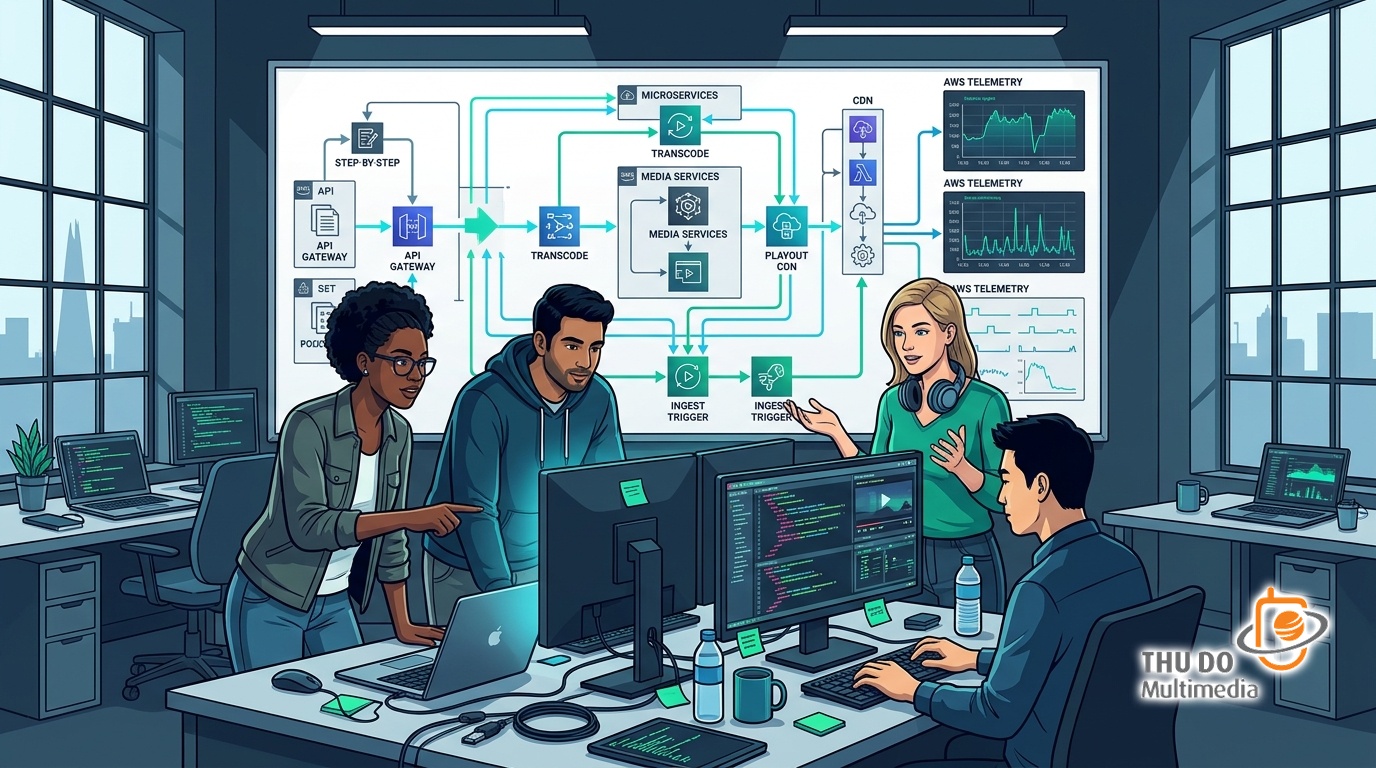
Architectural Blueprint: Designing a Cloud-Native Broadcast Channel Origination Environment
Deconstructing a traditional, monolithic broadcast chain requires a fundamental reimagining of how video signals flow from storage to the end-viewer. To achieve true software-defined resiliency, broadcasters must dismantle legacy signal paths and rebuild them as decoupled, containerized microservices. In a robust cloud-native broadcast channel origination framework, core functions—such as content ingest, Media Asset Management (MAM), scheduling, dynamic graphics, transcoding, and playout—operate as independent microservices that communicate via secure APIs and event-driven message buses. This modularity ensures that a failure in the graphics rendering pipeline, for instance, never compromises the stability of the core video playout engine.
At the foundation of this architecture lies scalable cloud object storage, such as Amazon S3, which serves as the centralized repository for high-bitrate mezzanine files, proxy assets, and auxiliary metadata. Modern ingest workflows must seamlessly handle manual web uploads, batch CSV playlist imports, and high-capacity live feeds without bottlenecking system performance. Once ingested, assets are indexed and prepared for playout. To guarantee enterprise-grade reliability, these architectures utilize redundant broadcast routers running on virtual instances distributed across dual Availability Zones (AZs). This ensures zero single points of failure, enabling the system to maintain rigorous 99.99% uptime SLAs that match or exceed traditional on-premise master control rooms.
Furthermore, engineering teams implementing a microservices architecture for linear TV automation must pay meticulous attention to cloud networking and data egress optimization. By leveraging Amazon VPC peering, private subnets, and strategic content delivery network (CDN) caching, broadcasters can minimize data transfer fees while maintaining frame-accurate synchronization across multiple regional endpoints. Container orchestration platforms like Kubernetes manage the automatic scaling of compute nodes, spinning up additional transcoding pods during peak programming shifts and scaling them back down during off-peak hours to optimize cloud computing spend.
Inside the Virtual Master Control Room Playout: Automation, GFX, and Frame-Accurate Operations
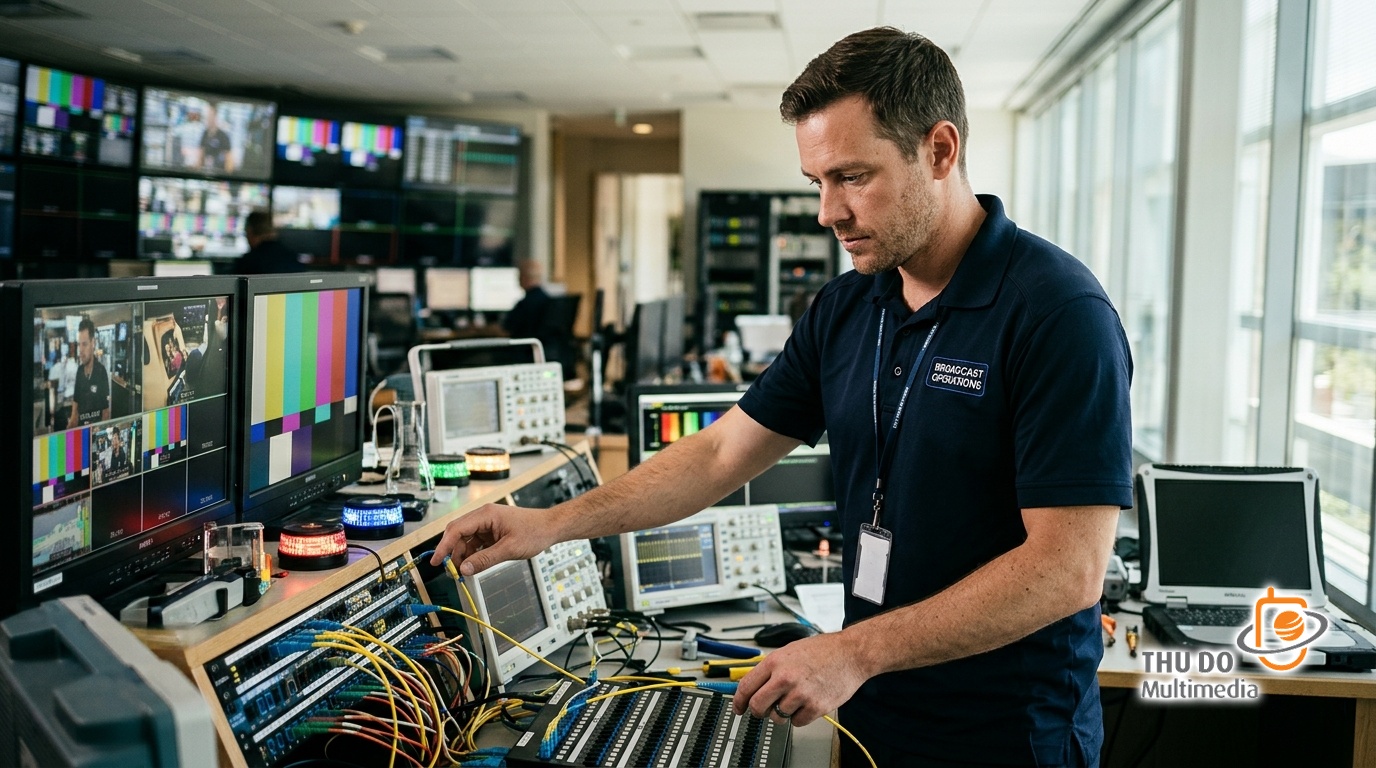
Managing 24/7 linear feeds used to require rows of operators staring at wall-to-wall hardware monitors, manually correcting timing drifts and cueing secondary events. Today, the virtual master control room playout consolidates these complex workflows into a unified, web-based single pane of glass. Master control operators gain real-time visibility into live video feeds, scheduled program blocks, advertising contracts, and on-air content through intuitive, color-coded timelines that offer 5-minute, hourly, daily, and weekly views. This centralized visibility drastically reduces cognitive fatigue and allows a lean team to oversee dozens of simultaneous channels from a single laptop, whether sitting in a physical control room or working remotely.
Moving away from legacy, hardware-locked character generators, modern virtual master control rooms deploy HTML5 dynamic graphics and lightweight PNG/video overlays. These visual elements are governed by tag-based 24/7 autopilot rules that automatically trigger channel branding, lower-thirds, age-rating slates, and data-driven tickers based on metadata embedded in the playlist schedule. Live feed integration is equally streamlined; master control operators can inject live satellite or IP streams directly into the automated scheduler, executing immediate or latency-configured skips, seamless segment breaks, and dedicated live tabs to manage high-stakes broadcasts with frame-accurate precision.
Platforms like the Evrideo cloud playout solution exemplify this operational evolution by empowering media companies to manage end-to-end linear workflows through an advanced web interface. By integrating automated scheduling engines and intelligent playlist validation, these systems reduce manual master control workloads by up to 60%. Operators are liberated from repetitive, error-prone data entry, allowing them to focus on high-value tasks such as quality control oversight, regional content localization, and monetization strategy.
Monetization, Dynamic Ad Insertion, and Multi-Platform Distribution
Reaching audiences wherever they consume content is no longer a luxury; it is an existential requirement for modern media companies. Cloud-native distribution pipelines enable broadcasters to deliver pristine, broadcast-quality video to any endpoint—whether traditional satellite, cable headends, OTT applications, or FAST platforms like Samsung TV Plus, Pluto TV, and LG Channels—with a single click. Instead of maintaining separate hardware encoders and egress pipelines for every destination, broadcasters utilize flexible cloud trans-muxing services that package streams into HLS, DASH, or RTMP formats dynamically on the fly.
Monetization is streamlined through advanced Server-Side Ad Insertion (SSAI) tools, such as AWS Elemental MediaTailor. SSAI stitches targeted, programmatic advertisements directly into the video manifest in the cloud before it reaches the viewer’s device. This approach effectively bypasses client-side ad blockers, prevents buffering during ad breaks, and maximizes monetization yield across both linear streams and VOD catch-up assets. Crucially, migrating to SaaS-based playout allows broadcasters to retain 100% of their advertising revenue control, eliminating the restrictive revenue-split models historically imposed by legacy syndication middlemen.
Transparency and compliance reporting are equally critical for revenue realization. Modern cloud playout platforms automatically generate comprehensive, customizable As-Run logs detailing exact start times, actual durations, unique media IDs, and rich metadata fields. These logs pair seamlessly with automated Electronic Program Guide (EPG) exports, ensuring downstream platform partners receive accurate, up-to-the-minute scheduling data. Deploying cloud linear TV master control software ensures that ad breaks fire with frame-accurate precision, satisfying strict advertiser compliance mandates and protecting bottom-line revenue.
Ensuring Enterprise Reliability, Monitoring, and the Cloud Broadcast Playout Migration Roadmap
Migrating mission-critical broadcast operations to the cloud requires a bulletproof strategy for observability, automated remediation, and phased transition. Enterprise-grade cloud playout environments implement comprehensive telemetry using tools like Amazon CloudWatch, Managed Grafana, and AWS Cost Explorer. These dashboards track operating system health, CPU throttling, buffer health, and real-time operational costs simultaneously, giving engineering and finance teams complete visibility into platform performance and cloud expenditure. Furthermore, serverless functions such as AWS Lambda can be triggered instantly by monitoring alarms to execute automatic video routing failovers and system remediations without human intervention.
For broadcasters embarking on a cloud broadcast playout migration, attempting a “big bang” cutover of all channels simultaneously is a recipe for disaster. Industry best practices dictate a phased migration strategy:
1. Discovery & Asset Auditing: Catalog existing media assets, graphic templates, and playlist formats while establishing baseline performance metrics.
2. FAST & Non-Critical Channels: Launch secondary or experimental FAST channels in the cloud to test ingest pipelines, ad insertion servers, and EPG distribution workflows in a low-risk environment.
3. Primary Linear & Niche Feeds: Migrate standard-definition and regional linear channels once operational confidence and team familiarity are established.
4. Mission-Critical & Live Sports: Transition high-value live sports master control feeds and premium 24/7 flagship networks to the fully redundant cloud architecture.
To de-risk this journey further, forward-thinking broadcasters partner with managed service providers whose dedicated broadcast engineers and master control operators act as 24/7/365 extensions of internal teams. Leveraging enterprise solutions such as the Evrideo platform alongside expert migration support ensures that media networks can navigate the transition from hardware appliances to microservices smoothly, securing long-term operational resilience and dramatic cost efficiencies.
Câu hỏi thường gặp
- What is cloud-native master control playout?
Cloud-native master control playout is a software-defined approach to television broadcasting where video ingest, scheduling, graphics overlay, transcoding, and channel origination run entirely as containerized microservices in the cloud rather than on dedicated physical hardware appliances. - How do microservices improve linear TV automation?
Microservices decouple individual broadcast functions—such as asset management, ad insertion, and subtitle generation—into independent, scalable modules. This allows broadcasters to update, scale, or replace specific workflow components instantly without disrupting live 24/7 linear streams. - Can cloud playout systems replace traditional hardware playout servers?
Yes. Modern cloud playout platforms match the frame-accurate reliability, 99.99% uptime SLAs, and low latency of traditional hardware (like SDI playout servers) while offering infinite scalability, zero CapEx, and rapid multi-platform distribution to FAST and OTT endpoints. - How does dynamic ad insertion work in cloud linear channels?
Server-Side Ad Insertion (SSAI) integrates targeted advertising directly into the video stream manifest in the cloud before it reaches the viewer’s device. This prevents ad-blockers from interfering and allows personalized ad delivery for both linear broadcasts and FAST channels. - What is the ROI timeline for migrating broadcast operations to the cloud?
Industry benchmarks show that migrating linear TV automation and master control to cloud SaaS infrastructure achieves an average TCO reduction of 42% with a typical ROI breakeven point within 18 months due to eliminated hardware refresh cycles and reduced manual operational overhead.
Recent Comments