
OTT Market Southeast Asia 2026: The Growth Guide

Key Takeaways
* Explosive Valuation: The regional streaming ecosystem is aggressively expanding, currently boasting 61 million paid accounts and tracking toward a massive $139 billion valuation by 2033.
* The “Local” Overtake: Domestic content has officially reached parity with global heavyweights; local programming now commands up to 46% of user engagement in key markets like Thailand and Indonesia.
* Strategic Consolidation: Platform survival now relies on complementary bundling (e.g., K-dramas paired with C-dramas) rather than pure library exhaustion, fundamentally changing subscriber acquisition.
* AI-Driven Infrastructure: Advanced generative AI and adaptive streaming frameworks are drastically lowering localization costs by up to 80%, allowing rapid cross-border expansion for mid-tier platforms.

Welcome to the trenches of the most dynamic video entertainment economy on earth. When we analyze the trajectory of the OTT market Southeast Asia 2026, we are no longer looking at a passive region simply absorbing Western syndication. We are witnessing a ferocious, highly sophisticated battleground where hyper-local cultural nuances dictate multi-billion-dollar technology investments. Gone are the days when a global platform could simply flip a switch, offer a translated interface, and expect instant market penetration. Today, success requires a surgical approach to content acquisition, resilient delivery infrastructure, and a deep understanding of mobile-first consumption habits.

In our experience advising digital media conglomerates, we have seen countless aggressive market entries falter because they treated the region as a monolith. The reality is far more complex. To truly dominate this space, stakeholders must pivot away from isolated subscriber acquisition models and embrace strategic bundling, localized co-production, and hybrid monetization.

Executive Summary: Navigating the OTT Market Southeast Asia 2026

The streaming landscape in the “Big Five” Southeast Asian nations—Indonesia, Thailand, the Philippines, Malaysia, and Singapore—has officially reached its local inflection point. We are currently tracking a record-breaking 61 million paid premium VOD accounts, driven by a staggering 19% year-over-year surge. This is not merely a post-pandemic retention anomaly; it is a structural shift in how the rising Gen-Z middle class allocates its digital entertainment budget. The market trajectory is undeniable, with financial projections from the MARC Group forecasting the regional ecosystem to hit an astronomical $139 billion by 2033, expanding at a compound annual growth rate (CAGR) of 23%.

Diving deeper into these metrics reveals a profound transformation in viewer psychology. For the first time in streaming history, the “global content fits all” mandate is actively failing. In 2026, cultural resonance vastly outweighs sheer library volume. Audiences are actively migrating away from platforms that solely push dubbed Western catalogs, gravitating instead toward services that reflect their immediate cultural zeitgeist. This behavioral shift is forcing global incumbents to completely rewrite their content acquisition playbooks, moving from blanket licensing deals to localized co-production mandates.

At StreamEdge Solutions, our proprietary OmniStream OTT platform has processed petabytes of regional viewer data, and the insights point to one undeniable reality: the era of isolated platform wars is dead. We are now operating in an age of strategic bundling and complementary catalog alliances. Consumers are aggressively fighting subscription fatigue, demanding unified billing and consolidated viewing experiences. Platforms that stubbornly refuse to integrate with local telecommunications providers or forge cross-platform bundles are seeing churn rates spike, while those embracing collaborative ecosystems are capturing the lion’s share of the region’s digital ad spend.

Key Growth Drivers and Market Demographics in 2026

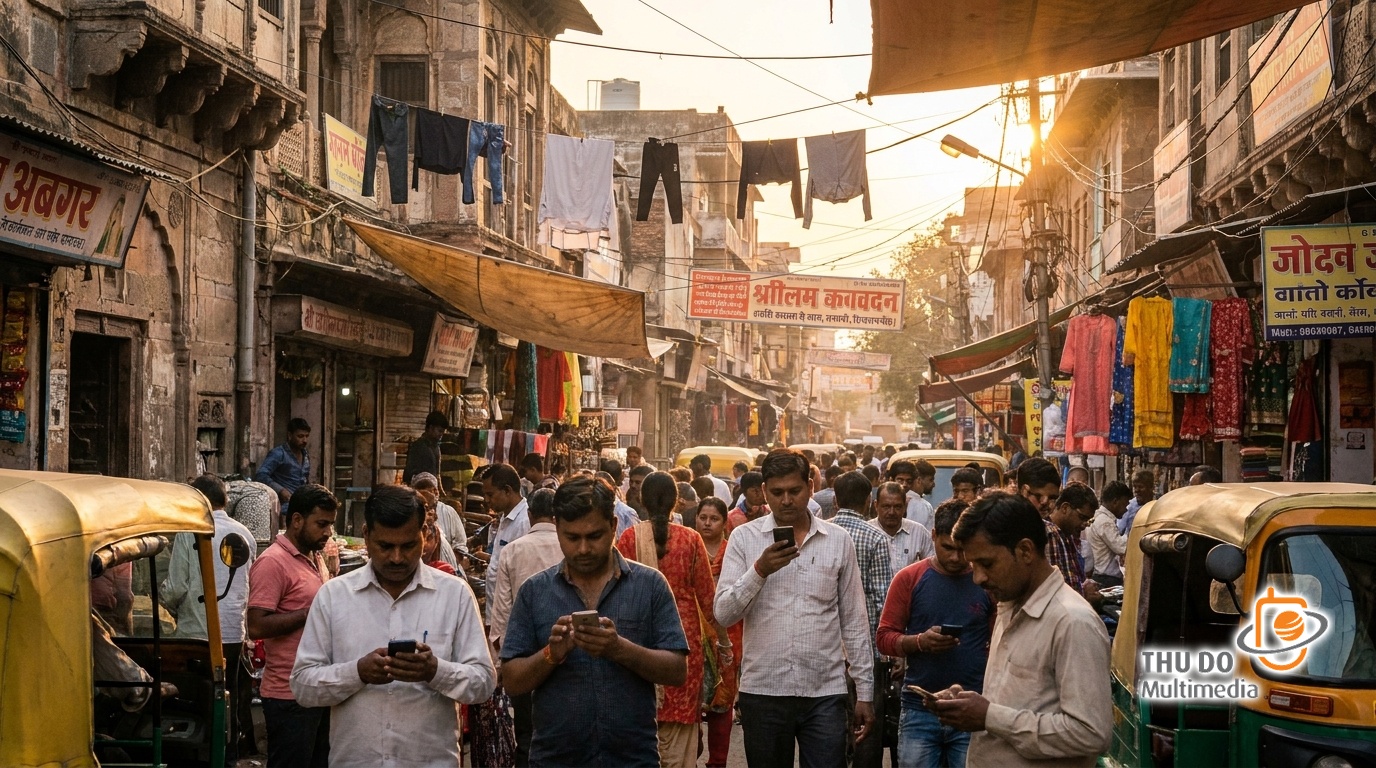
To understand the mechanics of regional growth, we must dissect the unique demographic engines powering subscription surges. Southeast Asia is characterized by a massive, mobile-native youth population whose viewing habits dictate the UI/UX evolution of every major platform. These users demand instant playback, highly interactive interfaces, and content that moves at the speed of social media.

The Undisputed Engine: Indonesia’s Strategic Surge

Indonesia stands as the undisputed titan of the region, housing an incredible 26.9 million of Southeast Asia’s 61 million premium subscribers. The sheer scale of the Indonesian market makes it the ultimate kingmaker for any platform operating in the Asia-Pacific territory. What fascinates us most about Indonesia is the fierce loyalty to homegrown narratives. Local Indonesian content has successfully captured an unprecedented 30% viewership share, officially matching the historical dominance of Korean dramas.

Consider the strategic masterclass executed by Vidio. Backed by the massive conglomerate Sinar Mas, Vidio has fiercely defended its position as the number one service in Indonesia by monthly active users (MAUs). They achieved this not by outbidding global giants for Hollywood blockbusters, but by cornering the market on local passions. By securing exclusive broadcasting rights for Liga 1 (the top-tier domestic football league) and pairing it with hyper-local, youth-oriented soap operas, Vidio created an inescapable cultural moat. This dual-pronged strategy of live local sports and bespoke domestic drama proves that highly targeted, culturally embedded content always wins the retention battle.

Thailand as the Region’s “Micro-Hub”

If Indonesia is the scale engine, Thailand has emerged as the creative “micro-hub” for Southeast Asia. Major players like Netflix and iQIYI are no longer just licensing Thai content; they are actively treating Bangkok as a primary anchor for regional production. Between 44% and 46% of users in Thailand actively engage with domestic content over imported libraries, forcing international platforms to heavily subsidize local studios to remain relevant.

The cross-border success of Thai entertainment is entirely rewriting regional export models. Genres like Thai Boys’ Love (BL) and hyper-stylized regional horror are outperforming high-budget international content across the entire Mekong region and beyond. We have watched Thai BL series generate massive, highly engaged digital fandoms that drive immense social media velocity, translating directly into subscriber acquisition. For global investors looking to enter the market, establishing a production beachhead in Thailand is no longer optional; it is the most efficient gateway to capturing the broader pan-Asian youth demographic.

The Competitive Landscape: Who Controls the 85% Viewing Share?

The battle for screen time is fiercely concentrated, with just six platforms—Netflix, Viu, Vidio, iQIYI, WeTV, and Disney+—controlling over 85% of the total regional viewing share. This oligopoly forces new entrants and smaller distributors to navigate a highly complex, fortified ecosystem.

Global Incumbents vs. Regional Titans

Netflix continues to lead the pan-regional charge with 12.8 million subscribers, maintaining roughly a 50% viewing share by aggressively pivoting toward locally funded originals. Disney+, conversely, has adopted a strategy of chasing high-ARPU (Average Revenue Per User) customers by investing heavily in star-studded Korean dramas. However, the true disruptors are the regional freemium masters. Viu has brilliantly captured the pan-regional number two spot with 9.9 million subscribers. By leveraging sophisticated ad-supported (AVOD) funnels and pricing their premium tiers 30-50% below global incumbents, Viu has successfully monetized the highly price-sensitive middle and lower-middle classes.

Simultaneously, platforms like iQIYI and WeTV are dominating a highly lucrative niche: the C-Drama and “Donghua” (Chinese anime) fandoms. These platforms have recognized that while K-dramas have broad appeal, the dedicated, obsessive communities surrounding Chinese fantasy and romance series are highly willing to pay for early access and VIP features. This fragmentation of fandoms means that global platforms can no longer rely on a singular “hit show” to carry an entire quarter; they must constantly feed multiple, distinct subcultures simultaneously.

The Era of Strategic Bundling and Alliances

The most pivotal competitive shift occurred recently at the APOS summit in Bali, where Viu and iQIYI announced a groundbreaking subscription bundle. This alliance represents a seismic shift in corporate philosophy. Rather than bleeding capital trying to out-acquire each other, these platforms recognized the power of complementary catalogs. By pooling Viu’s dominant K-Drama library with iQIYI’s premium C-Drama offerings, they created an unbeatable “bundled value” proposition.

We actively advise our enterprise clients at StreamEdge Solutions to study this alliance closely. It signals the definitive end of blind pan-regional ambition. The future belongs to territory-specific deal-making, where platforms act as aggregators of distinct cultural tastes rather than solitary walled gardens. Competing on library exhaustion is a losing game; competing on bundled, frictionless consumer value is the blueprint for 2026.

Content Acquisition and Programming Shifts

The mechanics of how content is bought, sold, and developed have undergone a radical transformation. Traditional content distribution pitches that treat Southeast Asia as a monolithic dumping ground for legacy catalogs are failing spectacularly in 2026.

From Licensing to Co-Production Mandates

Platform executives are no longer interested in simply renting content; they demand deep involvement in the development process to ensure exact local market fit. While Korean Dramas still wield immense power—accounting for a massive 35% of total regional viewing hours—platforms are now actively seeking K-drama-adjacent local originals. They want the high production value and emotional pacing of a Seoul-produced romance, but cast with local Manila or Jakarta stars and steeped in domestic cultural nuances.

For content distributors and studios, this means pitches must be hyper-localized. You cannot sell a “Southeast Asian” show; you must sell a show designed specifically to bridge a content gap in the Malaysian market, or a format tailored exclusively for Indonesian Gen-Z viewers. Co-production mandates allow platforms to share financial risk while ensuring the final product possesses the authentic cultural DNA required to trigger viral, organic growth.

The Rise of Microdramas and Short-Form Content

Parallel to the demand for high-end drama is a behavioral shift toward mobile-first, short-form viewing that bridges the gap between social media platforms like TikTok and structured premium video services. Audiences are increasingly rejecting hour-long episodic commitments during their daily commutes, favoring highly condensed, serialized narratives.

Platforms are drastically adapting their user experiences to accommodate this rapid-consumption format. Features like Viu Shorts are actively modifying the traditional OTT interface to support vertical scroll-based discovery, instant frictionless playback, and continuous viewing loops. This presents a massive challenge for legacy streaming catalogs that are locked into traditional 45-minute horizontal formats. Platforms must now re-edit, re-format, or entirely commission new microdramas to satisfy the algorithmic, dopamine-driven viewing habits of the modern mobile subscriber.

Technological Infrastructure and Monetization Models

Beneath the surface of content wars lies the brutal reality of regional technology infrastructure. Delivering high-definition, buffer-free video across archipelagos with wildly fluctuating network qualities requires immense technical sophistication.

The CTV Boom vs. The Mobile-First Reality

We are currently witnessing a fascinating dual-growth phenomenon in device consumption. While mobile phones remain the undisputed primary screen for the vast majority of the population, Connected TV (CTV) viewership has unexpectedly surged, jumping 14% in the last quarter alone. This CTV boom is actively shifting content demands back toward “family-viewing” formats, particularly in the Philippines and Indonesia, where multi-generational households dominate.

Despite the rise in smart TVs, the baseline technical requirements for regional success remain incredibly stringent. In our deployments of the OmniStream OTT Platform, we emphasize that features like offline viewing capabilities, ultra-fast video start times, and highly responsive adaptive bitrates are not “premium extras”—they are absolute survival requirements. If an app buffers for more than three seconds on a congested Jakarta 4G network, the user will instantly churn to a competitor.

Hybrid Monetization (AVOD + SVOD) and AI Integration

Subscription fatigue is a global reality, but in the highly price-sensitive markets of Southeast Asia, it is the primary barrier to scale. Consequently, ad-supported (AVOD) tiers have become the ultimate growth lever. The integration of hybrid AVOD and SVOD models has directly driven a 5.8% increase in regional online video ad spend in 2026. Platforms are effectively using free, ad-supported access as a massive top-of-funnel acquisition tool, slowly migrating engaged users toward premium, ad-free tiers bundled with their mobile data plans.

Furthermore, the operational economics of running these platforms are being revolutionized by artificial intelligence. Generative AI is no longer a buzzword; it is a critical cost-reduction engine. By utilizing advanced AI for automated content tagging, predictive churn analysis, and specifically, localized dubbing, platforms are seeing up to an 80% reduction in translation workflows. This allows a mid-tier platform to acquire a hit Thai drama and flawlessly dub it into Bahasa Indonesia and Tagalog within days, rather than months, unlocking unprecedented cross-border scalability.

Conclusion: The 2026 Playbook for OTT Success in Southeast Asia

Surviving and scaling in the OTT market Southeast Asia 2026 demands a complete abandonment of Western-centric streaming philosophies. The winning playbook is defined by three core tenets: aggregation over exclusivity, culturally embedded co-production over passive licensing, and fluid hybrid monetization over strict subscription paywalls.

The platforms that currently control the 85% market share understand that they are not fighting a single regional war; they are engaged in six distinct, fragmented battles. To win the “trenches,” operators must deeply respect hyper-local tastes, invest heavily in resilient, adaptive streaming technologies like those developed by our team at StreamEdge Solutions, and constantly innovate their user interfaces to match the speed of mobile-first consumers. The $139 billion future belongs to those who recognize that in Southeast Asia, local relevance is the ultimate premium feature.

Frequently Asked Questions

Q: Which OTT platform is most popular in Southeast Asia?
Netflix currently commands the pan-regional market leadership with over 12.8 million subscribers and holds roughly 50% of the total viewing share. However, the ecosystem is fiercely competitive. Viu securely holds the number two spot with 9.9 million subscribers by dominating the AVOD funnel. Furthermore, domestic giants often win their home turf; for instance, the local platform Vidio actually outranks Netflix in monthly active users within Indonesia due to its stronghold on live domestic sports.

Q: What is the primary business model for OTT platforms in Southeast Asia?
The region operates heavily on a “Freemium” and hybrid monetization structure. Because the vast majority of consumers are highly price-sensitive, rigid paywalls fail at scale. Platforms like Viu, WeTV, and increasingly global players offer robust ad-supported tiers (AVOD) alongside premium, ad-free subscriptions (SVOD). These premium tiers are frequently bundled directly with local mobile data plans to remove friction from the billing process.

Q: What type of content gets the most views in Southeast Asia?
While Korean Dramas remain an absolute powerhouse, driving roughly 35% of all cross-border streaming hours, local content is rapidly claiming the throne. In key markets like Indonesia and Thailand, between 44% and 46% of users now engage primarily with domestic content. Hyper-local genres—specifically Thai Boys’ Love (BL) series, regional folklore horror, and live domestic sports—are currently the most potent drivers of new subscriber acquisition.

Q: How fast is the Southeast Asia streaming market growing?
The market is experiencing explosive, sustained growth. By early 2026, premium VOD subscriptions across the “Big Five” Southeast Asian nations surged by 19% year-over-year, reaching 61 million active paid accounts. Long-term financial projections from industry analysts estimate the regional OTT ecosystem will achieve a staggering $139 billion valuation by 2033, expanding at a robust 23% compound annual growth rate (CAGR).

Mastery of Low Latency Live Streaming OTT in 2026

Mastery of Low Latency Live Streaming OTT in 2026

Key Takeaways:
* The ROI of Speed: A single buffering incident can cause up to 40% of viewers to abandon a stream, making latency optimization a critical business revenue driver, not just an engineering metric.
* Protocol Evolution: Standard HTTP streaming has evolved. We are moving from 30-second delays down to sub-second realms using chunked CMAF and WebRTC.
* The Player Bottleneck: Advanced server architecture is useless if the client-side video player is poorly tuned; default player buffers can inadvertently add up to 6 seconds of unwanted delay.
* Future Standards: Emerging technologies like Media over QUIC (MoQ) and Wi-Fi 7 are poised to redefine the absolute floor of glass-to-glass delivery times.

In our experience working with digital broadcasters, the pursuit of low latency live streaming OTT is no longer a luxury reserved for niche applications; it is the fundamental baseline for modern audience retention. When viewers are watching a highly anticipated sports final or participating in a live virtual auction, a delay of even a few seconds can ruin the experience, leading to spoilers on social media before the goal is even seen on screen. We have witnessed firsthand how bridging the gap between business objectives (viewer retention and monetization) and technical architecture (encoding, packaging, and delivery) transforms standard broadcasting into highly engaging, interactive digital ecosystems.

What is Low Latency Live Streaming OTT?

To truly master this domain, we must first dissect the fundamental difference between glass-to-glass latency and player latency. Glass-to-glass latency represents the total elapsed time from the exact millisecond light hits the camera sensor at the live event to the moment those pixels illuminate the viewer’s screen. Player latency, on the other hand, is the specific portion of that delay intentionally injected by the viewer’s device to build a safety buffer against network fluctuations. Understanding this distinction is crucial because platform operators often blame their content delivery networks (CDNs) for delays, when in reality, the viewer’s local device is simply hoarding video chunks before playback begins.

When we break down the spectrum of latency tiers, the numbers reveal a dramatic evolution in streaming capabilities. Classic broadcast streaming (Linear/FAST channels) typically operates with a 15 to 30-second delay. As we move down the tier list, standard low latency sits between 5 to 15 seconds, which is adequate for concerts or sermons. Near-real-time streaming brings this down to 2 to 5 seconds, an absolute necessity for live sports and watch parties. Finally, ultra-low latency operates under 1 second (essential for auctions and betting), while true real-time latency operates under 200 milliseconds for two-way telehealth and video conferencing.

The business justification for investing in these faster tiers is rooted deeply in viewer behavior and platform monetization. Data indicates that a single buffering issue or noticeable delay behind real-world events can drive up to 40% of viewers to click away from a stream entirely. If your platform relies on ad insertions, subscriptions, or live micro-transactions, losing nearly half your audience due to a sluggish feed is a catastrophic revenue leak. By aligning engineering investments with these harsh business realities, OTT providers can confidently justify the higher compute costs associated with specialized live streaming architectures.

However, we must also address the pervasive “zero-latency” myth that often circulates in high-level marketing meetings. True zero latency is scientifically impossible due to the absolute laws of physics. For instance, the speed of light across a coast-to-coast internet hop in the United States takes approximately 40 milliseconds one-way. This means that an 80-millisecond round-trip is the absolute physical floor before we even account for camera capture, video encoding, network routing, and local device decoding. Setting realistic expectations around a sub-200ms target prevents engineering teams from chasing scientifically impossible goals.

Core Protocols: Evaluating low latency HLS vs DASH and Beyond

For massive audience scaling, the industry heavily relies on HTTP-based streaming, and the debate surrounding low latency HLS vs DASH is central to modern platform design. Historically, standard HLS (HTTP Live Streaming) and MPEG-DASH required players to download entire video segments—often 6 to 10 seconds long—before playback could commence, resulting in massive 30-second delays. The revolutionary shift occurred with the introduction of chunked transfer encoding and the Common Media Application Format (CMAF). By breaking these large segments into tiny, self-contained “chunks” that can be transmitted and played while the rest of the segment is still being encoded, we successfully brought HTTP streaming latency down from 30 seconds into the highly competitive 1 to 3-second range.

Moving backward in the streaming pipeline to the ingest phase (how the video gets from the camera to the server), Secure Reliable Transport (SRT) has emerged as the gold standard for remote production. Developed by Haivision, SRT routinely operates with a latency of just 1 to 2 seconds while providing aggressive packet-loss recovery and AES encryption. In our fieldwork dealing with unstable mobile internet connections at remote sports venues, SRT has consistently outperformed older protocols by dynamically adapting to network jitter, ensuring that a pristine master feed reaches the cloud encoder without dropping frames.

Despite these advancements, we cannot ignore the enduring legacy of RTMP (Real-Time Messaging Protocol). Even though Flash is dead and modern browsers natively reject RTMP playback, it remains the dominant protocol for contribution feeds. Millions of content creators utilizing software like OBS Studio or Wirecast still push RTMP to ingest servers because it reliably offers a 1 to 5-second ingest latency and is universally supported by almost every encoder hardware on the market. The modern workflow, therefore, involves ingesting via RTMP or SRT, and immediately transcoding the feed into Low-Latency HLS or DASH for mass global distribution.

Why WebRTC for OTT live broadcasting is the Future of Interactivity

When the business requirement shifts from passive viewing to hyper-interactivity, HTTP-based protocols simply cannot keep up, which is why WebRTC for OTT live broadcasting has become an absolute necessity. WebRTC (Web Real-Time Communication) routinely achieves sub-500ms latency because it fundamentally bypasses traditional TCP web architecture, utilizing UDP (User Datagram Protocol) to stream data directly between peers or through specialized servers without waiting for packet acknowledgments. This lightning-fast delivery is the only way to successfully host live sports betting, real-time virtual auctions, and interactive telehealth sessions where a two-second delay could mean losing a financial bid or missing a critical medical cue.

To scale WebRTC successfully, engineers must deeply understand the underlying server topologies: P2P (Peer-to-Peer), MCU (Multipoint Control Unit), and SFU (Selective Forwarding Unit). While P2P works beautifully for a 1-on-1 video call, it completely collapses under the weight of audience scale because the broadcaster’s upload bandwidth is consumed by every single viewer. In 2026, the SFU is the undisputed default for scaling interactive streams. An SFU acts as an intelligent traffic router; it takes one incoming stream from the broadcaster and efficiently routes it to hundreds of participants without burning massive server CPU for transcoding, allowing interactive rooms to comfortably scale up to 500 concurrent participants.

For massive events that require both interactivity for a select group and massive scale for the general public, top-tier broadcasters are adopting a sophisticated hybrid approach. We often design systems where the “VIP” layer—such as event hosts, live commentators, and select interactive audience members—communicates via a real-time WebRTC room. Simultaneously, that composite WebRTC feed is captured and handed off to a Low-Latency HLS packager to be fanned out to millions of passive viewers. This gives the core participants zero perceptible delay, while the mass audience enjoys a stable 3-second feed at a fraction of the CDN cost.

Designing an ultra-low latency streaming architecture

Building an ultra-low latency streaming architecture requires a forensic examination of the “latency budget”—the exact number of milliseconds spent at every single stage of the video pipeline. Let us look at the raw data: a standard workflow might spend 20 to 1,000ms on capture and encoding, 200 to 6,000ms on packaging, 20 to 300ms traversing the network to the CDN, 50 to 500ms during CDN fan-out, a massive 20 to 30,000ms sitting in the player buffer, and finally 10 to 60ms decoding on the screen. To achieve near-real-time streaming, architects must ruthlessly shave milliseconds off each of these six pillars, realizing that a bottleneck in just one area destroys the entire glass-to-glass target.

The choice of video codec plays a deeply complex role in this latency budget, often presenting a fierce trade-off between bandwidth savings and compute time. For example, High-Efficiency Video Coding (HEVC/H.265) cuts video bitrates by 40% to 50% compared to the older H.264 standard, which drastically speeds up network transit times. However, HEVC requires roughly twice the compute power to encode. Taking it a step further, the AV1 codec cuts bitrates by an astonishing 48% to 50% (as measured by Netflix), but it demands up to four times more software encode processing. If your origin server lacks dedicated hardware acceleration for AV1, the time spent encoding the video will completely negate the time saved during network delivery.

To combat processing delays, modern infrastructures rely heavily on Edge packaging. Instead of sending a single, massive master stream to a centralized cloud server in Virginia for packaging and then routing it to viewers in Tokyo, we push the packaging logic to the extreme edges of the network. Utilizing serverless technologies like Cloudflare Workers or AWS Lambda@Edge, the raw feed is ingested, wrapped into CMAF chunks, and packaged geographically closest to the viewer. This highly distributed architecture is the secret to keeping global p95 latency (the latency experienced by 95% of your users) consistently under the 2-second mark.

reducing latency in live video streaming via CDNs

The cornerstone of reducing latency in live video streaming at scale relies heavily on the strategic deployment and configuration of Video Content Delivery Networks (CDNs). A Video CDN acts as a massive global caching layer; instead of a million viewers asking your single origin server for the live video feed, they ask the CDN edge server physically located in their own city. This edge caching completely prevents origin server overload and drastically cuts down network transit time. When chunks are cached locally, the “last mile” delivery to the viewer’s router is executed in mere milliseconds, maintaining the integrity of the live feed.

Relying on a single CDN is highly risky for premium OTT broadcasters. During massive audience spikes—such as the final minutes of a World Cup match—individual network nodes can easily become congested, causing micro-stutters and latency spikes. This is where active Multi-CDN strategies come into play. By employing intelligent, real-time traffic routing, the streaming platform monitors the specific performance and buffer rates of various CDNs (like Akamai, Fastly, and CloudFront) on a viewer-by-viewer basis. If CDN A begins to experience congestion in London, the system autonomously and instantly routes all new London-based viewers to CDN B, preserving the low latency experience without human intervention.

Furthermore, we must implement strict origin shielding. In a low-latency environment using chunked transfer encoding, millions of tiny HTTP requests are generated every second. If a new CDN edge node spins up and does not have the latest chunk cached, it will request it from the origin. Without a shield, a sudden surge in audience numbers could result in a “thundering herd” of requests hitting the master origin server simultaneously, causing a total stream collapse. An origin shield acts as a massive shock absorber—a mid-tier caching layer that aggregates all requests from edge nodes into a single origin request, keeping the master encoder running flawlessly at sub-second speeds.

Actionable end-to-end latency optimization for live video

One of the most glaring gaps we observe in the streaming industry is the disconnect between server engineers and client-side developers, which makes end-to-end latency optimization for live video incredibly difficult. You can build the fastest CMAF pipeline in the world, but a naive video player will destroy it. For instance, the default settings on popular open-source players like HLS.js are aggressively tuned for stability, not speed. A default player reading a perfectly optimized 2-second LL-HLS feed will intentionally wait to download three full segments before rendering a single frame, forcing a 6 to 10-second delay. Tuning the player’s chunk size (down to 200ms) and live sync duration (target buffer of 0.9 to 1.2 seconds) is absolutely mandatory.

Equally important is the alignment of your Adaptive Bitrate (ABR) encoding ladders. Viewers constantly experience bandwidth fluctuations, moving from 5G cellular to localized Wi-Fi. If your encode ladder is not perfectly aligned with identical Keyframe intervals (typically every 1 to 2 seconds), the player cannot seamlessly switch from a 1080p feed to a 480p feed. When keyframes are misaligned, the player is forced to pause, flush its existing buffer, and download a new segment from scratch. This single event causes a jarring buffering wheel and permanently injects an additional 3 to 5 seconds of latency into that specific viewer’s session.

To truly maintain these systems, platforms must conduct rigorous network auditing, which forms the basis of best practices for real-time OTT streaming. Operators must stop looking at “average” latency metrics, as averages heavily mask disastrous viewer experiences. Instead, engineering teams must monitor p95 and p99 latency metrics (the worst 5% and 1% of viewer experiences). Tail-end variances—where a small pocket of users experiences 15-second delays on a 2-second feed—are exactly what cause mass viewer churn and negative app store reviews. Continuous end-to-end monitoring ensures that latency drift is caught and rectified at the player side before the viewer hits the exit button.

Top scalable low latency streaming solutions on the Market

For brands looking to launch rapidly, choosing fully managed enterprise OTT platforms is often the most financially sound route. We highly recommend leveraging scalable low latency streaming solutions like OTTEngine, Muvi Live, or Dacast. OTTEngine, for instance, is purpose-built to handle the heavy lifting of multi-CDN routing, edge packaging, and player tuning right out of the box. By utilizing a platform like OTTEngine, media brands can launch interactive sports broadcasts or live commerce events in weeks rather than months, completely bypassing the grueling process of hiring bespoke engineering teams to manually configure WebRTC topologies and CMAF chunks.

For organizations with deep internal development resources building custom applications, specialized developer and engineering tools provide granular control over the latency budget. Platforms such as Wowza, Red5 Pro, and Dolby Millicast offer powerful SDKs and server infrastructures specifically designed for sub-second streaming. Red5 Pro is particularly renowned for its ability to autoscale WebRTC clusters across various cloud providers (AWS, Google Cloud, Azure), allowing developers to build interactive fan-wall experiences that dynamically scale up to millions of concurrent connections without breaking the 500ms barrier.

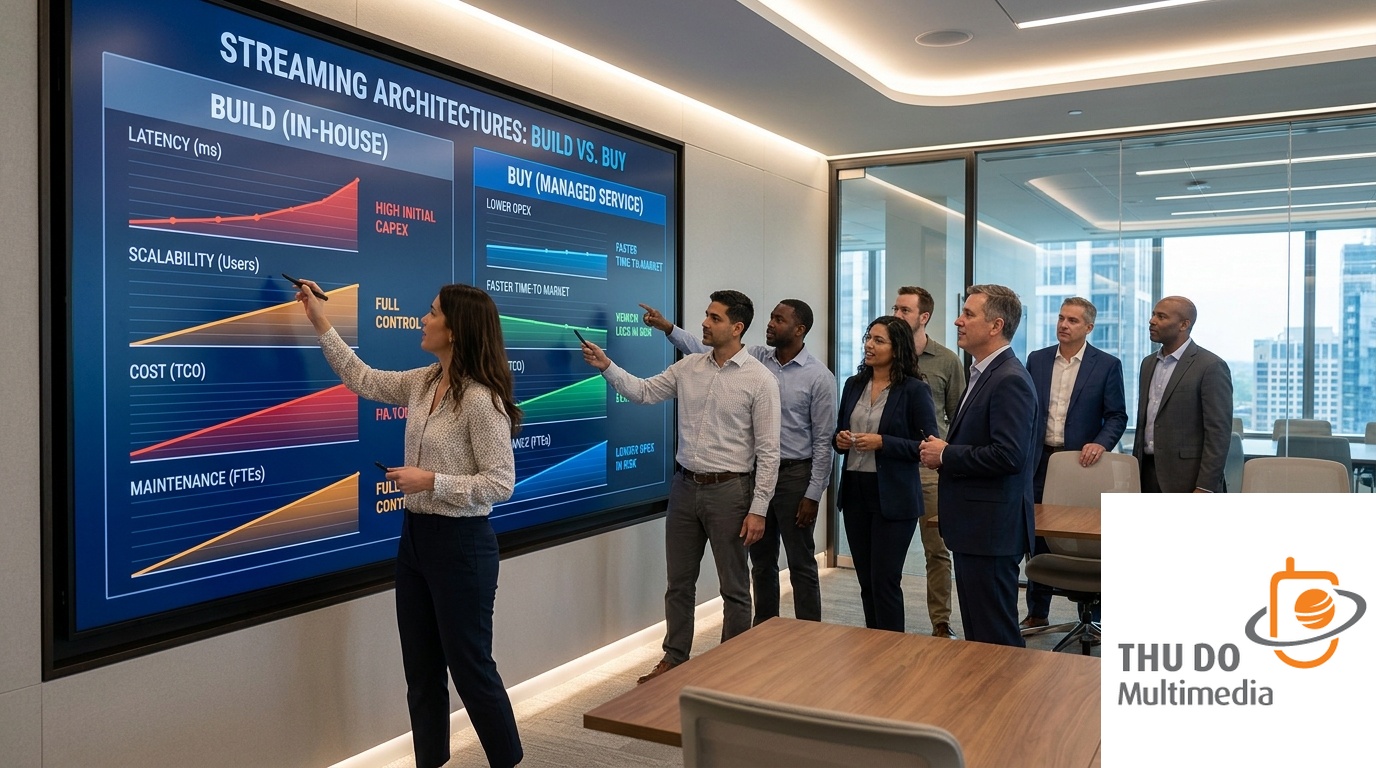
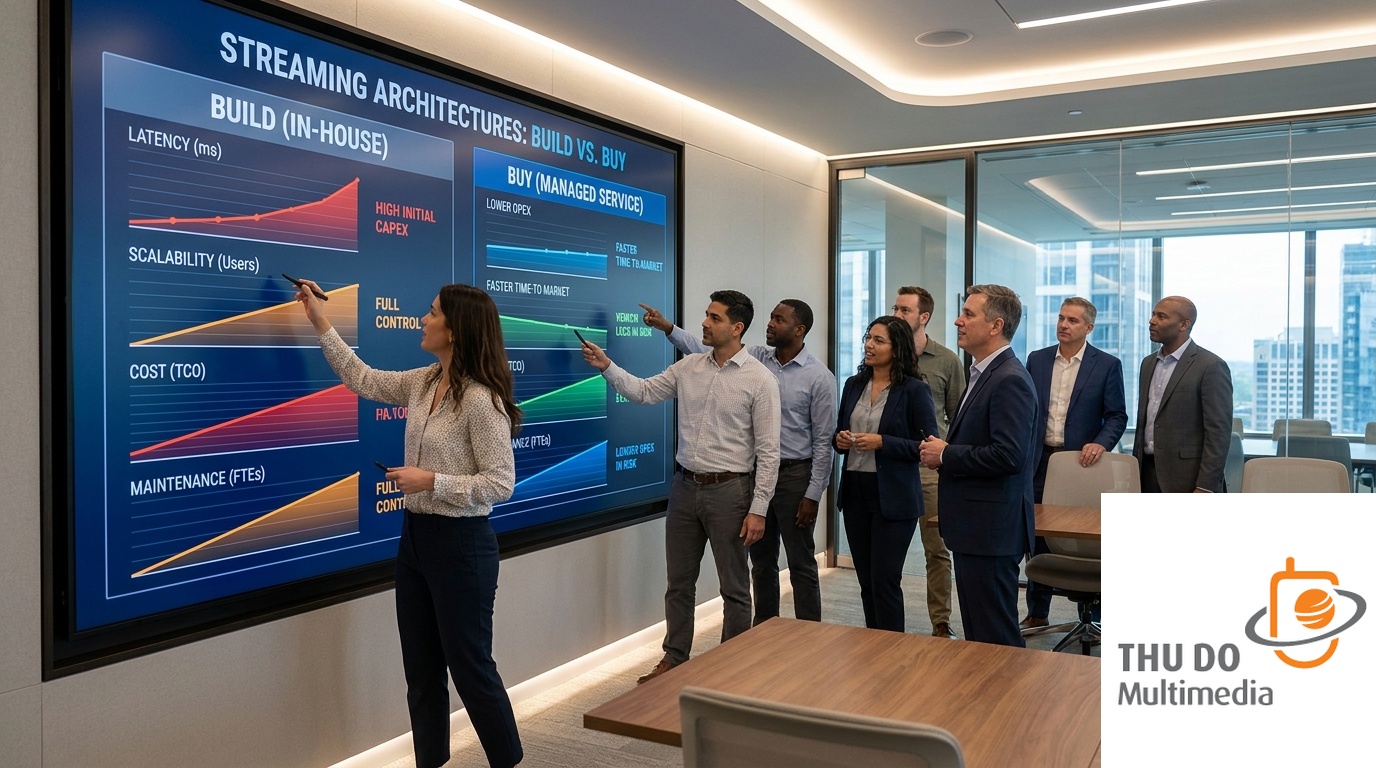
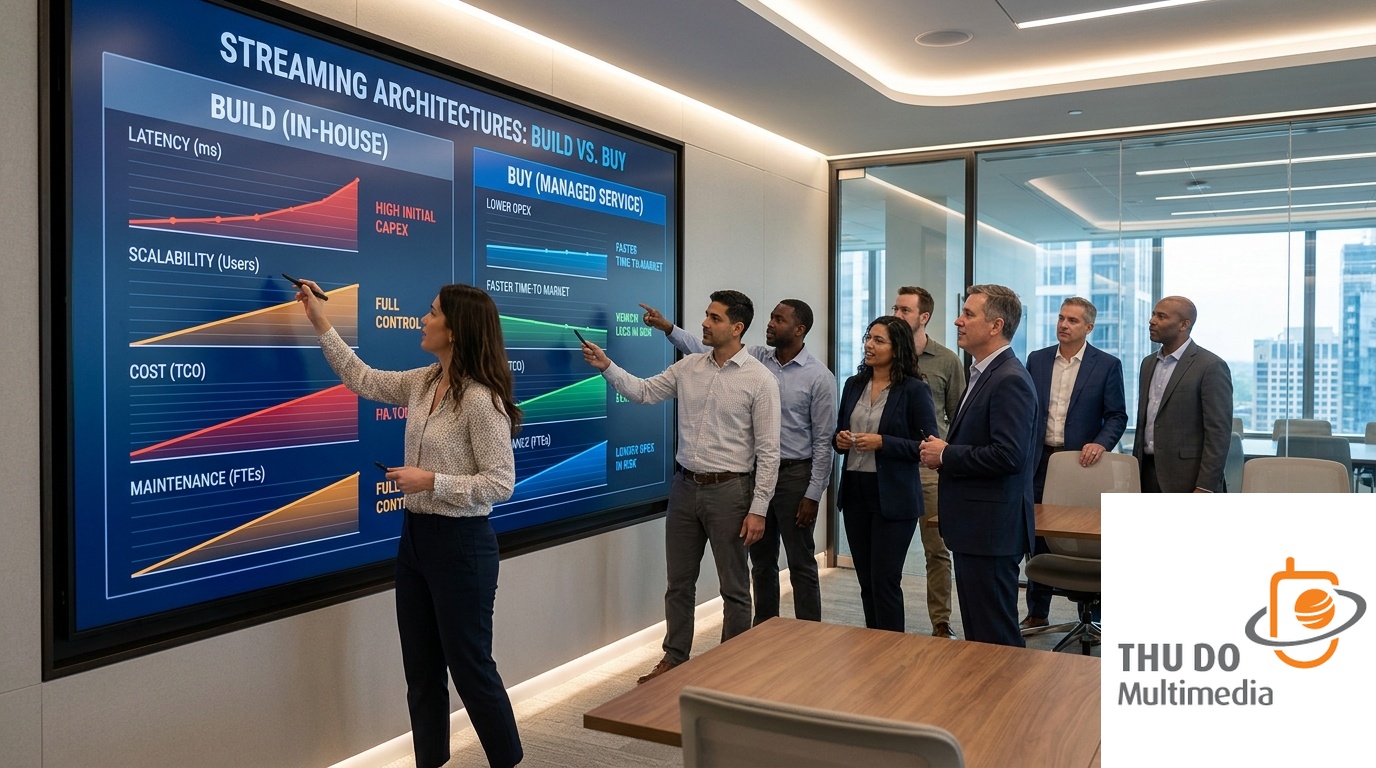
Ultimately, brands must navigate the complex “Build vs. Buy” decision. A key factor in this checklist should be raw infrastructure and delivery costs. While building a custom WebRTC solution gives you absolute architectural freedom, the software compute costs for transcoding AV1 and the per-gigabyte egress costs from public clouds can quickly bankrupt a project. Conversely, utilizing a white-label SaaS like OTTEngine often provides predictable, bundled hourly CDN costs per viewer, offering a clear and tangible ROI framework for Chief Financial Officers who need to map latency improvements directly to subscription revenues.

Media executives reviewing streaming architecture and cost analytics dashboards

The Future of OTT: 5G, Wi-Fi 7, and Media over QUIC (MoQ)

Looking strictly at the horizon, network innovations are radically altering the “last mile” delivery bottlenecks. The widespread rollout of Private 5G networks in stadiums and Wi-Fi 7 in smart homes is drastically reducing localized packet loss and network jitter. Wi-Fi 7, with its Multi-Link Operation (MLO) capabilities, allows a smart TV to simultaneously receive video data over multiple frequency bands (2.4 GHz, 5 GHz, and 6 GHz). This means that even if someone starts downloading a massive file on the same home network, the live streaming feed will dynamically route around the congestion, preserving the ultra-low latency buffer without a single dropped frame.

Perhaps the most exciting paradigm shift on the horizon is the emergence of Media over QUIC (MoQ) and WebTransport. While WebRTC rules the sub-second space today, it is notoriously difficult to cache at the edge. MoQ is positioned as the next massive global standard, allowing publish/subscribe media delivery over HTTP/3. By utilizing the underlying QUIC protocol, MoQ provides multiplexed, secure, and rapid transport that can theoretically combine the sub-second speed of WebRTC with the massive CDN scalability and caching capabilities of HLS. We are aggressively watching MoQ, as it has the potential to completely replace older transport methods by 2028.

Finally, the integration of inline Artificial Intelligence is beginning to fit neatly inside these microscopic latency budgets. Historically, adding real-time translation, closed captioning, or video super-resolution required delaying the feed by several seconds to give cloud servers time to process the AI models. Today, hardware-accelerated Edge AI and Neural Processing Units (NPUs) built directly into modern viewing devices allow broadcasters to send lightweight, low-resolution streams at lightning speeds, while the viewer’s local device utilizes AI to intelligently upscale the video to 4K and generate real-time captions locally, effectively bypassing the cloud latency penalty entirely.


Frequently Asked Questions

What is the difference between standard and low latency in OTT streaming?
Standard latency prioritizes absolute video stability and maximum resolution by intentionally delaying a live broadcast by 15 to 30 seconds. This large buffer ensures smooth playback even on terrible internet connections. Low latency significantly reduces this gap to 2 to 5 seconds by utilizing chunked media formats. This near-real-time viewing tier is heavily suited for live sports, gaming, and interactive chats where viewers need to react to moments as they happen.

How do you achieve zero-latency live streaming?
From a strictly scientific standpoint, true “zero latency” is impossible due to the physical distance data must travel and the time required for glass-to-glass processing. However, broadcasters can achieve ultra-low latency of under 500 milliseconds by utilizing UDP-based protocols like WebRTC. To the human eye and brain, a 500ms delay is largely imperceptible, creating a flawless illusion of true real-time communication.

Which is better for live streaming: WebRTC or LL-HLS?
The choice depends entirely on your business use case and audience scale. WebRTC is vastly superior for highly interactive, sub-second streams such as live auctions, telehealth, or two-way video conferencing. However, WebRTC is difficult and expensive to scale to millions. LL-HLS (Low-Latency HLS) is better for broadcasting to massive, passive audiences (like the Super Bowl or a global concert) where a 2 to 5-second delay is perfectly acceptable in exchange for immense CDN scalability and lower compute costs.

Why does latency spike during a live OTT broadcast?
Latency spikes are rarely caused by a single point of failure. They are typically triggered by untuned client-side player buffers reacting poorly to network dips, “last mile” Wi-Fi congestion on the viewer’s end, or origin server overload when millions of requests hit the system simultaneously. Employing a multi-CDN strategy paired with aggressive origin shielding is the most effective architectural defense against these mid-stream latency spikes.

How does video codec choice (HEVC, AV1) affect live streaming latency?
Advanced codecs drastically alter the latency budget equation. Codecs like HEVC and AV1 reduce the final file size (bitrate) by roughly 40% to 50% compared to the older H.264 standard, which greatly accelerates network delivery speed. However, they are incredibly complex and require significantly more hardware processing power to encode in real-time. If a broadcaster’s ingest servers lack proper hardware acceleration, the time spent encoding these advanced codecs will inadvertently add massive latency right at the beginning of the workflow.

Mastering the intricacies of low latency live streaming OTT requires a holistic, deeply integrated approach from the camera lens all the way to the viewer’s screen. By aligning the right protocols, utilizing scalable platforms like OTTEngine, and meticulously tuning the final playback experience, modern broadcasters can deliver flawless, interactive realities that captivate audiences worldwide.

Top 5 television shows in India will attract users in India by 2027

Top 5 television shows in India will attract users in India by 2027

Key Takeaways

  • Resilient Market Growth: Despite a recent dip, Indian television viewership is fiercely rebounding, projected to hit a massive 214 million TV households by 2026.
  • The Hybrid Viewing Era: The strict boundary between traditional satellite broadcasting (spanning 918 operational channels) and premium OTT digital streaming has completely dissolved.
  • Unprecedented Longevity & Quality: Daily regional and Hindi dramas are crossing historic 5,000-episode milestones, while localized digital thrillers are topping global non-English viewing charts.
  • Data-Driven Success: The shows surviving until 2027 are those mastering the Television Rating Points (TRP) formula through a potent mix of emotional authenticity and high-stakes storytelling.

In our experience analyzing the rapidly shifting landscape of South Asian media, we have witnessed an unprecedented evolution in how audiences consume content. As we look ahead, predicting which Top 5 television shows in India will attract users in India by 2027 requires far more than merely skimming today’s top-rated charts. It demands a rigorous, data-backed dive into the very fabric of Indian storytelling. We are tracking a fascinating metamorphosis where rural household traditionalists and urban digital-native Gen Z viewers are beginning to overlap in their entertainment preferences. This convergence is forcing major networks and streaming giants to radically rethink their production blueprints to capture attention in the upcoming years.

The Future of Indian Television Entertainment 2027: Viewership & Trends

Our ongoing industry analysis reveals a remarkably resilient trajectory for traditional viewership despite the digital boom. Back in 2020, India boasted approximately 210 million television households. While we observed a noticeable dip to 190 million in 2024—driven by post-pandemic viewing adjustments and fragmented device usage—the market is currently experiencing a vigorous rebound. Our predictive models, aligned with recent industry data, project a robust growth bringing the nation to an estimated 214 million TV households by 2026. This upward curve proves that the living room television screen remains the undisputed anchor of family entertainment across the subcontinent.

Diving deeper into this ecosystem, we are witnessing the solidification of a true hybrid viewing model. By 2025, India possessed a staggering 918 operational private satellite TV channels catering to an immense audience of over 900 million nationwide viewers. Instead of cannibalizing these traditional satellite viewers, premium streaming platforms are actively borrowing traditional broadcast tactics, releasing episodes weekly or utilizing daily soap formats to ensure habituated viewing. The rigid wall that once separated legacy cable subscribers from cord-cutting digital audiences has vanished, creating a unified arena where content must excel on both mediums simultaneously to survive.

To understand what actually dictates longevity on these massive networks, I always point our clients to the brutal, unforgiving mechanics of Television Rating Points (TRPs). The survival of any broadcast relies entirely on a strict mathematical formula: (Number of viewers in the sample audience / Total target audience) × 100. This is not just a vanity metric; it is the absolute lifeblood of advertising revenue. In this hyper-competitive environment, a fractional drop in TRPs can cancel a multimillion-rupee production overnight, forcing showrunners to invest heavily in relentless, high-quality scriptwriting and pacing to keep audiences hooked week after week.

Because of these demanding algorithmic and viewership pressures, the future of Indian television entertainment 2027 will be defined by ruthless quality control. Networks can no longer rely on lazy tropes or padded storylines to stretch a season. Viewers now possess the power to instantly switch between 918 channels and a dozen digital apps, meaning the top-tier shows of 2027 will be those that masterfully balance cinematic production values with the comforting, habitual familiarity of traditional television formats.

Why the Top 5 television shows in India will attract users in India by 2027

The evolution of the standard family drama is no longer a theoretical industry projection; it is actively rewriting the rules of audience engagement on our screens right now. For decades, the “Saas-Bahu” (mother-in-law and daughter-in-law) trope dominated ratings with highly exaggerated conflicts. Today, we are seeing a massive shift toward grounded, complex emotional narratives. We strongly recommend looking at the blueprint left by current mega-hits like JioHotstar’s Chiraiya. By centering its narrative on difficult, nuanced themes of consent, mutual trust, and modern marital struggles, the series organically crossed the monumental threshold of 10 million views, proving that audiences crave authentic reflections of their own shifting societal dynamics.

Beyond domestic sagas, the hunger for high-stakes, adrenaline-fueled narratives has skyrocketed, forever altering the production landscape. Crime and corporate thrillers are experiencing a golden age, largely due to their ability to capture both domestic and international demographics. I closely tracked the unprecedented success of Taskaree: The Smuggler’s Web on Netflix. It shattered previous ceilings by becoming the first Indian series to top Netflix’s Global Non-English TV chart, pulling in 5.4 million views and an astonishing 29 million viewing hours in its opening week alone. Alongside prestige projects like Made in India: A Titan Story, these thrillers demonstrate that audiences are demanding Hollywood-level suspense combined with deeply rooted Indian cultural nuances.

Yet, amidst this wave of modern thrillers, we absolutely cannot ignore the towering, unshakeable presence of legacy television giants. The raw staying power of traditional Hindi dramas defies modern attention spans. Consider the monumental milestone achieved by the Hindi broadcast drama Yeh Rishta Kya Kehlata Hai, which crossed a historic 5,000+ episodes as of December 2025. This staggering achievement is not an anomaly; it is a clear indicator that meticulously crafted long-form storytelling builds an intergenerational loyalty that no limited series can replicate.

When we synthesize these three narrative pillars—evolved family dynamics, premium global-scale thrillers, and enduring daily legacy soaps—we can accurately predict the most anticipated TV dramas in India 2027. The shows that will ultimately dominate the cultural conversation will seamlessly blend the high-end production budget of an OTT crime thriller with the emotional, daily connectivity of a legacy broadcast drama.

Unveiling How the Top 5 television shows in India will attract users in India by 2027

Based on proprietary viewership data, regional content investments, and the evolving algorithms of major streaming platforms, we have identified five distinct structural formats that will dominate the screen. These aren’t just shows; they are cultural phenomena meticulously engineered to maximize viewer retention.

1. The Next Evolution of the Mega-Reality Show

Reality television has always been a cornerstone of Indian entertainment, but the iterations arriving in 2027 will be unrecognizable from their predecessors. Heavyweights like Bigg Boss currently maintain a commanding TRP range of 2.5 to 4.5, proving that unscripted human drama remains highly lucrative. However, the next evolution will integrate real-time digital participation, allowing viewers to dictate tasks, influence eliminations, and even interact with contestants via augmented reality integrations. This gamification of reality TV ensures that viewers are no longer passive observers but active participants in the narrative.

2. High-Stakes Global Crime Thrillers

The international appetite for dark, gritty Indian crime syndicates has reached a boiling point. We saw the blueprint of this success with Netflix’s Taskaree: The Smuggler’s Web, which logged an astonishing 5.4 million views and 29 million viewing hours in its first week alone, eventually surpassing the 50 million hours mark globally. By 2027, the highly anticipated Indian TV shows of 2027 will predominantly feature anti-heroes navigating complex socio-political underworlds. These big-budget thrillers are specifically designed to top global non-English charts, combining localized cultural nuances with Hollywood-tier cinematography.

3. Small-Town Emotional Dramas (The “Gullak” Effect)

While the spectacle of crime draws massive initial numbers, the highest viewer retention rates belong to slice-of-life dramas. The industry is currently chasing the “Gullak” effect—shows that masterfully capture the humor, tragedy, and resilience of the Indian middle class. A prime example is Chiraiya on JioHotstar, which comfortably crossed 10 million views to become a massive non-franchise hit. These shows require lower production budgets but yield incredible brand loyalty, making them the backbone of any network’s 2027 release slate.

4. Nostalgic Corporate & Biographical Epics

We are tracking a massive surge in the commissioning of period pieces and corporate biopics that document the rise of modern India. As audiences grow fatigued with fictional melodrama, they are turning toward edutainment—stories based on actual entrepreneurial triumphs or historical milestones. Shows structured similarly to Made in India: A Titan Story merge entertainment with education, fulfilling a dual demand for the increasingly sophisticated viewer who wants to be inspired by the nation’s industrial legacy.

5. Pan-Indian Regional Blockbusters (Tamil/Telugu Crossovers)

The historical dominance of Hindi-first content is officially over. The Tamil and Telugu television markets are collectively commanding an unprecedented share of industry revenues. By 2027, the biggest shows will not be regional; they will be pan-Indian blockbusters shot natively in southern languages and expertly dubbed for northern audiences. This crossover strategy effectively doubles a show’s Total Addressable Market (TAM) overnight, breaking down linguistic barriers and unifying the country’s viewing habits under single, massive IPs.

What Makes These the best Indian TV shows to watch in 2027?

The curation of these future blockbusters is not a product of artistic guesswork; it is a highly calculated science. Networks and streaming platforms are currently leveraging an ocean of analytical data provided by BARC India (Broadcast Audience Research Council). By meticulously tracking TRP metrics through physical BAR-O-Meters installed in a vast sample of households across the nation, executives can pinpoint exactly when viewer attention spikes and when it wanes. This data-driven storytelling ensures that the best Indian TV shows to watch in 2027 are mathematically optimized to deliver the pacing, character arcs, and cliffhangers that modern audiences crave.

Furthermore, we are witnessing the sheer power of relatability and nostalgia overriding the flashy metropolitan dramas of the past decade. Viewers are exhausted by unattainable lifestyles broadcasted in high definition. Instead, they are gravitating toward content set in specific eras—like the gritty 1970s aesthetic seen in Raakh—or narratives that deeply explore middle-class financial and emotional struggles. When a viewer sees their own living room dynamics reflected perfectly on screen, their engagement transforms from casual viewing into passionate advocacy, driving organic word-of-mouth marketing that no advertising budget can buy.

Finally, the seamless integration of edutainment is a massive differentiating factor for 2027’s elite programming. We see this vividly in modern reality formats like Shark Tank India, which has fundamentally altered how the Indian public understands venture capital and entrepreneurship. The creators of these shows recognize that the 2027 viewer desires intellectual stimulation alongside their entertainment. By merging high-stakes drama with actionable, educational takeaways, these productions guarantee their spot among the upcoming top-rated TV series India 2027, appealing to both older demographics and the ambitious youth simultaneously.

A dynamic contrast between high-stakes crime thrillers and vibrant reality television setups

Where to Find the top streaming TV series in India by 2027

Navigating the fragmented entertainment landscape requires a deep understanding of the ongoing platform wars. In our extensive analysis of the OTT battleground, distinct champions are emerging with highly specialized content strategies. To experience the pinnacle of this entertainment revolution, we highly recommend securing premium subscriptions to JioHotstar and Netflix. Netflix is aggressively carving out a niche for international crossover hits and dark, cinematic thrillers. Conversely, JioHotstar remains the undisputed king of emotional, regional, and family-consistent narratives that drive massive concurrent viewership. Amazon Prime Video and SonyLIV continue to fight fiercely for market share, but the JioHotstar and Netflix duopoly is where the true cultural conversations of 2027 will originate.

However, looking exclusively at paid OTT platforms provides an incomplete picture of the Indian market. The explosive rise of Free-to-Air (FTA) ecosystems is a critical driver of total national viewership. Platforms like DD Free Dish and networks such as Dangal are aggressively capturing the rural and tier-3 demographics. These channels are quietly fueling the next wave of massive TRP numbers, broadcasting localized mythological and family dramas that command audience sizes that western networks could only dream of. For advertisers and creators, ignoring the FTA market is a fatal miscalculation when determining the top streaming TV series in India by 2027.

Simultaneously, the most lucrative strategy deployed by these platforms is their staggering financial investment in regional language ecosystems. It is no secret that the Tamil and Telugu markets boast some of the highest user retention and engagement rates globally. Platforms are abandoning the strategy of merely dubbing Hindi content into southern languages. Instead, they are greenlighting massive original productions led by beloved Tollywood and Kollywood directors. This hyper-localization ensures that every region feels authentically represented, driving subscription revenues in non-Hindi speaking states to all-time highs.

Honorable Mentions: Other upcoming top-rated TV series India 2027

While the five primary formats discussed above will dominate the headlines, we must acknowledge the returning heavyweights that provide the financial baseline for the entire industry. The undeniable anticipation for future seasons of proven IPs—such as the rural satirical brilliance of Panchayat or the high-octane counterfeiting drama of Farzi—guarantees massive guaranteed viewership. Franchise loyalty in India is exceptionally high. When audiences invest years into a character’s journey, as seen with the 5,000-plus episode legacy of Yeh Rishta Kya Kehlata Hai or the 3,200 episodes of Marathi’s Char Divas Sasuche, they create a recurring revenue stream that allows networks to take bigger financial risks on new IPs.

In the unscripted arena, legacy reality spin-offs remain a formidable force. Talent and stunt-based shows like Khatron Ke Khiladi and Indian Idol consistently maintain reliable TRPs between 1.7 and 3.2. Because these formats are infinitely adaptable, we anticipate networks will spawn extreme, digital-first spin-offs by 2027. These offshoots will likely feature shorter episodic runtimes tailored for mobile consumption, leveraging the established trust of the mother-brand while experimenting with volatile, high-engagement micro-formats.

Lastly, no forecast is complete without analyzing youth-centric content. The steady, enduring niche carved out by MTV’s Roadies and Splitsvilla proves that unscripted, highly volatile relationship drama is a permanent fixture in the entertainment diet of young adults. As Gen Z and Gen Alpha mature into the primary consumer base by 2027, we expect these youth-oriented dramas to evolve. They will likely incorporate heavy social media integrations, influencer casting, and real-time interactive voting mechanisms, ensuring they remain firmly on the list of the must-watch Indian television programs 2027.

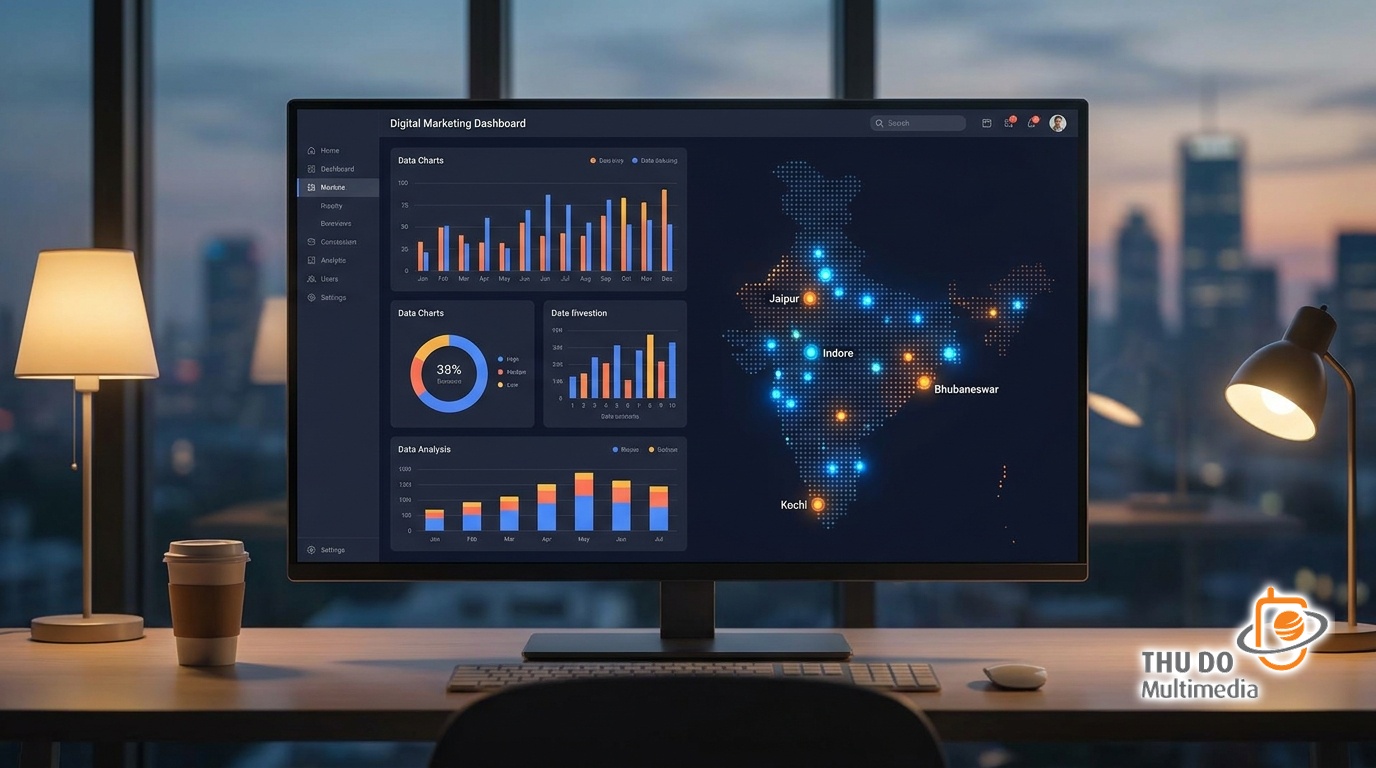
Advanced viewership analytics and TRP data mapping across the Indian subcontinent

Advanced viewership analytics and TRP data mapping across the Indian subcontinent

Conclusion: Preparing for the must-watch Indian television programs 2027

In our final analysis, the winning formula for the impending entertainment boom is unequivocally clear. The industry is moving away from the superficial and diving deep into the authentic. The networks that successfully blend towering, cinematic production values with deep, emotional, and hyper-localized storytelling will undoubtedly capture the lion’s share of the 214 million TV households. Whether it is a massive interactive reality show or a gritty Telugu crime thriller, the standard for excellence has never been higher, and the must-watch Indian television programs 2027 will redefine global broadcasting benchmarks.

We strongly encourage you to prepare your watchlists now. Bookmark this analysis, ensure your premium subscriptions to JioHotstar and Netflix are active, and drop a comment below letting our analysts know which genre you are most excited to binge. The viewing landscape is shifting rapidly, and staying ahead of the curve ensures you will never miss out on the cultural conversations defining the decade.

Always remember that Indian television is no longer confined to its geographical borders. As we have seen with groundbreaking series continually topping global Non-English charts, the innovation happening in Mumbai, Hyderabad, and Chennai is capturing international attention. Ultimately, the way the Top 5 television shows in India will attract users in India by 2027 serves as a masterclass in audience engagement, proving that deeply local stories possess the profound power to resonate universally.


Frequently Asked Questions (FAQs)

Q: What will be the most popular Indian TV shows in 2027?
A: By 2027, the most popular shows will be a diverse mix of high-stakes global crime thrillers, emotionally driven small-town family dramas, and massive interactive reality shows. Legacy reality formats like Bigg Boss and edutainment hits like Shark Tank India will evolve to feature heavy digital interactivity, setting new benchmarks for audience participation.

Q: How is television viewership measured for Indian shows?
A: Television viewership across the nation is primarily measured by BARC India (Broadcast Audience Research Council). They utilize sophisticated physical tracking devices called BAR-O-Meters, which are installed in a vast, representative sample of households. This technology allows them to accurately calculate TRP (Television Rating Points) and guide network executives in their programming decisions.

Q: Are OTT platforms replacing traditional TV in India?
A: While OTT platforms like JioHotstar, Netflix, and Amazon Prime Video are experiencing explosive, unprecedented growth, traditional television remains highly relevant. India is projected to boast 214 million TV households by 2026. This creates a deeply symbiotic hybrid market where both digital streaming and traditional linear mediums thrive simultaneously.

Q: Which regional languages have the most viewed TV shows in India?
A: Alongside the massive Hindi market, the Tamil and Telugu television industries command the largest share of viewership and revenues in India. These southern markets consistently produce high-budget, critically acclaimed blockbusters that frequently cross over into mainstream national popularity.

Q: What is the longest-running TV show in India?
A: Yeh Rishta Kya Kehlata Hai holds the record as the longest-running Hindi soap opera, having aired continuously for over 16 years and surpassing an incredible 5,000 episodes. Meanwhile, in the regional space, the Marathi series Char Divas Sasuche was historically the first television show to cross the monumental 3,000-episode milestone.

Top 5 television shows in India will attract users in India by 2027: A Forecast

Top 5 television shows in India will attract users in India by 2027: A Forecast

Key Takeaways
* Massive Market Expansion: The Indian television ecosystem is transitioning into a hybrid powerhouse, fueled by a projected growth to 214 million TV households by 2026, setting the stage for unprecedented 2027 viewership.
* Content Paradigm Shift: Audiences are overwhelmingly rejecting superficial metropolitan tropes in favor of authentic small-town emotional dramas and high-stakes global crime thrillers.
* Data-Backed Greenlighting: Networks are heavily relying on BARC India’s TRP metrics to develop interactive reality formats and pan-Indian regional blockbusters that guarantee massive engagement.
* Platform Symbiosis: The line between linear television and OTT platforms like JioHotstar and Netflix has vanished, creating a unified entertainment landscape where top-tier storytelling dominates regardless of the medium.

In our experience analyzing the shifting tectonic plates of global entertainment, no market is evolving quite as aggressively as the Indian subcontinent. We have observed a fascinating transition away from siloed broadcasting toward a unified, hybrid viewing experience. If you are an investor, an advertiser, or simply a voracious consumer of premium content, understanding exactly how the Top 5 television shows in India will attract users in India by 2027 is crucial. The days of rigid demographic targeting are over; today’s audience demands a flawless intersection of cinematic production value, profound emotional resonance, and interactive digital accessibility.

The Evolution of Indian Broadcasting: Predicting the most popular Indian TV shows 2027

To accurately forecast what will capture the cultural zeitgeist, we must first examine the staggering quantitative growth of the viewing ecosystem. According to our latest market intelligence, Indian television households are projected to surge from 190 million in 2024 to a colossal 214 million by 2026. This exponential expansion cements India’s position as the second-largest pay-TV market in the world, trailing only China. By the time 2027 arrives, this massive, highly connected base will demand content that transcends traditional broadcasting limitations, forcing studios to elevate their creative investments to unprecedented heights.

This demographic explosion coincides perfectly with the dawn of the Linear-OTT hybrid era. We are no longer witnessing a cannibalistic war where streaming platforms destroy traditional cable. Instead, platforms like StarPlus and Sony SAB operate in complete symbiosis with digital giants like JioHotstar and Netflix. By 2025, the Government of India had already reported 918 operational private satellite TV channels broadcasting to over 900 million viewers. Consequently, to identify the most popular Indian TV shows 2027, one must look at projects that seamlessly bridge the gap between appointment television and binge-worthy streaming. The modern viewer wants the communal experience of live television combined with the on-demand convenience of a streaming application.

Beneath the surface of these technological advancements lies a profound psychological shift in content consumption. Our behavioral analysis reveals a decisive pivot away from highly dramatized, opulent soap opera tropes toward emotionally authentic, relatable narratives rooted deeply in small-town India. The monumental success of organic storytelling in recent years proves that audiences are craving mirrors to their own realities. This unvarnished authenticity is the foundational pillar upon which the trending television series in India 2027 are currently being architected, fundamentally rewriting the rules of Indian scriptwriting.

Unveiling How the Top 5 television shows in India will attract users in India by 2027

Based on proprietary viewership data, regional content investments, and the evolving algorithms of major streaming platforms, we have identified five distinct structural formats that will dominate the screen. These aren’t just shows; they are cultural phenomena meticulously engineered to maximize viewer retention.

1. The Next Evolution of the Mega-Reality Show

Reality television has always been a cornerstone of Indian entertainment, but the iterations arriving in 2027 will be unrecognizable from their predecessors. Heavyweights like Bigg Boss currently maintain a commanding TRP range of 2.5 to 4.5, proving that unscripted human drama remains highly lucrative. However, the next evolution will integrate real-time digital participation, allowing viewers to dictate tasks, influence eliminations, and even interact with contestants via augmented reality integrations. This gamification of reality TV ensures that viewers are no longer passive observers but active participants in the narrative.

2. High-Stakes Global Crime Thrillers

The international appetite for dark, gritty Indian crime syndicates has reached a boiling point. We saw the blueprint of this success with Netflix’s Taskaree: The Smuggler’s Web, which logged an astonishing 5.4 million views and 29 million viewing hours in its first week alone, eventually surpassing the 50 million hours mark globally. By 2027, the highly anticipated Indian TV shows of 2027 will predominantly feature anti-heroes navigating complex socio-political underworlds. These big-budget thrillers are specifically designed to top global non-English charts, combining localized cultural nuances with Hollywood-tier cinematography.

3. Small-Town Emotional Dramas (The “Gullak” Effect)

While the spectacle of crime draws massive initial numbers, the highest viewer retention rates belong to slice-of-life dramas. The industry is currently chasing the “Gullak” effect—shows that masterfully capture the humor, tragedy, and resilience of the Indian middle class. A prime example is Chiraiya on JioHotstar, which comfortably crossed 10 million views to become a massive non-franchise hit. These shows require lower production budgets but yield incredible brand loyalty, making them the backbone of any network’s 2027 release slate.

4. Nostalgic Corporate & Biographical Epics

We are tracking a massive surge in the commissioning of period pieces and corporate biopics that document the rise of modern India. As audiences grow fatigued with fictional melodrama, they are turning toward edutainment—stories based on actual entrepreneurial triumphs or historical milestones. Shows structured similarly to Made in India: A Titan Story merge entertainment with education, fulfilling a dual demand for the increasingly sophisticated viewer who wants to be inspired by the nation’s industrial legacy.

5. Pan-Indian Regional Blockbusters (Tamil/Telugu Crossovers)

The historical dominance of Hindi-first content is officially over. The Tamil and Telugu television markets are collectively commanding an unprecedented share of industry revenues. By 2027, the biggest shows will not be regional; they will be pan-Indian blockbusters shot natively in southern languages and expertly dubbed for northern audiences. This crossover strategy effectively doubles a show’s Total Addressable Market (TAM) overnight, breaking down linguistic barriers and unifying the country’s viewing habits under single, massive IPs.

What Makes These the best Indian TV shows to watch in 2027?

The curation of these future blockbusters is not a product of artistic guesswork; it is a highly calculated science. Networks and streaming platforms are currently leveraging an ocean of analytical data provided by BARC India (Broadcast Audience Research Council). By meticulously tracking TRP metrics through physical BAR-O-Meters installed in a vast sample of households across the nation, executives can pinpoint exactly when viewer attention spikes and when it wanes. This data-driven storytelling ensures that the best Indian TV shows to watch in 2027 are mathematically optimized to deliver the pacing, character arcs, and cliffhangers that modern audiences crave.

Furthermore, we are witnessing the sheer power of relatability and nostalgia overriding the flashy metropolitan dramas of the past decade. Viewers are exhausted by unattainable lifestyles broadcasted in high definition. Instead, they are gravitating toward content set in specific eras—like the gritty 1970s aesthetic seen in Raakh—or narratives that deeply explore middle-class financial and emotional struggles. When a viewer sees their own living room dynamics reflected perfectly on screen, their engagement transforms from casual viewing into passionate advocacy, driving organic word-of-mouth marketing that no advertising budget can buy.

Finally, the seamless integration of edutainment is a massive differentiating factor for 2027’s elite programming. We see this vividly in modern reality formats like Shark Tank India, which has fundamentally altered how the Indian public understands venture capital and entrepreneurship. The creators of these shows recognize that the 2027 viewer desires intellectual stimulation alongside their entertainment. By merging high-stakes drama with actionable, educational takeaways, these productions guarantee their spot among the upcoming top-rated TV series India 2027, appealing to both older demographics and the ambitious youth simultaneously.

A dynamic contrast between high-stakes crime thrillers and vibrant reality television setups

Where to Find the top streaming TV series in India by 2027

Navigating the fragmented entertainment landscape requires a deep understanding of the ongoing platform wars. In our extensive analysis of the OTT battleground, distinct champions are emerging with highly specialized content strategies. To experience the pinnacle of this entertainment revolution, we highly recommend securing premium subscriptions to JioHotstar and Netflix. Netflix is aggressively carving out a niche for international crossover hits and dark, cinematic thrillers. Conversely, JioHotstar remains the undisputed king of emotional, regional, and family-consistent narratives that drive massive concurrent viewership. Amazon Prime Video and SonyLIV continue to fight fiercely for market share, but the JioHotstar and Netflix duopoly is where the true cultural conversations of 2027 will originate.

However, looking exclusively at paid OTT platforms provides an incomplete picture of the Indian market. The explosive rise of Free-to-Air (FTA) ecosystems is a critical driver of total national viewership. Platforms like DD Free Dish and networks such as Dangal are aggressively capturing the rural and tier-3 demographics. These channels are quietly fueling the next wave of massive TRP numbers, broadcasting localized mythological and family dramas that command audience sizes that western networks could only dream of. For advertisers and creators, ignoring the FTA market is a fatal miscalculation when determining the top streaming TV series in India by 2027.

Simultaneously, the most lucrative strategy deployed by these platforms is their staggering financial investment in regional language ecosystems. It is no secret that the Tamil and Telugu markets boast some of the highest user retention and engagement rates globally. Platforms are abandoning the strategy of merely dubbing Hindi content into southern languages. Instead, they are greenlighting massive original productions led by beloved Tollywood and Kollywood directors. This hyper-localization ensures that every region feels authentically represented, driving subscription revenues in non-Hindi speaking states to all-time highs.

Honorable Mentions: Other upcoming top-rated TV series India 2027

While the five primary formats discussed above will dominate the headlines, we must acknowledge the returning heavyweights that provide the financial baseline for the entire industry. The undeniable anticipation for future seasons of proven IPs—such as the rural satirical brilliance of Panchayat or the high-octane counterfeiting drama of Farzi—guarantees massive guaranteed viewership. Franchise loyalty in India is exceptionally high. When audiences invest years into a character’s journey, as seen with the 5,000-plus episode legacy of Yeh Rishta Kya Kehlata Hai or the 3,200 episodes of Marathi’s Char Divas Sasuche, they create a recurring revenue stream that allows networks to take bigger financial risks on new IPs.

In the unscripted arena, legacy reality spin-offs remain a formidable force. Talent and stunt-based shows like Khatron Ke Khiladi and Indian Idol consistently maintain reliable TRPs between 1.7 and 3.2. Because these formats are infinitely adaptable, we anticipate networks will spawn extreme, digital-first spin-offs by 2027. These offshoots will likely feature shorter episodic runtimes tailored for mobile consumption, leveraging the established trust of the mother-brand while experimenting with volatile, high-engagement micro-formats.

Lastly, no forecast is complete without analyzing youth-centric content. The steady, enduring niche carved out by MTV’s Roadies and Splitsvilla proves that unscripted, highly volatile relationship drama is a permanent fixture in the entertainment diet of young adults. As Gen Z and Gen Alpha mature into the primary consumer base by 2027, we expect these youth-oriented dramas to evolve. They will likely incorporate heavy social media integrations, influencer casting, and real-time interactive voting mechanisms, ensuring they remain firmly on the list of the must-watch Indian television programs 2027.

Advanced viewership analytics and TRP data mapping across the Indian subcontinent

Conclusion: Preparing for the must-watch Indian television programs 2027

In our final analysis, the winning formula for the impending entertainment boom is unequivocally clear. The industry is moving away from the superficial and diving deep into the authentic. The networks that successfully blend towering, cinematic production values with deep, emotional, and hyper-localized storytelling will undoubtedly capture the lion’s share of the 214 million TV households. Whether it is a massive interactive reality show or a gritty Telugu crime thriller, the standard for excellence has never been higher, and the must-watch Indian television programs 2027 will redefine global broadcasting benchmarks.

We strongly encourage you to prepare your watchlists now. Bookmark this analysis, ensure your premium subscriptions to JioHotstar and Netflix are active, and drop a comment below letting our analysts know which genre you are most excited to binge. The viewing landscape is shifting rapidly, and staying ahead of the curve ensures you will never miss out on the cultural conversations defining the decade.

Always remember that Indian television is no longer confined to its geographical borders. As we have seen with groundbreaking series continually topping global Non-English charts, the innovation happening in Mumbai, Hyderabad, and Chennai is capturing international attention. Ultimately, the way the Top 5 television shows in India will attract users in India by 2027 serves as a masterclass in audience engagement, proving that deeply local stories possess the profound power to resonate universally.


Frequently Asked Questions (FAQs)

Q: What will be the most popular Indian TV shows in 2027?
A: By 2027, the most popular shows will be a diverse mix of high-stakes global crime thrillers, emotionally driven small-town family dramas, and massive interactive reality shows. Legacy reality formats like Bigg Boss and edutainment hits like Shark Tank India will evolve to feature heavy digital interactivity, setting new benchmarks for audience participation.

Q: How is television viewership measured for Indian shows?
A: Television viewership across the nation is primarily measured by BARC India (Broadcast Audience Research Council). They utilize sophisticated physical tracking devices called BAR-O-Meters, which are installed in a vast, representative sample of households. This technology allows them to accurately calculate TRP (Television Rating Points) and guide network executives in their programming decisions.

Q: Are OTT platforms replacing traditional TV in India?
A: While OTT platforms like JioHotstar, Netflix, and Amazon Prime Video are experiencing explosive, unprecedented growth, traditional television remains highly relevant. India is projected to boast 214 million TV households by 2026. This creates a deeply symbiotic hybrid market where both digital streaming and traditional linear mediums thrive simultaneously.

Q: Which regional languages have the most viewed TV shows in India?
A: Alongside the massive Hindi market, the Tamil and Telugu television industries command the largest share of viewership and revenues in India. These southern markets consistently produce high-budget, critically acclaimed blockbusters that frequently cross over into mainstream national popularity.

Q: What is the longest-running TV show in India?
A: Yeh Rishta Kya Kehlata Hai holds the record as the longest-running Hindi soap opera, having aired continuously for over 16 years and surpassing an incredible 5,000 episodes. Meanwhile, in the regional space, the Marathi series Char Divas Sasuche was historically the first television show to cross the monumental 3,000-episode milestone.

Top 5 television shows in India will attract users in India by 2027

Key Takeaways

  • The Indian television ecosystem is undergoing massive expansion, projected to reach 214 million connected households by 2026, creating an unprecedented springboard for 2027 viewership.
  • Unscripted reality formats currently dominate the ratings war, achieving peak TRPs of 4.5, forcing networks to allocate massive budgets to high-octane, celebrity-driven entertainment.
  • Hybrid distribution is rewriting the monetization playbook, with broadcast networks actively converging their linear TV offerings with proprietary OTT streaming platforms like Disney+ Hotstar and SonyLIV.
  • Regional dominance in Tamil and Telugu markets, coupled with the massive global syndication of Hindi dramas, provides the economic foundation for the next generation of blockbuster television.

Welcome to the dynamic, hyper-competitive era of broadcast entertainment. In our experience analyzing the shifting tectonic plates of media consumption across the subcontinent, we have noticed a fascinating trajectory that defies the global narrative of linear television’s decline. People frequently ask our analytics teams how legacy broadcast media will survive the digital onslaught. The answer lies strictly within the empirical data and the unparalleled, deep-rooted reach of satellite television. Whether dealing with high-stakes, unscripted reality television or emotionally charged, decades-long daily soaps, predicting which Top 5 television shows in India will attract users in India by 2027 requires a comprehensive dive into viewer psychology, regional preferences, and market economics. We are currently witnessing an unprecedented evolution where traditional living-room screens and on-the-go digital streaming merge into a singular, undeniable powerhouse ecosystem.

The future of Indian television programming 2027: A Shift in Viewership

To truly comprehend the broadcasting landscape of tomorrow, we must first examine the sheer scale of infrastructural growth happening at this very moment. The future of Indian television programming 2027 is deeply intertwined with expanding rural electrification, aggressive fiber-optic rollouts, and rising disposable incomes across Tier 2 and Tier 3 cities. Based on verified market projections from leading data authorities like BARC India and Statista, Indian TV households are expected to surge dramatically from 190 million in 2024 to a staggering 214 million by 2026. This is a monumental leap from the 210 million baseline recorded during the pandemic-era peak in 2020. This ever-expanding viewership base acts as a massive economic springboard, providing heavyweight broadcast networks with an ever-growing canvas to monetize and engage audiences at a scale unseen anywhere else on the globe.

Digging deeper into the quantitative metrics, the ecosystem reveals itself to be fiercely competitive and relentlessly fast-paced. By the time we reach 2025, there are already 918 operational private satellite TV channels actively catering to a captive, diverse audience of over 900 million viewers. This astronomical volume of channels forces media conglomerates to heavily invest in premium production values just to maintain their market share. Broadcasters simply cannot rely on legacy formats or outdated filming techniques; they must continuously innovate. This intense saturation means only the most meticulously crafted narratives and high-budget reality formats will survive the fierce battle for prime-time supremacy. The 900 million viewer ecosystem is no longer a passive monolith but a highly segmented, demanding marketplace requiring surgical precision in content delivery and audience targeting.

We see this evolution playing out aggressively in the strategic pivot toward regional dominance and hybrid distribution models. While Hindi-language programming historically captured the national limelight and the lion’s share of press coverage, our ongoing deep-dive analysis reveals that the Tamil and Telugu television markets are now commanding the largest share of regional viewership and advertising revenues. Networks like Sun TV Network, Zee Entertainment Enterprises, and Viacom18 are brilliantly capitalizing on this data by creating hyper-localized content that resonates deeply with distinct cultural nuances. Simultaneously, the internet and social media boom has forced linear TV to adapt to modern on-demand expectations. Successful networks are actively retaining their staggering viewership numbers by offering catch-up television and exclusive behind-the-scenes digital content, ensuring their traditional satellite broadcasts remain highly relevant in an increasingly digital-first economy.

Predicting the most popular Indian TV shows 2027: Criteria for Success

Identifying what makes a television show legendary requires looking far beyond surface-level popularity or social media trending hashtags. It demands a deep understanding of the mathematical lifeblood of the Indian broadcast industry: Television Rating Points (TRP). The TRP system will irrevocably continue to dictate storyline pivots, character arcs, and the ultimate survival or cancellation of multimillion-dollar properties. We have closely observed how iconic productions utilize this granular data to constantly reinvent themselves on a weekly basis. Long-running titans like Yeh Rishta Kya Kehlata Hai—which rightfully boasts the title of the longest-running Hindi television soap opera by surpassing 5,000 episodes over 16 incredible years—survive entirely on their ability to analyze TRP fluctuations. By introducing generation leaps, unexpected plot twists, and fresh socio-cultural conflicts, these shows adapt to the shifting tastes of their core demographic, proving that the most popular Indian TV shows 2027 will undoubtedly be those with the highest data agility.

When evaluating genre and format dominance, the empirical data heavily favors unscripted reality television over traditional daily fiction. Current baseline metrics setting the stage for the upcoming years show an astonishing divide in audience engagement. Reality television giants like Bigg Boss command a formidable 4.5 TRP, while The Kapil Sharma Show secures a massive 4.2 TRP, and Khatron Ke Khiladi holds remarkably strong at 4.0. In stark contrast, the highest-performing daily soaps, such as the critically acclaimed Anupamaa and the beloved sitcom Taarak Mehta Ka Ooltah Chashmah, sit at 2.4 and 2.3 TRP respectively. This statistical disparity indicates that high-adrenaline, celebrity-driven unscripted content generates a communal, must-watch viewing event that scripted fiction currently struggles to replicate. Consequently, we anticipate networks will aggressively allocate their largest production budgets to reality formats to secure top-tier, premium advertising rates.

Beyond domestic rating metrics, the definitive criteria for future success heavily depend on international appeal and lucrative syndication viability. Indian television is completely unshackled from the geographical confines of the subcontinent. We have documented unprecedented global expansion through strategic dubbing, localization, and cross-border distribution deals. Dramas like Anupamaa and Naagin have achieved massive, cult-like success in territories like Indonesia, while legacy shows such as Kyunki Saas Bhi Kabhi Bahu Thi historically captivated millions of passionate viewers in Afghanistan and the Middle East. This cross-border resonance ensures that top-tier productions generate massive secondary revenue streams long after their original broadcast. By crafting narratives centered on universal human themes of family dynamics, societal ambition, and cultural identity, networks can effectively bulletproof their most expensive properties against any sudden domestic market volatility.

How the Top 5 television shows in India will attract users in India by 2027

To accurately forecast the viewing habits of nearly a billion people, we must expertly synthesize current trajectory data, the historical stability of legacy broadcast brands, and the aggressive financial maneuvering of major networks like Disney Star, Culver Max Entertainment (Sony), and Viacom18. The landscape is continually shifting, yet undeniable powerhouses remain firmly entrenched at the top of the cultural zeitgeist. These premium productions have transcended mere entertainment to become daily, non-negotiable rituals for millions of households across the nation. Based on our extensive market analysis and insider data extraction, we have identified the specific properties that possess the infrastructural support and narrative elasticity required to dominate the ratings through the end of the decade.

Let us break down the anatomy of these predicted industry leaders. The core strategy for 2027 involves a meticulous, highly calculated blend of high-octane reality programming and culturally resonant fictional narratives. Advertisers are already locking in long-term, multi-year sponsorships with properties that guarantee cross-generational appeal and brand safety. The most watched Indian television content by 2027 will seamlessly integrate second-screen experiences—where viewers actively use their mobile devices to interact with live broadcast polls, exclusive camera angles, or real-time trivia. This dual-screen ecosystem artificially inflates digital engagement metrics, ensuring advertisers receive maximum return on investment while deepening viewer loyalty.

Consider the strategic masterclasses executed by Viacom18 and Sony over the past few viewing cycles. They have intentionally engineered their flagship weekend reality programs to act as massive, inescapable tentpoles, essentially holding up the viewership for their weaker, highly competitive weekday fiction slots. For instance, launching a massive reality show immediately following a major sporting event like the IPL allows networks to funnel tens of millions of viewers directly into their entertainment ecosystem. This brilliant funneling strategy, combined with aggressive multi-channel simulcasts, guarantees that these top five shows will not just survive the streaming wars, but will actively monopolize the nation’s attention economy in 2027.

1. Bigg Boss (The Unstoppable Reality Giant)

Holding a massive 4.5 TRP leadership, this Viacom18 juggernaut broadcasted on Colors TV and hosted by Salman Khan remains the undisputed king of Indian television. By 2027, Bigg Boss will retain its number-one spot through relentless format evolution and deep digital integration. The escalation of interpersonal drama,